
From Waste Paper to Creative Printing
The paper industry has always played a vital role in human civilization, but it also places significant strain on the environment. Global paper consumption is increasing, and with it comes an increasing amount of waste paper, raising the question of how to recycle and dispose of it. While traditional recycling plants can process large quantities of waste paper, the process is often water-intensive and energy-intensive, and the range of recycled products is limited.
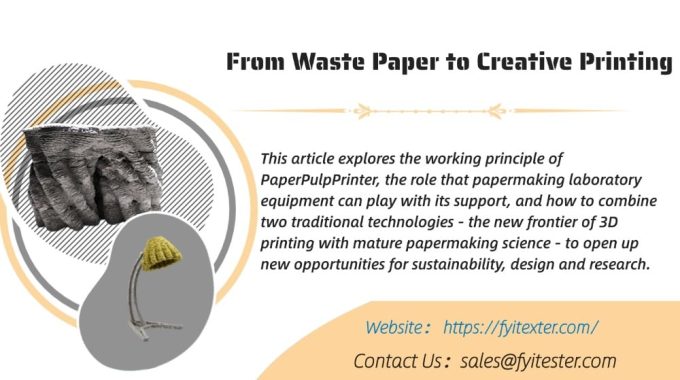
This is where Dutch designer Beer Holthuis comes up with an intriguing new solution: the PaperPulpPrinter. This machine uses “pulp” made from waste paper and a natural binder for 3D printing. It goes beyond simply recycling waste paper back into paper and can create a variety of durable, aesthetically pleasing, and environmentally friendly objects.
However, researchers, teachers, and manufacturers interested in exploring this technology often face a practical challenge: how to consistently prepare, test, and optimize this waste paper printing material? This is where the equipment found in traditional papermaking labs comes in handy. Companies like FYI Tester offer a variety of specialized equipment for processing pulp, measuring fiber properties, forming paper, and more. Combining these tools with PaperPulpPrinter forms a complete small innovation ecosystem, allowing researchers to more smoothly explore, improve, and even apply this interesting environmentally friendly technology on a large scale in the future.
PaperPulpPrinter: Innovation in Sustainable Design
The PaperPulpPrinter, developed by Beer Holthuis, uses a syringe-like extruder to “stack” layers of pulp, a mixture of shredded paper and a natural binder. Instead of using common plastic filaments or resins, it uses waste paper discarded almost daily in offices and homes. This creates a closed-loop system: printed objects are both durable and practical, and can be recycled back into pulp for the next manufacturing cycle.

This approach has numerous advantages:
- Environmental impact – Waste paper is diverted from landfills, reducing reliance on plastic and other non-renewable printing materials.
- Aesthetics – Pulp printing has a natural, rough texture, distinct from the sleek, industrial look of plastic. Designers can highlight this unique quality in furniture, lighting, or decorative items.
- Material quality – Paper is readily available, affordable, and easily recycled locally, making it particularly suitable for small studios or schools.
However, while ideal, pulp printing also has its challenges. For example, the consistency of the pulp must be just right: too thick and it can easily clog the printhead, while too thin makes it difficult to form. Parameters such as fiber length, freeness, and concentration can affect the bonding between layers and even cause the printed product to crack after drying. This is precisely where traditional papermaking techniques and specialized equipment can be effective.
Traditional papermaking laboratory equipment
For decades, the paper industry has been refining the tools used to study pulp properties in the laboratory. FYI Tester provides production and testing equipment that helps users simulate and optimize every step of the pulp preparation process before scaling up production.
Key instruments include:
- Laboratory Pulper (PAP-10): Pulps wastepaper to ensure adequate fiber separation.
- Flotation Deinker (PAP-20): Removes ink and other impurities, improving pulp cleanliness.
- Valley Beater (PAP-30): Mechanically treats fibers to enhance softness and cohesion.
- Fiber Screener (PAP-40): Removes oversized or undisintegrated fiber bundles and impurities.
- Fiber Disintegrator (PAP-50): Thoroughly disperses and evenly distributes fibers.
- Freeness Tester (PAP-60): Evaluates pulp drainage and flowability—critical for predicting paper printability.
- The Paper Sheet Forming Machine (PAP-70) and Laboratory Sheet Press (PAP-80) are used to produce standardized test sheets, facilitating comparisons of different pulp performance.
- The Pulp Thickener (PAP-90) thickens diluted pulp for subsequent processing or storage.
- All above can be found here: https://fyitester.com/production-machine/papermaking-machine/
This suite of equipment enables researchers to precisely control pulp quality and systematically adjust various variables affecting printing results, laying a reliable foundation for subsequent applications.
How Does the Device Support 3D Pulp Printing
Combining traditional papermaking equipment with the PaperPulpPrinter provides a clear path for pulp 3D printing to move from “experimental experimentation” to “reproducible science.” The following steps are particularly critical:

1.Raw Material Preparation
Before entering the 3D printing process, pulp undergoes pre-processing, including shredding, cleaning, and conditioning. A laboratory pulper converts office waste paper into a usable pulp, while a deinking unit removes residual ink, enhancing print flow and enhancing the aesthetics of the finished product. Missing these steps can easily lead to printhead clogging and inconsistent print quality.
2.Fiber Optimization
Fiber properties directly impact the bond strength between printed layers. A valley-type pulper adjusts fiber flexibility, while a fiber screening device controls fiber size uniformity. These optimizations ensure stronger bond strength between printed layers and minimize deformation after drying.
3.Printability Calibration
A freeness tester is specifically designed to assess whether pulp can flow through the printer’s narrow nozzle at a stable rate. By measuring drainage performance, operators can proactively adjust pulp concentration or beating time to avoid breakage or clogging during printing.
4.Performance Comparison Analysis
Using traditional sheet forming and pressing equipment to produce standard paper samples, researchers can compare 3D-printed products side-by-side with conventional paper. By testing metrics such as tensile strength, porosity, and surface smoothness, they can scientifically quantify the performance differences between the two.
5.Closed-Loop Recycling Verification
The PaperPulpPrinter’s products are inherently recyclable, and the papermaking laboratory provides a foundation for evaluating the material’s recyclability. Printed objects can be repulped, thickened, and screened to test for fiber degradation and the material’s recyclability limits.
Challenges and Future Outlook
While pulp 3D printing holds great potential, it also faces some practical challenges. For example, pulp is prone to shrinkage and cracking during drying, limiting the size and thickness of printed objects. It’s currently difficult to achieve the same level of detail as plastic 3D printing. Furthermore, the cost of equipment investment can be a barrier for small studios.
Nevertheless, the combination of the PaperPulpPrinter and papermaking equipment is opening new doors for sustainable manufacturing:
• Education: Students can learn about environmentally friendly materials and digital manufacturing through hands-on practice, fostering awareness of the circular economy and sustainable design through experimentation.
• Design: Design studios can experiment with prototyping eco-friendly furniture, lighting, or packaging, fully leveraging the pristine, natural texture of pulp and showcasing its unique aesthetic.
• Scientific Research: Researchers can use laboratory equipment to systematically explore the feasibility of multi-cycle recycling, fiber modification, and blending pulp with other biomaterials, thereby optimizing material properties.
• Industrial Applications: As the technology matures, pulp 3D printing has the potential to be used in small-batch, customized production, particularly for products that prioritize environmental friendliness and recyclability without requiring extreme precision.
Conclusion
The PaperPulpPrinter is more than just a novel gadget—it’s a concrete example of a “circular materials economy.” In this system, waste paper is no longer discarded; it’s given a new life, transformed into both practical and design objects.
However, the key to truly transforming this technology from an artistic display into scalable application lies in precise control of pulp properties. This is where the expertise accumulated over many years in traditional papermaking laboratories can be of great value.
Utilizing a suite of sophisticated tools, including pulpers, beaters, deinking equipment, and freeness testers, combined with innovative 3D printing processes, researchers and designers can build a robust experimental system. This not only improves the quality of printed products but also builds a bridge between papermaking and digital manufacturing, moving towards more sustainable production methods.
Against the backdrop of increasingly severe environmental challenges, this hybrid “traditional + digital” model may unlock new possibilities for material innovation. Waste paper will no longer be the end of a resource; instead, it will become the beginning of a cycle—a starting point that blends creativity, technology, and environmental responsibility.