
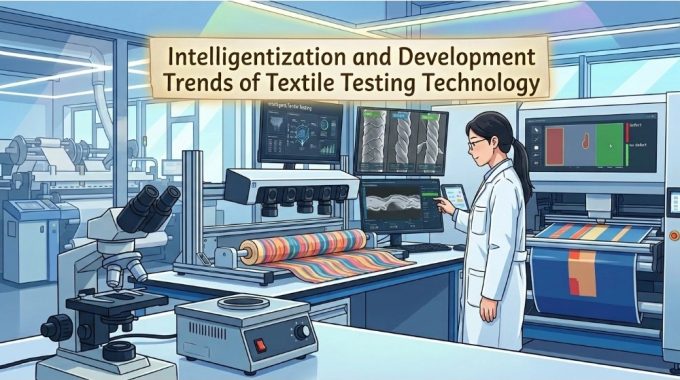
Intelligentization and Development Trends of Textile Testing Technology
Textile testing is essentially a high-stakes detective game. It’s where lab gear and chemicals meet the gut instinct of a technician who has handled thousands of swatches. You’re trying to prove a product is actually what the label says it is.
It used to be a simple internal quality check, but the tech behind making clothes has moved faster than the tech behind testing them. Modern fabrics are complicated, and the old “break it to test it” methods aren’t cutting it anymore. “Smart” testing is the obvious solution—it’s faster, cleaner, and doesn’t ruin the product.
But let’s be real: having the tech and actually making it work on a factory floor are two different things. We have the standards and the systems on paper, but the actual rollout is still messy and full of practical holes that the brochures don’t mention.
Research on intelligent application of textile testing
AI Fiber Type Identification

In most textile labs, the “gold standard” for identifying fibers is still surprisingly low-tech: you either squint at it through a microscope or you set it on fire. Both work, to an extent. You can spot the scales on wool or the twist of a cotton fiber easily enough, and a burn test tells you pretty quickly if you’re dealing with melting plastic (polyester) or charred protein (silk). But let’s be honest—it’s destructive, subjective, and prone to human error.
Techniques like infrared spectroscopy are supposed to be the “high-tech” fix, but they’re often too sensitive for their own good. If you have a blend, the data gets muddled.
That’s the real argument for AI. You aren’t just looking at one fiber under a lens; you’re letting a camera system analyze the whole landscape of the fabric. It processes the cross-sections and surface textures at a scale a human eye just can’t match, cross-referencing them with thousands of known samples. It’s the difference between a detective looking for a single fingerprint and a facial recognition system scanning a whole crowd. It’s faster, it doesn’t ruin the sample, and it actually handles the complexity of modern blends.
AI fabric inspection

An AI fabric inspection machine is basically a high-speed camera with a brain. It’s hunting for off-color patches or snags in the weave, processing those images in real-time to spot anomalies.
The logic is straightforward: if it’s a small, one-off glitch, the system notes the coordinates and keeps going. But if the machine sees a major tear—or worse, the same flaw over and over—it shuts everything down. It’s a fail-safe.
The real value, though, is that you stop guessing. Instead of just tossing out a bad roll of fabric at the end of the day, the team can look at the feedback, trace the flaw back to a specific part of the finishing line, and fix the root cause. It turns a quality check into a roadmap for fixing the actual weaving process.
AI fiber content detection
The old way of identifying wool and hair fibers is, frankly, a headache. You’re stuck in a loop of peering through an electron microscope and then dousing samples in chemicals to see what dissolves. The problem is that fibers aren’t uniform. A slight structural difference between two batches can throw the whole test off, leading to “accurate” results that aren’t actually right.
To get a result you can actually trust, you usually have to run the same test on three different swatches and just hope the average is close enough. It’s a bottleneck in the production line.
Switching to AI-driven wool and cotton analyzers feels like finally turning the lights on. Instead of manual guesswork, you’re using high-res imaging to let a computer do the heavy lifting. It recognizes the “hard” silhouette of linen or the signature spiral of a cotton fiber instantly. You aren’t just saving time; you’re getting a real-time map of the blend ratio. We’re talking about moving from a “best guess” over several hours to a definitive lab report in under ten minutes.
Cross-sectional area calculation

There’s something almost absurd about the traditional way we measure fiber cross-sections: a technician peering into a microscope and hand-sketching what they see onto a sheet of A4 paper. You’re essentially asking a person to act like a human scanner, then use that drawing to calculate surface area. Between the different yarn types and varying fabric densities, the margin for error is massive. The “data” you end up with is only as good as the person’s drawing skills.
AI scanning replaces that guesswork with actual data. Using an AI cross-section analyzer, you capture the raw image and let the software handle the tedious parts. It maps the fiber edges, cleans up the noise, and calculates the area instantly. You’re moving away from a subjective sketch to a digital blueprint. It’s faster, obviously, but more importantly, it’s consistent. You get the same high-precision result regardless of who is running the machine.
Textile fiber fineness testing
Fiber fineness used to be a tedious calculation, but AI-driven instruments have turned it into a near-instant data point. We’re essentially looking for the “CV” (coefficient of variation)—how consistent that fiber is from one end to the other.
In a modern lab, you’ve got a few ways to tackle this. Imaging is the most visual—think of it as a high-speed laser camera that “sees” the fiber’s thickness. Optical systems do something similar with light projections to map out the dimensions. If you’re using the airflow method, you’re actually measuring pressure; the machine blows air through the sample and calculates fineness based on how the fibers resist that flow. Even the old weighing method is faster now, linking mass and diameter data instantly.
The shift here isn’t just about speed. It’s about removing the “average of an average” problem. You’re getting precise, individual measurements that a human technician—no matter how skilled—simply couldn’t catch by hand.
Current status and development trends of intelligentization
We talk about AI like it’s a futuristic concept, but in textile labs, it’s already the baseline. The industry is hitting a point where manual testing just can’t keep up with production speeds or the complexity of modern blends. The “AI Wool Analyzer” was the first real proof of this—it turned a specialized, slow process into something automated and repeatable.
What’s actually changing isn’t just the “scanning.” It’s the entire chain. We’re seeing systems that not only analyze the fiber but also handle the data logging and sample transport. You’re essentially removing the chance for a tired technician to miss a defect at 4:00 PM on a Friday.
The Reality
Smart testing is the only way to scale. If you’re still relying on manual checks, you’re dealing with bottlenecks, inconsistent data, and the high cost of destructive testing. Shifting to AI doesn’t just “simplify” the process—it makes the data actually reliable enough to act on in real-time. It’s the difference between catching a mistake after 1,000 yards have been woven and catching it before the loom even star