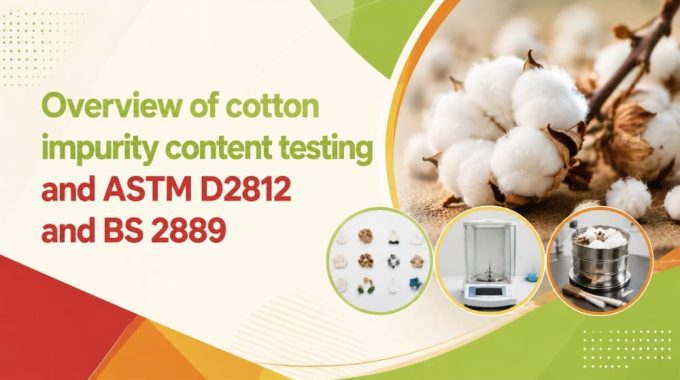
Overview of cotton impurity content testing and ASTM D2812 and BS 2889
Cotton inevitably contains various impurities during its natural growth, harvesting, storage, transportation, and processing due to various reasons. These impurities not only affect the quality and price of raw cotton but also significantly impact the production and economic benefits of textile mills. Therefore, several major cotton-producing and consuming countries in the world, including China, have established detailed standards for testing cotton impurity content to regulate related matters in commercial practices and scientific research. The following is a brief introduction and analysis of the standards and instruments used for measuring impurity content in cotton outside of China.
Historical Development

The earliest and most systematic standards for testing impurity content in cotton were proposed in the UK. In 1955, the Textile Institute organized a drafting committee comprised of researchers and industry professionals to develop standards for testing impurity content in cotton fibers, resulting in Standard No. 35, a trial standard for textiles. After revisions, it was established as British National Standard BS 2889:1967 in 1967, “Methods for determining the content of waste cotton for spinning and the content of spinning waste and lint waste using an impurity analyzer.”
In 1995, the Textile Institute and the British Standards Institution (BSI) reviewed and slightly modified the standard, converting the imperial units to metric units. In 2002, the standard was finalized without further changes. Currently, the standard remains BS 2889:1967 and is titled “Methods for determining the content of impurities in cotton and the content of textile waste and impurities using a Syle impurity analyzer.” As a major cotton-producing country, India, referencing British national standards, promulgated its national standard IS 4871:1968, “Method for determining the fiber and impurity content in cotton using mechanical and pneumatic instruments,” in 1968. This standard underwent its most recent re-approval in February 2004, with no change to the standard number or name.
In 1969, the American Society for Testing and Materials (ASTM) published ASTM D 2812—1969 T, ”Test Method for Impurity Content in Cotton.” After several revisions, ASTM D 2812—1995, “Test Method for Cotton Fiber and Non-Cotton Fiber Content,” was promulgated in September 1995. This standard underwent further review in 2021, and ASTM D 2812—2007 (Reapproved 2021) became the current standard for cotton impurity testing in the United States.
Overview of BSI and ASTM Standards
Definition
ASTM D 2812—1995 (Reapproved 2002) defines and describes foreign substances, invisible impurities, visible impurities, and cotton fibrous substances.
BS 2889: 1967 does not provide any definitions or descriptions for the terms used therein.
Principle
After weighing, the sample is separated into impurities and cotton fibrous material using an analyzer. Typically, when testing cotton, there is also the possibility of dust being released into the air or loss due to changes in the sample’s moisture content. The separated impurities and cotton fibrous material are weighed separately and expressed as their respective mass fractions relative to the original sample mass.
Sampling methods and sample preparation

Sampling methods
ASTM D 2812—1995 (Reapproved 2002) requires sampling to be performed according to the methods specified in ASTM D 1441—1987 (1993), “Sampling Procedure for Test Cotton Fibers,” with the sampled laboratory specimens comprising two test specimens of 100 g ± 5 g each.
BS 2889: 1967 does not provide specific requirements for sampling, nor does it reference British Standard BS EN 12751—1999, “Sampling of Fibers, Yarns and Fabrics for Test Use in Textiles.” It only states that the number of test specimens and sampling methods are usually specified in the raw material specifications, and that the parties can discuss and determine the testing requirements. If neither of the above two standards specifies requirements, generally two 100 g specimens are tested.
Sample preparation
ASTM D 2812—1995 (Reapproved 2002) has no special requirements for specimen preparation; generally, test specimens do not require pre-conditioning. However, samples must be placed in an atmospheric environment with humidity similar to that of the testing laboratory for at least 24 hours.
BS 2889: 1967 specifies that the laboratory testing environment is under standard atmospheric conditions (humidity 65% ± 2%, temperature 20℃ ± 2℃). Specimens must be conditioned under standard atmospheric conditions for 4 hours before weighing. If the specimen is weighed every hour, and the weight difference between two consecutive weighings does not exceed 0.25%, then a shorter conditioning time can be used.
Test Procedure
Although both use an analytical instrument for testing, the test procedures of ASTM D 2812—1995 (Reapproved 2002) and BS 2889: 1967 are somewhat different, as briefly described below.
Test Procedure of ASTM D 2812—1995 (Reapproved 2002)
(1) Clean the output box, impurity tray, and sedimentation chamber. If the analyzer has not been used for testing that day, release the clutch, prevent the feed rollers from contacting the sample, and run the analyzer idle for 2-3 minutes.
(2) Weigh the sample to an accuracy of 0.1 g and record its mass as W (g).
(3) Place the sample on the feed table, open the airflow control valve to make the rollers contact the sample, and begin feeding the sample at a constant feed rate until the entire sample is fed.
(4) After all samples have been fed, collect all fibrous impurities from the sedimentation chamber and impurity tray and feed them back into the analyzer.
(5) Temporarily loosen the rollers and close the airflow control valve, and collect the clean cotton in the output box.
(6) Pass the clean cotton through the analyzer again.
(7) Collect all fibrous impurities from the sedimentation chamber and impurity tray and feed them back into the analyzer.
(8) Temporarily loosen the rollers and close the airflow control valve, collect the clean cotton in the output box, and weigh it to an accuracy of 0.1 g. This is the mass of cotton fibrous material, L (g).
(9) Collect impurities from the impurity tray, including tiny particles adhering to the side walls of the settling chamber and the surface of the cotton feeding table, weighing to an accuracy of 0.1 g. This is the mass of visible impurities, V (g).
Test Procedures of BS 2889: 1967
(1) Clean the output box, impurity tray, and sedimentation chamber. If the analyzer has not been used for testing that day, release the clutch, prevent the feed rollers from contacting the sample, and run the analyzer idle for 2-3 minutes.
(2) Open the airflow valve to its maximum, close the roller, and begin feeding the sample. After the sample is fed in, collect all fibers in the output box.
(3) Feed the collected fibers back into the analyzer. After completion, set the clean cotton aside.
(4) Pick out the impurities containing fibers from the sedimentation chamber and impurity tray and feed them back into the analyzer. Collect the fibers in the output box again.
(5) Feed the fibers collected in this step back into the analyzer. After completion, set the cotton fibers aside.
(6) Collect the impurities on the side wall of the impurity tray and sedimentation chamber, as well as the seeds embedded in the serrated roller, and weigh them.
(7) Pass the impurities containing fibers from steps (3), (5), and (7) through the analyzer again. After completion, discard the impurities, weigh the remaining fibers in the output box, and set them aside.
(8) Combine the cotton fibers collected in steps (3), (5), and (7) and weigh them.
As can be seen from the above test procedures, ASTM D 2812—1995 (Reapproved 2002) and BS 2889: 1967 differ not only in operation but also in the order of each step.
BS 2889: 1967 first passes the clean cotton obtained in the first test through the analyzer before passing the impurities through it, and then passes the impurities through the analyzer twice more, thus obtaining three groups of cotton fibers. Superficially, the method of BS 2889: 1967 seems to achieve a more thorough separation of cotton fibrous substances and impurities in the sample.
Calculation and expression of results
According to ASTM D 2812—1995 (Reapproved 2002), the net cotton content, visible impurity content, invisible impurity content, and non-cotton fibrous material content can be calculated separately. The specific calculation formulas are as follows:
Net cotton content = (L / W) × 100%
Visible impurity content = (V / W) × 100%
Invisible impurity content = [(W – (V + L)) / W] × 100%
Non-cotton fibrous material content = 100% – Net cotton content
Where:
W — Sample mass, g;
L — Net cotton mass obtained, g;
V — Visible impurity mass, g.
Unlike ASTM D 2812—1995 (Reapproved 2002), BS 2889: 1967 does not include indicators for invisible impurity content and non-cotton fibrous material content. BS 2889: 1967 only requires the calculation of impurity content (%) and net cotton content (%). The specific calculation method is as follows: subtract the mass of cotton fiber in step (7) from the mass measured in step (6) to obtain the mass of impurities. Then divide the mass of impurities by the original total mass of the sample (usually 100 g) to get the impurity content (%). Divide the mass of net cotton measured in step (8) by the original total mass of the sample to get the net cotton content (%).
Cotton impurity detection instrument

YG041 Trash Analyzer is used to determine the amount of the impurity of raw cotton, cotton rolls, and chemical fiber defect.
This machine is complete with the standards:GB/T 6499-2022 (Method A) ,ASTM D2812-07(2021).
Follows are features of the analyzer:
- Equipped with lighting fixture;
- The whole body is metal structure, sturdy and durable.
Reference: *China Fiber Inspection* (Vol. 06, No. 08) — “Foreign cotton impurity content detection and related measurements” If any copyright infringement is detected, please contact us.