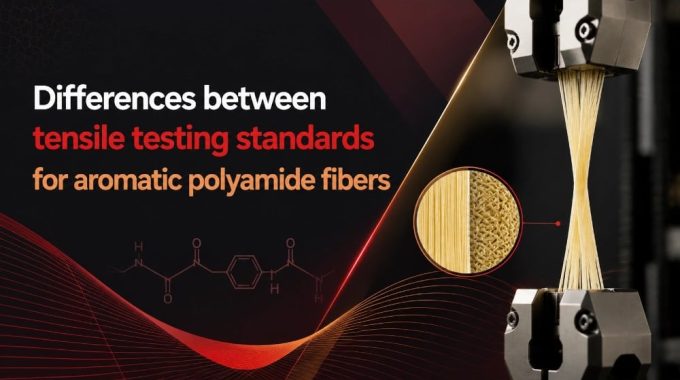
Differences between tensile testing standards for aromatic polyamide fibers
Aromatic polyamide fibers are fibers composed of linear macromolecules formed by aromatic groups linked by amide or imide bonds. At least 85% of the amide or imide bonds are directly connected to two aromatic rings, and when imide bonds are present, their percentage does not exceed that of amide bonds.
Based on the substitution position of the aromatic groups, aromatic polyamide fibers are further divided into para-aramid fibers and meta-aramid fibers. Para-aramid fibers have a linear molecular chain arrangement; a typical product is poly(p-phenylene terephthalamide) fiber, abbreviated as para-aramid (also known as aramid 1414 in my country). Meta-aramid fibers have a zigzag molecular chain arrangement; a typical product is poly(m-phenylene isophthalamide) fiber, abbreviated as meta-aramid (also known as aramid 1313 in my country).
This article mainly introduces and compares the currently implemented testing standards for meta-aramid and para-aramid fibers, analyzing the differences.
China’s current standard system for tensile testing of meta-aramid and para-aramid fibers

Currently, the main Chinese standards for tensile testing are GB/T 19975—2005 “Test Method for Tensile Properties of High-Strength Fiber Filaments” and GB/T 14337—2008 “Test Method for Tensile Properties of Chemical Fibers – Staple Fibers”. GB/T 19975—2005 applies to para-aramid filaments, while GB/T 14337—2008 applies to meta-aramid and para-aramid staple fibers. In addition, Chinese product standards FZ/T54076—2014 “Para-aramid (1414) Filaments”, GB/T31889—2015 “Meso-aramid Staple Fibers”, and GB/T 35442—2017 “Para-aramid Staple Fibers” also specify requirements for testing methods.
GB/T 19975—2005
GB/T 19975—2005, “Test Methods for Tensile Properties of High-Strength Fiber Filaments,” specifies the test methods for breaking strength, elongation at break, initial modulus, and tensile creep properties of high-strength fiber filaments. It is applicable to ultra-high molecular weight polyethylene fibers, aramid fibers, carbon fibers, and other high-strength synthetic fiber filaments (generally referring to filaments with a breaking strength greater than 10 cN/dtex). Currently, this standard has a wide range of applications, and most high-performance fiber manufacturers in China use this standard for testing.
GB/T 14337—2008
GB/T 14337—2008, “Test Methods for Tensile Properties of Chemical Fibers—Short Fibers,” specifies the testing methods for the tensile properties of single chemical fiber short fibers. It is applicable to the testing of the tensile properties of short fibers from polyester, polyamide, polyacrylonitrile, polypropylene, polyvinyl alcohol formaldehyde, and cellulose fibers. The main application areas of meta- and para-aramid short fibers are similar to those of ordinary chemical fiber filaments. However, due to their better flame retardancy and high-temperature resistance, they are widely demanded in specialized fields. Therefore, as a substitute product, most Chinese enterprises and downstream customers of aramid products use this standard for testing the performance of aramid short fibers.

FZ/T 54076—2014
FZ/T 54076—2014, “Para-aramid (1414) Filament,” applies to para-aramid (1414) filaments with a total linear density of 222~3330 dtex, a single filament linear density of 1.26~3.33 dtex, and a circular cross-section. As a specific product standard for para-aramid filaments, it was drafted by Chinese manufacturers, and extensive research has been conducted on the testing of tensile properties. Based on the influence of spacing length and tensile speed on test results, and considering that most twisting equipment in China currently has a fixed length of 500 mm, and taking into account factors such as technology and production testing efficiency, Chinese manufacturers have uniformly stipulated that the spacing length for para-aramid is 250 mm and the tensile speed is 125 mm/min. This differs slightly from the provisions in GB/T 19975—2005, and the initial modulus calculation formula is also slightly different.
GB/T 31889—2015
GB/T 31889—2015 “Mesoaramid staple fibers with a nominal linear density of 0.80~15.00 dtex”. Metaaramid staple fibers are the main product form of meta-aromatic polyamide fibers. Regarding the tensile property test, GB/T 14337—2008 specifies that the actual value of the pretension is 0.075 cN/dtex.
GB/T 35442—2017
GB/T 35442—2017, “Parameric Staple Fibers,” applies to parameric staple fibers with a linear density between 1.0 and 5.0 dtex. Other specifications of parameric staple fibers can be used with reference to this standard. The standard details the main test methods and product performance for Chinese manufacturers. Regarding the tensile property test, the requirements of GB/T 14337—2008 are followed, but the actual pre-tension value is specified as 0.2 cN/dtex, the tensile speed as 20 mm/min, and the spacing length as 25 mm.
The current international standard system for tensile testing of meta-aramid and para-aramid fibers
Because aromatic polyamide fibers were developed earlier internationally, the relevant testing standards have been revised several times and are relatively comprehensive. As an important high-performance fiber material, the testing standards are mainly based on the American Society for Testing and Materials (ASTM) standards. Currently, the main testing standards are ASTM D3822 “Tension Properties of Single Textile Fibers” and ASTM D 7269 “Standard Test Method for Tensile Testing of Aromatic Polyamide Yarns”. ASTM D 7269 is mainly applicable to aromatic polyamide filaments, while ASTM D 3882 is mainly applicable to staple fibers.
ASTM D 3822
ASTM D 3822, “Test Method for Tensile Properties of Single Textile Fibers,” is primarily applicable to natural fibers, synthetic fibers, and yarns made from them of sufficient length. It specifies a series of test intervals for the main tensile test parameters and allows selection of an appropriate tensile speed based on the fiber’s elongation at break.
ASTM D 7269
ASTM D 7269, “Standard Test Method for Tensile Testing of Aramid Yarns,” is primarily applicable to aramid yarns, tire cords, and fabrics made from them.
In fact, the earliest ASTM standard to address aramid testing methods was ASTM D 885, originally developed by the American Society for Testing and Materials (ASTM) in 1946. After several revisions, the latest version was released in 2010. my country’s GB/T 19975—2005 standard also references its 2001 version, albeit not an equivalent one. It’s worth noting that versions prior to 2004 included test methods for aramid yarns, but these were removed in the 2007 revision, primarily due to the development of ASTM D 7269, a standard specifically for aromatic polyamide fibers, in 2006. This demonstrates the increasing specialization and refinement of international standards. The test conditions specified in these standards are also relatively flexible, allowing users to select appropriate test conditions based on downstream applications and fiber morphology.
Differences between China’s Aromatic Polyamide Fiber Tensile Testing Standards and International Standards
Comparing the available testing standards for aramid fibers in China with international standards reveals the following:
- China’s tensile testing standards for aromatic polyamide fibers consist of method standards and product standards, while international standards only have two method standards: short fiber and filament tow.
- Regarding aromatic polyamide short fiber standards, the main difference between Chinese and international testing methods lies in the tensile speed.
- Regarding aromatic polyamide filaments, the main differences between Chinese and international testing methods lie in the spacing length and tensile speed. Furthermore, China currently lacks testing methods and product standards for meta-aramid filaments.
Reference: *Synthetic Fiber in China* (Vol. 48, No. 08) — “Differences between domestic and international tensile testing standards for aromatic polyamide fibers” If any copyright infringement is detected, please contact us.