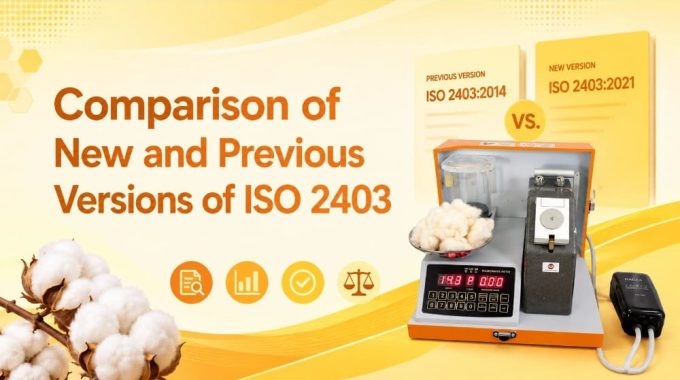
Comparison of New and Previous Versions of ISO 2403: Textiles—Cotton fibers—Determination of micronaire value
The Micronaire value reflects the fineness and maturity of cotton fibers; as a critical intrinsic quality indicator, it is closely linked to the processing and utilization of cotton fibers. In 1972, the International Organization for Standardization (ISO) officially published the test method for Micronaire value: ISO 2403:1972, *Textiles — Cotton fibres — Determination of Micronaire value*.
ISO 2403 underwent two subsequent revisions in 2014 and 2021. The latest revised edition, ISO 2403:2021, *Textiles — Cotton fibres — Determination of Micronaire value*, was published on August 27, 2021, superseding ISO 2403:2014.
In international trade, given that the Micronaire value serves as a key criterion for assessing cotton quality, the accuracy and consistency of its determination are of paramount importance. Consequently, staying abreast of changes to ISO standards is of significant importance for aligning with international practices and eliminating technical barriers in international trade.
Foreword
ISO 2403:2021 incorporates a Foreword that outlines the basis for the standard’s drafting, includes statements regarding patents and trade names, identifies the drafting and responsible technical committees, and details the technical changes introduced relative to ISO 2403:2014. The inclusion of this Foreword enhances the overall completeness of the standard.
Introduction
ISO 2403:2021 features a new Introduction that describes the evolutionary history of Micronaire testers, the typical range of Micronaire values, and the significance represented by these values. The method prescribed in this standard for determining Micronaire values offers several advantages—including simple sample preparation, short measurement times, and the ability to rapidly and accurately assess the intrinsic quality of cotton fibers—thereby enhancing users’ understanding and appreciation of both Micronaire values and the testing equipment used to measure them.
Normative References
The new standard refines and updates the list of normative references, replacing ISO/R 139 with ISO 139, and ISO/R 220 with ISO 1130.
Terms and Definitions
The definition of the Micronaire value in ISO 2403:2014 was relatively broad and somewhat difficult to interpret; however, ISO 2403:2021 clarifies the concepts of the Micronaire table and the Micronaire scale through Note 1 and Note 2, rendering the definition of the Micronaire value more comprehensive, concise, and accessible.
Apparatus and Materials
In ISO 2403:2021, Note 1 and Note 2 within Clause 5.2.2 provide brief descriptions of the relevant apparatus, along with explanations regarding operational details and calibration methods, thereby serving as a convenient reference for users. Concurrently, Annex Y—which detailed the calibration and operational procedures for various instruments and equipment—has been removed from ISO 2403:2014.
Preparation of Test Specimens

ISO 2403:2014 stipulated that sampling be conducted in accordance with the provisions of ISO/R 220, or alternatively, that test specimens be drawn using other methods subject to the prior agreement of the interested parties. ISO 2403:2021 now specifies that sampling shall be carried out in accordance with the provisions of ISO 1130 or based on a prior agreement between the interested parties.
The sample preparation method outlined in the ISO 2403:2014 standard requires that, following sampling, any foreign matter—such as seeds, sand, stem fragments, and other impurities—be removed from the sample. The sample preparation method introduced in ISO 2403:2021, while retaining the procedures of the original standard, adds an alternative method that involves drawing a test specimen directly from the sample without removing any foreign matter.
The Micronaire value serves as a measure of the air permeability of a specific quantity of cotton fibers under prescribed conditions. Impurities present in the test sample—such as leaf fragments, burrs, broken seeds, and immature seeds—exhibit air permeability characteristics distinct from those of cotton fibers; consequently, the impurity content within the test sample directly impacts the accuracy of the test results.
Currently, with the increasing prevalence of mechanized cotton harvesting, the turnaround times for cotton procurement, processing, and official inspection have progressively shortened. This has resulted in an increased daily workload for cotton inspectors, making it difficult to ensure the complete removal of all impurities from test samples prior to determining the Micronaire value. Therefore, the sample preparation method specified in ISO 2403:2021 is more comprehensive and reflective of actual operating conditions than that of ISO 2403:2014, thereby serving as an effective means to prevent trade disputes.
Test Report
Building upon the test report requirements of ISO 2403:2014, ISO 2403:2021 incorporates additional testing information—such as the method used for test specimen preparation, the testing date, any deviations from the prescribed procedures, and any observed anomalies—thereby further enhancing the scientific rigor, objectivity, and verifiability of the test report.
Annexes

ISO 2403:2021 retains the content of Annex X (Instrument Calibration Methods) from ISO 2403:2014, while re-designating the title of ISO 2403:2014 Annex X as Annex A.
Clause 5.2.2 of ISO 2403:2021 stipulates that the operation of different models of airflow instruments shall be conducted in accordance with the specific operating instructions provided by the respective manufacturers. Consequently, Annex Y and Annex Z (Operating Methods for Different Airflow Instruments) from ISO 2403:2014 have been removed.
An informative Annex B (Precision Testing for Micronaire Value Measurement) has been added. In accordance with Method B for test specimen preparation as outlined in Clause 7.2 of ISO 2403:2021, Annex B details a precision study conducted across 72 laboratories, utilizing the test results to analyze the precision of Micronaire value measurements.
Annex C (Comparison Testing of Two Test Specimen Preparation Methods) has been added. In accordance with Methods A and B for test specimen preparation as outlined in Clause 7.2 of ISO 2403:2021, Annex C describes a comparative study in which a single operator, working within a single laboratory and utilizing identical testing equipment, tested 15 test specimens to compare the results obtained using Test Specimen Preparation Method “A” against those obtained using Test Specimen Preparation Method “B”.
Conclusion
ISO 2403:2021 represents a revision of the ISO 2403:2014 standard, rendering the standard more comprehensive and rational. The new standard places greater emphasis on practicality and scientific rigor, offering significant guidance for the testing of cotton fiber Micronaire values.
Reference: *China Fiber Inspection* (Vol. 23, No. 07) — “Comparison of New and Old Standards: ISO 2403 — Textiles — Determination of Micronaire Value of Cotton Fibres.” If any copyright infringement is detected, please contact us.