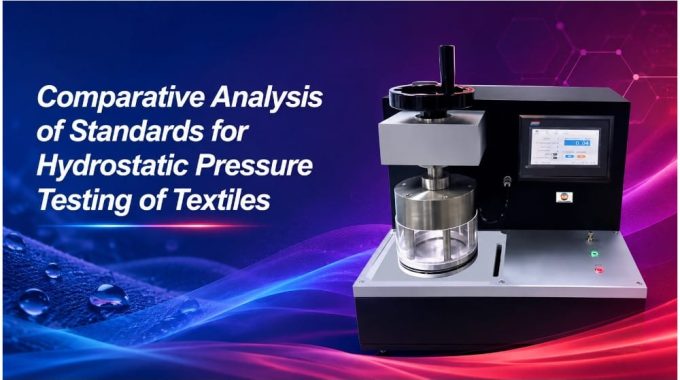
Comparative Analysis of Standards for Hydrostatic Pressure Testing of Textiles
There are currently two main types of waterproof fabric designs. The first is laminated waterproof fabric, created by bonding ordinary fabric with a special adhesive through a lamination process to form a waterproof composite; this structure may consist of two or more layers. The second type is coated waterproof fabric, produced by applying a coating agent—via direct or transfer coating methods—to seal the fabric surface, thereby imparting water resistance.
Hydrostatic pressure resistance is a key performance indicator for waterproof, moisture-permeable fabrics. Hydrostatic pressure refers to the resistance encountered by water as it attempts to pass through the fabric. Under standard atmospheric conditions, the fabric is subjected to steadily increasing water pressure until water droplets penetrate the reverse side; the pressure value recorded at this moment represents the hydrostatic pressure. The higher the hydrostatic pressure the fabric can withstand, the better its water resistance or impermeability.
Prominent domestic and international standards for hydrostatic pressure testing include ISO 811, AATCC 127 (USA), JIS L 1092 (Japan), GB/T 4744 (China National Standard), and FZ/T 01004 (China Textile Industry Standard). As testing requirements and result descriptions vary across these standards, this paper outlines the differences between them.
This paper analyzes the hydrostatic pressure test results of several representative coated fabrics using different standards; it also presents an inter-laboratory comparison of representative samples and briefly analyzes the resulting data.
Comparison of Hydrostatic Pressure Test Standards

ISO 811:1981 Textiles — Determination of resistance to water penetration — Hydrostatic pressure test
The testing principle of ISO 811:1981 is to express the resistance of a fabric to water penetration in terms of the hydrostatic pressure it withstands. Under standard atmospheric conditions, one side of the specimen is subjected to a continuously increasing water pressure until water penetrates at three points, at which time the pressure is recorded. Water pressure may be applied to either the upper or lower surface of the specimen. Test results and their average values are expressed in cmH2O.
AATCC 127-2014 “Water Resistance: Hydrostatic Pressure Test”
The test principle of AATCC 127—2014 is as follows: one side of the specimen is subjected to hydrostatic pressure increasing at a constant rate until water droplets penetrate the surface at three separate points. The water pressure may be applied to either the top or the bottom of the specimen.
JIS L 1092:2009 “Testing methods for water resistance of textiles”
Measure the water level when overflow occurs at one or two locations and note the situation in the report; for the high water pressure method, calculate the average of the five tests and retain one decimal place. If the water level rises but overflow does not occur at all three locations, measure the water pressure at the point(s) where overflow does occur and note the situation in the report.
GB/T 4744—2013 Textiles—Determination of resistance to water penetration—Hydrostatic pressure method
The test principle of GB/T 4744—2013 involves subjecting one side of a specimen to continuously increasing water pressure under standard atmospheric conditions until three points of water penetration appear on the opposite side. The pressure value at the moment the third penetration point appears is recorded and used to evaluate the specimen’s water resistance. The hydrostatic pressure value for each specimen and the average value are expressed in kPa (cmH2O), rounded to one decimal place. Average hydrostatic pressure values are calculated separately for different types of specimens from the same sample.
FZ/T 01004-2008 Determination of resistance to water penetration of coated fabrics
The test principle of FZ/T 01004-2008 involves subjecting one side of a coated fabric specimen to continuously increasing water pressure under specified conditions until a predetermined pressure value is reached. Observations are made to detect any penetration within a specified timeframe, or the pressure is continuously increased until penetration occurs. For tests at a specified pressure value, the specimens pass if no points of water penetration or traces of wetting appear on the surfaces of any of the five specimens; otherwise, they fail. For tests determining the ultimate hydrostatic pressure, the average value of the five specimens is calculated, and the result is recorded as an integer.
Testing requirements for the hydrostatic pressure of textiles vary across different national standards; details are provided in Table 1.
Table 1 Differences among hydrostatic pressure test standards of various countries
| Item | ISO 811:1981 | AATCC 127:2014 | JIS L 1092:2009 7.1 | GB/T 4744:2013 | FZ/T 01004:2008 |
| Scope | Applicable to tightly woven fabrics | Applicable to all fabrics, including those with waterproof and water-repellent finishes | Applicable to air-impermeable fabrics | Applicable to various types of fabrics (including composite fabrics) and their products | Applicable to coated fabrics; other waterproof fabrics may refer to this standard |
| Conditioning | Condition to equilibrium under standard atmospheric conditions* | Condition for at least 4 hours under standard atmospheric conditions | Condition to equilibrium under standard atmospheric conditions | Condition to equilibrium under standard atmospheric conditions | Condition for at least 16 hours under standard atmospheric conditions |
| Test water requirements | Deionized or distilled water at (20±2)°C or (27±2)°C | Fresh deionized or distilled water at (21±2)°C | Fresh deionized or distilled water at (20±3)°C | Deionized or distilled water at (20±2)°C or (27±2)°C | Water at room temperature |
| Specimen requirements | At least 5 specimens | 3 specimens, minimum size 200 mm × 200 mm | Approx. 150 mm × 150 mm; 5 specimens | At least 5 specimens from different locations; size must meet test area requirements | 5 square specimens, side length approx. 200 mm; circular specimens, diameter 130 mm–200 mm |
| Test method | Pressure increase method | Pressure increase method | Pressure increase method and constant pressure method | Pressure increase method | Pressure increase method and constant pressure method |
| Rate of pressure increase or constant water pressure value | (10±0.5) or (60±3) cm H₂O/min | 60 mbar/min | Pressure increase method: A (low pressure): (600±30) mm/min or (100±5) mm/min; B (high pressure): 100 kPa/min; Constant pressure: pressure value specified by the client (6.0±0.3) kPa/min; (60±3) cmH₂O/min | Constant pressure method: Water pressure value to be specified by the client | |
| Test termination condition | Appearance of the third water droplet | Appearance of the third water droplet (ignore droplets within 3 mm of the specimen clamping ring edge) | Occurrence of 3 points of water penetration | Appearance of the third water droplet | Occurrence of water penetration |
| Expression of test results | Average of 5 test values, expressed in cmH₂O | Average of 3 test values, expressed in mbar | Average of 5 test values; low-pressure rate-of-rise method expressed in mmH₂O, high-pressure method in kPa; constant pressure method: record the time required for 3 points of water penetration to appear, accurate to 0.5 s | Average of 5 test values, expressed in kPa (cmH₂O), rounded to one decimal place | Average of 5 test values; low-pressure rate-of-rise method results rounded to the nearest whole number. Constant pressure method: if no water penetration points or signs of wetting appear on the surfaces of any of the 5 specimens, the specimen passes the test; otherwise, it fails. |
As shown in Table 1, ISO 811:1981, AATCC 127-2014, and GB/T 4744—2013 all employ the increasing pressure method for hydrostatic pressure testing, whereas JIS L 1092:2009 (Section 7.1) and FZ/T 01004—2008 specify two testing methods: the increasing pressure method and the constant pressure method. When the increasing pressure method is used, all standards measure the hydrostatic pressure at the appearance of the third water droplet, with the exception of FZ/T 01004—2008, which measures the pressure at the appearance of the first water droplet.
Analysis of Hydrostatic Pressure Comparison Results

Impact of Different Method Standards on Hydrostatic Pressure Testing
(1) Test Protocol
Five specimens of homogeneous coated fabric were randomly selected. Their final hydrostatic pressure values were determined using the standard methods GB/T 4744-2013 and FZ/T 01004-2008, respectively, with a pressure increase rate of 60 cmH₂O/min; the results represent the average of the five specimens.
(2) Test Results and Analysis
A comparison of the hydrostatic pressure test values obtained under the different standards is presented in Table 2.
Table 2 Comparison of hydrostatic pressure test results under different standards
| Hydrostatic pressure (cmH2O) | GB/T 4744-2013 | FZ/T01004-2008 |
| 1 | 653 | 535.3 |
| 2 | 39 | 29.3 |
| 3 | 631 | 439.7 |
| 4 | 43 | 42.7 |
| 5 | 588.3 | 420 |
As shown in Table 2, there are differences between the test results obtained using FZ/T 01004-2008 and GB/T 4744-2013; the hydrostatic pressure values recorded using FZ/T 01004-2008 are lower. This is primarily because FZ/T 01004-2008 records the hydrostatic pressure at the appearance of the first water droplet, whereas GB/T 4744-2013 records it at the third droplet. The impact of the testing method varies depending on the sample; for instance, the results for Sample 4 are essentially consistent between the two methods, whereas the results for Sample 3 show a difference of 30%.
Impact of different laboratories on hydrostatic pressure testing
Test Protocol: A sample of sky-blue coated woven fabric was randomly selected.
Method: The ultimate hydrostatic pressure of the sample was tested in accordance with standard FZ/T 01004-2008, using a pressure increase rate of 60 cmH₂O/min. The result represents the average value of five samples.
Test Data, Results, and Analysis
Table 3: Inter-laboratory Hydrostatic Pressure Comparison Results
| Laboratory ID | Hydrostatic Pressure (kPa) | Instrument Model |
| 1 | 16 | YG812S |
| 2 | 24 | YG812S |
| 3 | 31 | YG812P |
| 4 | 13 | YG812D |
| 5 | 20 | YG812D |
As shown in Table 3, the standard adopted for the comparison is FZ/T 01004-2008. This standard defines the hydrostatic pressure value as the point at which a single water droplet penetrates the material. Since the samples are coated fabrics, uneven coating—a potential occurrence—can influence the test data and lead to variations in results; differences in the testing instruments used by the laboratories also affect the outcomes.
Conclusion
ISO 811:1981, AATCC 127-2014, and GB/T 4744-2013 all employ the pressure-increase method to test hydrostatic pressure, with essentially identical testing procedures. JIS L 1092:2009 (Section 7.1) and FZ/T 01004-2008 specify two testing methods: the pressure-increase method and the constant-pressure method. When the pressure-increase method is used, FZ/T 01004-2008 measures the hydrostatic pressure at the appearance of the first water droplet, whereas the other standards measure the pressure at the appearance of the third droplet.
Under identical conditions, hydrostatic pressure values obtained using FZ/T 01004-2008 are lower than those obtained using GB/T 4744-2013, and the impact of the testing method varies depending on the sample. External comparisons indicate that the uniformity of coated samples significantly influences the results; differences in the instruments used by laboratories also affect the outcome.
Reference: China Fiber Inspection (2017 08)— “Comparative Analysis of Standards for Hydrostatic Pressure Testing of Textiles” If any copyright infringement is detected, please contact us.