Analysis of Test Methods for Surface Wetting Resistance of Textiles
With improvements in living standards and advancements in technology, functional textiles offering water, oil, and stain resistance have garnered increasing attention from consumers. The ability of textiles to resist surface wetting by various liquids—such as water, oil, alcohol, blood, and chemical reagents—plays a crucial role in practical applications. This article outlines the testing standards, methods, and technical parameters regarding the surface wetting resistance of textiles.
Wetting is the process wherein the solid-gas interface of a fabric surface is replaced by a solid-liquid interface. When a liquid contacts a fabric surface and reaches equilibrium, the sum of the horizontal components of the interfacial tensions between the liquid, solid, and gas phases equals zero; this equilibrium relationship is described by the well-known Young’s equation, which elucidates the balance of forces involved in surface wetting. Current methods for testing the surface wetting resistance of textiles include the spray rating method, droplet observation method, contact angle method, and roll-off angle method. These tests evaluate wetting resistance either through subjective rating of the wetted area on the fabric surface or through indirect assessment based on properties such as surface tension and adhesion.
Spray Rating Method
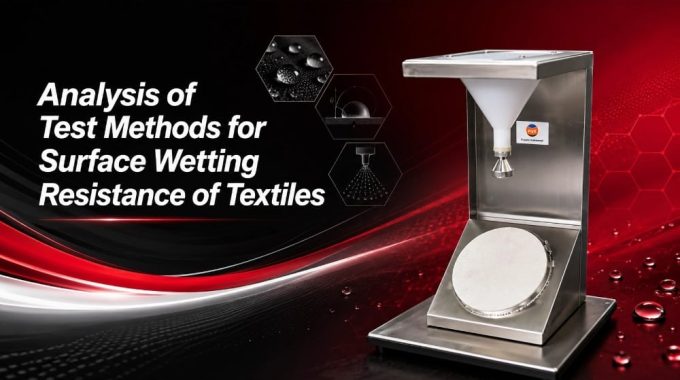
The spray test method simulates exposure to varying degrees of rainfall by subjecting the fabric to a spray under controlled conditions of water flow rate, height, direction, and duration. The fabric is rated based on the appearance of water droplets and the wetted area on its surface after spraying, using standard reference images and descriptive criteria.
In the GB/T 4745 test (“Textiles—Determination of resistance to surface wetting (spray test)”), 250 mL of distilled or deionized water is poured into a funnel featuring 19 holes (each approximately 0.86 mm in diameter). The funnel is positioned 150 mm above the center of the specimen, which is mounted at a 45-degree angle. The fabric surface is sprayed continuously for 25 to 30 seconds. The water-repellency grade or score is determined by comparing the specimen’s appearance—specifically the number of droplets, the extent of wetting at impact points, and the total wetted area—against standard descriptions and reference images. Ratings range from Grade 0 (poorest) to Grade 5 (best); a rating of Grade 3 indicates resistance to surface wetting, while Grades 4 and 5 indicate excellent resistance. Similar test standards include ISO 4920, JIS L1092, and AATCC 22.

“Determination of water repellency of fabrics—Bundesmann rain-shower test” is used to evaluate the wetting resistance of fabrics subjected to simulated rainfall—involving specific duration and pressure—while in motion. In this test method, a rainfall generator is positioned 1,500 mm above the specimen surface, featuring approximately 300 identical nozzles evenly distributed across a flat area with a diameter of 406 mm. The specimen holder is tilted at a 15° angle relative to the vertical to facilitate water runoff; the fabric is subjected to a rainfall rate of approximately 100 mL/min per 100 cm² of exposed surface area for a duration of 10 minutes. A wiper blade is attached to the specimen holder, positioned against the underside of the specimen and rotating at 20 revolutions per minute during the test. The water repellency grade is determined by comparing the appearance of the tested specimen against standard reference images: Grade 5 indicates rapid runoff of small droplets (best surface wetting resistance); Grade 1 indicates wetting of the entire surface (worst surface wetting resistance); and Grade 3 indicates partial wetting by droplets. Similar test standards include ISO 9865 and JIS L1092.

Droplet observation method
The droplet observation method involves applying liquids with varying surface tensions—such as hydrocarbons, oils, and alcohol solutions—onto the fabric surface and evaluating the fabric’s resistance to wetting by observing phenomena such as wetting, wicking, and changes in contact angle.
The GB/T 19977—2014 standard, “Textiles—Oil repellency—Hydrocarbon resistance test,” employs eight standard hydrocarbon test liquids with different surface tensions; wetting is determined by observing the specimen-droplet interface for signs such as darkening, wicking, or a reduction in contact angle.

For Sample A, the droplet remains distinct with a well-defined curvature and a large contact angle, indicating no wetting of the fabric; Samples B, C, and D exhibit varying degrees of wetting. The oil repellency grade is determined by the highest-numbered standard test liquid that does not wet the fabric; the scale ranges from 0 to 8, with higher grades indicating superior resistance to wetting.
In accordance with GB/T 30159.1—2013 (“Textiles—Testing and evaluation for soil-release properties—Part 1: Soil resistance”), the fabric’s performance is rated after contact with liquid soilants (peanut oil or dark soy sauce) by observing the degree of surface darkening and the volume of the droplet remaining on the specimen. Ratings range from Grade 1 to Grade 5: Grade 5 is assigned when the droplet remains distinct with a well-defined curvature and large contact angle, showing no surface wetting; Grades 4, 3, and 2 are assigned when the surface shows partial or total darkening and approximately 3/4, 1/2, or 1/4 of the droplet volume remains on the specimen, respectively; and Grade 1 is assigned when the droplet disappears into the specimen surface, indicating complete wetting.
Contact angle method
The contact angle method evaluates a fabric’s wetting resistance by measuring the static angle formed when a liquid droplet comes into contact with the horizontal fabric surface. During testing, a droplet of a specific volume is placed on the fabric; the cohesive forces resulting from the liquid’s surface tension cause the droplet to assume a particular shape, which is determined by the balance between the fabric’s surface energy, the liquid’s surface tension, and the solid-liquid interfacial energy. High-resolution imagery is used to capture the droplet, identify the solid-liquid baseline, and draw a tangent to the gas-liquid interface; the angle θ formed between these lines is the contact angle, as illustrated in the figure. A larger contact angle θ indicates greater wetting resistance (associated with a larger droplet volume on the surface), while a smaller angle θ indicates weaker wetting resistance (associated with a smaller droplet volume on the surface).

Rolling Angle Method
The rolling angle method evaluates a fabric’s wetting resistance by measuring the angle of inclination relative to the horizontal at which a droplet begins to slide off the fabric surface, a process governed by the adhesion between the droplet and the fabric. During the test, after a droplet of a specific volume has stabilized on the fabric surface, the platform holding the fabric is tilted slowly. As the tilt angle increases, the contact angles on either side of the droplet change, allowing for the observation of receding and advancing angles at the upper and lower edges of the droplet; the angle of inclination at the moment the droplet begins to roll across the fabric surface is defined as the rolling angle (α). A smaller rolling angle indicates superior wetting resistance, whereas a larger rolling angle indicates inferior wetting resistance.
Different test methods for surface moisture resistance vary in their underlying principles, evaluation metrics, and ability to differentiate results; therefore, the appropriate method should be selected based on actual daily usage conditions.
Reference: Textile Dyeing and Finishing Journal (2024 No. 5)— “Analysis of Test Methods for Surface Wetting Resistance of Textiles and Discussion on Their Correlation” If any copyright infringement is detected, please contact us.