Comparison of testing methods for moisture permeability of textiles (moisture absorption method)
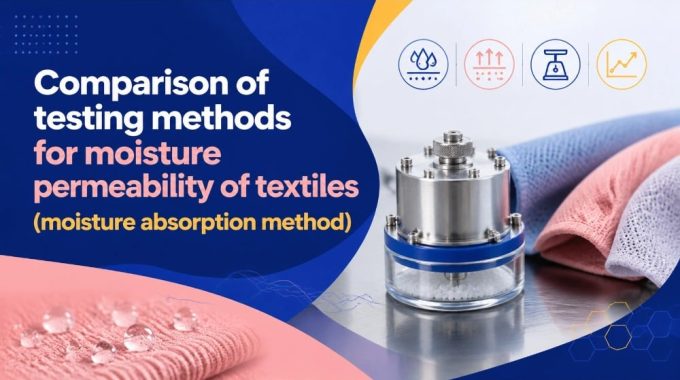
With the development of the times, people’s demands for clothing have gone beyond just comfort; they also require clothing to have certain functions. Moisture permeability is both an important factor affecting comfort and an indicator of functionality. The testing of moisture permeability is mainly done through the weighing method. Under the condition of maintaining constant water vapor pressure on both sides of the fabric, the mass of water vapor passing through a unit area of the fabric within a specified time is measured. The existing method for testing moisture permeability is the moisture permeability cup method, which includes two types: the absorption method and the evaporation method. Currently, the Chinese standard GB/T 12704.1, the Japanese standard JIS L 1099 Method A-1, and the American standard ASTM E96/96M all adopt the positive cup absorption method. This study will compare the relevant standards for the absorption method, test the same samples, and analyze and evaluate the results based on the comparison.
Standard comparison

Principle comparison
The test principle and general procedure of the moisture absorption method are the same in Chinese standard GB/T 12704.1, Japanese standard JIS L 1099 Method A-1, and American standard ASTM E96/96M. In all three cases, a certain amount of desiccant is placed in the moisture permeation cup of the test apparatus, the sample is placed with its front facing the desiccant, then a gasket and a pressure ring are placed in sequence, the cup lid is closed, the nut is tightened, and the edge of the cup is sealed with vinyl adhesive tape, forming the moisture permeation cup assembly for testing. The moisture permeation cup assembly is placed in an environment with the specified temperature, humidity, and wind speed, and weighed at intervals. Parameters such as moisture permeability are calculated based on the change in mass of the moisture permeation cup assembly.
Comparison of experimental parameters
The three standards differ somewhat in experimental parameters, such as the testing environment, as shown in Table 1. In addition, the testing procedures also differ.
The Chinese standard GB/T 12704.1 requires that, before the experiment, the desiccant meeting the particle size requirements be dried in a 160 ℃ oven for 3 hours. The permeation cup assembly is placed in the test chamber under specified conditions twice. The first time, it is placed in the test chamber for 1 hour to equilibrate, then removed, the lid is closed, and it is placed in a silica gel desiccant for 30 minutes to equilibrate before being weighed. After weighing, the permeation cup assembly is gently shaken to mix the desiccant. It is then placed back in the test chamber, the lid is removed, and it is kept in the environment with the temperature, humidity, and wind speed specified in the standard for 1 hour. The lid is then closed, and it is placed in a silica gel desiccant for 30 minutes to equilibrate before being weighed again. The permeability and moisture permeability rate are calculated based on the difference in mass between the two weighings.
Japanese standard JIS L 1099 Method A-1, except that the desiccant does not need to be dried, the moisture permeation cup assembly is weighed directly after being removed from the test chamber, without needing to be equilibrated in a desiccator. The final test result only calculates the moisture permeability; otherwise, it is consistent with the Chinese standard.
American standard ASTM E96/96M’s moisture absorption method requires immediate weighing upon placement in the test chamber, followed by weighing at intervals, for a total of 8-10 weighings. Once the rate of mass change reaches a steady state, a mass-time graph is plotted. The slope of the stable linear portion represents the water vapor transport rate. The moisture permeability is the characterization parameter obtained by dividing the water vapor transport rate by the test area.
Table 1: Experimental parameters for each standard
| Standard | Temperature and humidity | Wind speed (m·s⁻¹) | Desiccant mass (g) | Distance between desiccant and sample (mm) | Desiccant particle size (mm) |
| GB/T 12704.1 | a(38±2)℃、(90±2)%; b(23±2)℃、(50±2)%; c(40±2)℃、(65±2)% | 0.3~0.5 | 35 | 4 | 0.63~2.50 |
| JIS L 1099 方法 A‑1 | (40±2)℃、(90±5)% | 0~0.8 | 33 | 3 | 2.0~5.0 |
| ASTM E96/96M | Under non-extreme humidity conditions: Temperature: Program A 23℃, Program C 232.2℃, Program E 37.8℃; Humidity (50±2)% Under extreme humidity conditions: (38±2)℃, (90±2)% | 0.02~0.30 | — | 6 | 0.60~2.36 |
Experiment

Instruments and Reagents
Instruments: Water Vapor Permeability Tester, permeation cup (60 mm diameter) and accessories, oven (160 ℃), standard sieves (one 0.63 mm sieve and one 2.50 mm sieve), silica gel desiccant.
Reagents: Anhydrous calcium chloride desiccant (chemically pure).
Experimental Methods
Three samples with different moisture permeability were taken and tested according to the moisture absorption method specified in Chinese standard GB/T 12704.1, Japanese standard JIS L 1099 Method A-1, and American standard ASTM E96/96M. Based on experience, the Chinese standard GB/T 12704.1 recommends three temperature and humidity test environments, with condition a being the preferred choice: (38±2)℃ and (90±2)%. The Japanese standard JIS L 1099 Method A-1 requires a temperature and humidity test environment of (40±2)℃ and (90±5)%, which is close to condition a in the Chinese standard. To ensure comparability of the measured results, the American standard uses a test temperature and humidity condition of (38±1)℃ and (90±2)%. The wind speed is adjusted to 0.5 m/s according to the requirements of GB/T 12704.1 and JIS L 1099 Method A-1, and to 0.3 m/s according to the requirements of ASTM E96/96M. Since the common characterization parameter measured by the three standards is moisture permeability, the results obtained in this test are all expressed as moisture permeability.
The American standard ASTM E96/96M requires weighing under the test conditions, with the test subject not removed from the test chamber. Since the Water Vapor Permeability Tester used in this experiment does not have a weighing function, it was removed for weighing. To avoid errors, the permeabilizer cup lid was closed during weighing, and the experimental chamber was removed and weighed quickly, ensuring that the weighing was completed within 30 seconds and then placed back into the experimental chamber.
Comparison of moisture permeability
According to the testing requirements and procedures of each standard, three samples with different moisture permeability were tested, and their moisture permeability was calculated. The results are shown in Table 2.
Table 2 Moisture permeability tested by different standards
| Standard | Moisture permeability of sample 1 /[g・m⁻²・(24 h)⁻¹] | Moisture permeability of sample 2 /[g・m⁻²・(24 h)⁻¹] | Moisture permeability of sample 3 /[g・m⁻²・(24 h)⁻¹] |
| GB/T 12704.1 | 3087 | 8390 | 10600 |
| JIS L 1099 Method A‑1 | 3290 | 7752 | 9503 |
| ASTM E96/96M | 2855 | 7149 | 8460 |
As shown in Table 2, compared with the test results of Japanese standard JIS L 1099 Method A-1 and American standard ASTM E96/96M, the test results of Chinese standard GB/T 12704.1 are larger, while the test results of American standard ASTM E96/96M are smaller. Furthermore, for samples with lower moisture permeability, the differences in test results among the three standards are smaller, while the differences increase with higher moisture permeability.
Compared to the other two standards, Japanese standard JIS L 1099 Method A-1 has simpler parameter requirements and a more concise procedure; however, precisely because the parameter requirements are not high, such as wind speed (0~0.8) m/s, it has a significant impact on the moisture permeability test using the hygroscopic method [4]. The lack of specificity in the requirements may lead to significant differences in test results among different laboratories. Chinese standard GB/T 12704.1 has more specific requirements for each parameter procedure, reducing errors caused by different experimental conditions, but the procedure is more cumbersome. For samples that are urgent and have lower requirements, the procedure can be appropriately simplified by referring to the Japanese standard. The testing method using the American standard ASTM E96/96M is the most complex and demanding. It employs multi-point weighing to plot a curve, and then uses linear regression to obtain the slope of the linear region to calculate the moisture permeability. This method yields more accurate test results. When encountering controversial samples, it is recommended to use the multi-point weighing method from the American standard.
Conclusion
Based on the results of testing the same three samples using three standards, it can be seen that for samples with low moisture permeability, the differences in the test results among the three standards are relatively small, while the differences increase with the higher the moisture permeability. The test results of Chinese standard GB/T 12704.1 are relatively large, and the differences increase with the higher the moisture permeability. Chinese standard GB/T 12704.1 and Japanese standard JIS L 1099 Method A-1 have basically the same test parameters, so although there are deviations, the results are not significantly different. However, the test results of American standard ASTM E96/96M are relatively small due to the lower wind speed, and the differences increase with the higher the moisture permeability of the sample.
Reference: Textile Dyeing and Finishing Journal (2023 No. 3)— “Comparison of testing methods for moisture permeability of textiles (moisture absorption method)” .If any copyright infringement is detected, please contact us.