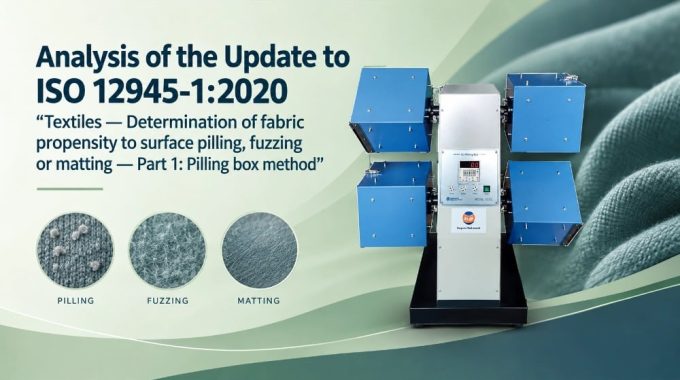
Analysis of the Update to ISO 12945-1:2020 “Textiles — Determination of fabric propensity to surface pilling, fuzzing or matting — Part 1: Pilling box method”
ISO 12945-1:2020, *Textiles — Determination of fabric propensity to surface pilling, fuzzing or matting — Part 1: Pilling box method*, was officially published in October 2020, replacing the original first edition (ISO 12945-1:2000). It is worth noting that this update introduces significant changes to both the testing and evaluation methods.
Pre-test processing

Compared to the somewhat mandatory wording of the 2000 version (7.1), the 2020 version leaves the decision regarding whether to pretreat test samples to the commissioning party and the testing laboratory, and even leans towards the option of proceeding directly to testing without pretreatment.
2000 Edition
7 Preparation of test specimens
7.1 Pretreatment
Unless otherwise agreed, launder or dry clean the sample using a method agreed between the interested parties.
NOTE 1 The procedures described in ISO 6330 or ISO 3175-1 and ISO 3175-2 may be suitable.
NOTE 2 It is recommended to launder or dry clean test specimens in order to protect the friction surfaces of the pilling box and specimen tubes from lubricants or finishes which may cause inconsistent results.
If laundering or dry cleaning is carried out, assess the specimens before and after the pretreatment using the grading scheme described in clause 9.
2020 Edition
6 Preparation of test specimens
Laboratory samples may be pre-treated by washing or dry-cleaning before cutting the test specimens, using conditions appropriate for the fabric end use or conditions agreed upon between the interested parties. When pretreated, the evaluation of the tested specimen from the pre-treated laboratory sample is done in comparison with that laboratory sample.
If there is no specific pretreatment agreed upon between the interested parties, the test specimen is tested as received.
Test RPM

As the rotation speed for the ICI Pilling box was not specified in the 2000 version, various organizations followed their own operational practices; the 2020 version specifically consolidates the commonly used rotation speeds and lists them in Table A.1 of Annex A.
Table 1 Examples of number of revolutions in relation to the fabric types and their use
| Fabric types | Range of number of revolutions |
| Knitted fabrics with carded yarns | 7 200 |
| Knitted fabrics with combed yarns | 10 800 to 14 400 |
| Woven fabrics with carded yarns | 7 200 to 18 000 |
| Woven fabrics with combed yarns | 14 400 to 18 000 |
| Heavyweight fabrics (e.g. for workwear fabrics) | 18 000 to 36 000 |
As shown in the table above, the number of test revolutions is generally determined based on the fabric’s weaving process; while the table provides optional ranges, the specific parameters require further consultation between the commissioning party and the testing party.
Rating
The most significant change in this update concerns the rating process.
First, the CEN technical committee has issued a new standard, ISO 12945-4:2020 (*Textiles — Determination of fabric propensity to surface pilling, fuzzing or matting — Part 4: Assessment of pilling, fuzzing or matting by visual analysis*). This standard incorporates the content of Clause 9 from the original ISO 12945-1:2000, with appropriate modifications. ISO 12945-4:2020 now serves as the unified rating method applicable to the ISO 12945 series of pilling and fuzzing test methods.
Second, let us look at the key changes regarding the rating process: the 2000 version relied on a visual comparison of the fabric before and after testing to provide an overall subjective assessment of fuzzing and pilling.
Table 2 ISO 12945-4:2000 Visual assessment
| Grade | Description |
| 5 | No change. |
| 4 | Slight surface fuzzing and/or partially formed pills. |
| 3 | Moderate surface fuzzing and/or moderate pilling. Pills of varying size and density partially covering the specimen surface. |
| 2 | Distinct surface fuzzing and/or distinct pilling. Pills of varying size and density covering a large proportion of the specimen surface. |
| 1 | Dense surface fuzzing and/or severe pilling. Pills of varying size and density covering the whole of the specimen surface. |
As can be seen from the excerpted table above, the descriptions of fuzzing and pilling are combined. A slight raised-fiber effect is associated with only minor pilling, whereas a pronounced raised-fiber effect accompanies severe pilling; this presents a challenge for evaluators. Due to the diverse characteristics of fabrics, instances of severe pilling without fuzzing—or significant fuzzing without pilling—are frequently encountered in actual testing. Consequently, this issue of inapplicability was addressed and improved in the 2020 version.
Table 3 Pilling grading scheme
| Grade | Description |
| 5 | No change |
| 4 | Partially formed pills |
| 3 | Moderate pilling — pills of varying size and density partially covering the specimen surface |
| 2 | Distinct pilling — pills of varying size and density covering a large proportion of the specimen surface |
| 1 | Severe pilling — pills of varying size and density covering the whole of the specimen surface |
Table 4 — Fuzzing grading scheme
| Grade | Description |
| 5 | No change |
| 4 | Slight surface fuzzing |
| 3 | Moderate surface fuzzing |
| 2 | Distinct surface fuzzing |
| 1 | Dense surface fuzzing |
Table 5 — Matting grading scheme
| Grade | Description |
| 5 | No change |
| 4 | Slight surface matting |
| 3 | Moderate surface matting |
| 2 | Distinct surface matting |
| 1 | Dense surface matting |
ISO 12945-4:2020 divides the visual assessment of tested fabrics into three categories: fuzzing, pilling, and matting. At least two assessors are required to rate the fabric under identical conditions, assigning separate grades for fuzzing, pilling, and matting. If there is a discrepancy of one grade or more between assessors for the same fabric sample, a re-assessment is required. Should the discrepancy persist, the report must state the maximum and minimum ratings in addition to the average value.
“Matting” is a new assessment criterion introduced in the 2020 version; it applies only to fabrics with a distinct raised pile that has a consistent directional orientation—such as faux fur, coral fleece, or flocked fabrics. Brushed fabrics used for thermal underwear, for instance, would generally not fall under this category.
This summary focuses on the three key updates to ISO 12945-1; other details—such as dimensional tolerances for the tumbling box, dimensions for the cork liners inside the box, and width tolerances for the PVC adhesive tape—have been omitted here.