Analysis of Differences Among Standards for Fabric Tear Strength Testing Methods
During use, fabrics are frequently subjected to concentrated loads, which can lead to localized damage and rupture—a phenomenon known as tearing. The tear resistance of a fabric is a key indicator of its durability. If a fabric has poor tear resistance, it may suffer extensive tearing when exposed to external forces during use, which compromises both its functionality and appearance. Consequently, tear resistance is a performance metric of great concern to both consumers and manufacturers, and it serves as a primary focus in the quality inspection of apparel and textile products.
Currently, there are five standardized methods in China for testing the tear resistance of textile fabrics: GB/T 3917.1—2009 “Textiles — Tear properties of fabrics — Part 1: Determination of tear force by the ballistic pendulum (Elmendorf) method”;
GB/T 3917.2—2009 “Textiles — Tear properties of fabrics — Part 2: Determination of tear force of trouser-shaped test specimens (single tear method)”;
GB/T 3917.3—2009 “Textiles — Tear properties of fabrics — Part 3: Determination of tear force of trapezoidal test specimens”;
GB/T 3917.4—2009 “Textiles — Tear properties of fabrics — Part 4: Determination of tear force of tongue-shaped test specimens (double tear method)”;
and GB/T 3917.5—2009 “Textiles — Tear properties of fabrics — Part 5: Determination of tear force of wing-shaped test specimens (single tear method).”
This article provides a comprehensive comparison of these five test methods, aiming to assist testing institutions and manufacturers in selecting the most appropriate method based on the specific characteristics of their products.
Scope of Application
Table 1 outlines the scope of application for five different test methods used to determine tearing strength. As shown in Table 1, GB/T 3917.1, GB/T 3917.2, and GB/T 3917.4 are primarily intended for woven fabrics, though they may also be applied to fabrics produced via other technologies, such as nonwovens. GB/T 3917.5 is applicable to woven fabrics as well as certain other types of fabrics. GB/T 3917.3, which covers the trapezoidal specimen tearing strength test, has the broadest scope; it is applicable to a wide variety of woven fabrics and nonwovens, with no explicitly excluded materials.
GB/T 3917.1, GB/T 3917.2, GB/T 3917.4, and GB/T 3917.5 are not suitable for knitted fabrics or elastic woven fabrics. Furthermore, the falling-pendulum method and the trouser-shaped specimen (single-slit) test are unsuitable for open-structure (sparse) fabrics—where the tear may shift—or for fabrics with high anisotropy. The wing-shaped specimen (single-slit) test is not applicable to non-woven products. The scope section of the standard for the tearing properties of fabrics (Part 5) specifies that the trapezoidal method is generally used for testing knitted fabrics, elastic woven fabrics, and non-woven products.
Among these standards, GB/T 3917.3 has the widest range of application, while GB/T 3917.1 and GB/T 3917.2 are the most frequently cited in product standards. Manufacturers may select the test method best suited to their specific products and requirements.
| Standard Number | Method Name | Scope of Application | Fabrics Not Suitable for Testing |
| GB/T 3917.1 | Determination of Tearing Strength by the Impact Pendulum Method | Woven fabrics; also applicable to fabrics produced by other techniques | Knitted fabrics, elastic woven fabrics, open-structure fabrics prone to tear transfer, and highly anisotropic fabrics |
| GB/T 3917.2 | Determination of Tearing Strength Using Trouser-Shaped Specimens (Single-Rip) | Woven fabrics; also applicable to fabrics produced by other techniques | Knitted fabrics, elastic woven fabrics, open-structure fabrics prone to tear transfer, and highly anisotropic fabrics |
| GB/T 3917.3 | Determination of Tearing Strength Using Trapezoidal Specimens | Various woven fabrics and non-woven fabrics | — |
| GB/T 3917.4 | Determination of Tearing Strength Using Tongue-Shaped Specimens (Double-Rip) | Woven fabrics; also applicable to fabrics produced by other techniques | Knitted fabrics and elastic woven fabrics |
| GB/T 3917.5 | Determination of Tearing Strength Using Wing-Shaped Specimens (Single-Rip) | Woven fabrics; also applicable to some fabrics produced by other techniques | Knitted fabrics, elastic woven fabrics, and non-woven products |
Table 1 Applicable scope of 5 test methods for tearing strength
Test Principle
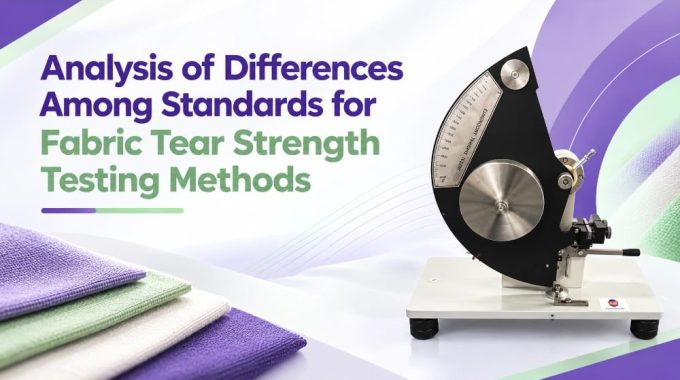
With the exception of the pendulum-impact method, the other four test methods operate on essentially the same principle: the two ends of a specimen are secured into upper and lower clamps, and a tensile testing machine is used to apply a pulling force, causing the specimen to tear along the direction of a pre-cut slit; the tearing force is then calculated. The pendulum-impact method, however, utilizes different equipment and operates on a slightly different principle: the specimen is secured in a fixture and a slit is made in it; a pendulum is then released, causing the specimen to tear along the direction of the slit. The work performed to tear the fabric over a specific distance is ultimately converted into a tearing force value.
Test Equipment
The tearing properties of fabrics can be determined using two different types of instruments: the pendulum-type tester and the constant rate of extension (CRE) tester (see Table 2). When using a pendulum-type impact tester in accordance with GB/T 3917.1, care must be taken in selecting the mass of the pendulum; the mass should be chosen such that the test results fall within 15% to 85% of the full-scale range of the corresponding scale. For the methods described in parts 2 through 5 of the standard, a constant rate of extension (CRE) tester is used with a tensile speed of 100 mm/min. Depending on the shape of the specimen, different gauge lengths are applied. Additionally, the width of the clamps must be selected appropriately, ensuring that the clamp width is no less than the width of the specimen.
| Standard No. | Instrument | Parameter Requirements |
| GB/T 3917.1 | Pendulum-type testing machine | Select the pendulum mass such that test results fall within 15%–85% of the full-scale range of the corresponding scale. |
| GB/T 3917.2 | Constant-rate-of-extension (CRE) testing machine | Extension speed: (100±10) mm/min; gauge length: (100±1) mm; clamp width: preferably 75 mm, and must not be less than the width of the specimen. |
| GB/T 3917.3 | Constant-rate-of-extension (CRE) testing machine | Extension speed: 100 mm/min; gauge length: (25±1) mm; clamp width: sufficient to grip the entire width of the specimen. |
| GB/T 3917.4 | Constant-rate-of-extension (CRE) testing machine | Extension speed: (100±10) mm/min; gauge length: (100±1) mm; clamp width: preferably 200 mm, and must not be less than the width of the specimen. |
| GB/T 3917.5 | Constant-rate-of-extension (CRE) testing machine | Extension speed: (100±10) mm/min; gauge length: (100±1) mm; clamp width: preferably 100 mm, and must not be less than 75 mm. |
Table 2 Instruments and parameters for 5 types of tearing strength test methods
Specimen preparation
The five test methods for tear strength have consistent requirements regarding the number of specimens. For each method, two sets of specimens must be prepared: one set in the warp direction and the other in the weft direction. For materials other than woven fabrics, the corresponding directional terms—such as “longitudinal” and “transverse”—are used. With the exception of the trapezoidal tear test (where specimens should not be taken from the edge of the fabric), each of the other four methods requires at least five specimens per set, or a greater number as agreed upon. No two specimens within a set may contain the same yarns along their length or width. Furthermore, specimens must not be taken from within 150 mm of the fabric edge.
The required shape and dimensions for the specimens vary across the five tear strength test methods; specific details are illustrated in Figures 1 through 5. When preparing the specimens, particular attention must be paid to the orientation: for GB/T 3917.1 and GB/T 3917.3, specimens with the short side parallel to the warp direction are classified as “weft-direction” tear specimens, while those with the short side parallel to the weft direction are “warp-direction” tear specimens. Conversely, for GB/T 3917.2, GB/T 3917.4, and GB/T 3917.5, specimens with the long side parallel to the warp direction are classified as “weft-direction” tear specimens, and those with the long side parallel to the weft direction are “warp-direction” tear specimens. Testing personnel should exercise care to distinguish between these orientations and avoid confusion.


Test Procedure
Depending on the testing equipment used, the five tear-testing methods can be categorized into two operational approaches: the falling-pendulum method and the constant-rate-of-extension (CRE) method. For the falling-pendulum method, an appropriate pendulum mass must be selected before testing; once the specimen is secured, the pendulum is released, and the tearing force is recorded. Across all five methods, specimens must be mounted such that the direction of the pre-cut (slit) is either parallel or perpendicular to the direction of the applied force. According to GB/T 3917.3, a test is considered valid only if the tear propagates along the line of the initial cut; otherwise, the result is not recorded. For the other four methods, a test is considered valid only if there is no yarn slippage from the fabric, no specimen slippage from the clamps, and the tear is complete and proceeds along the direction of the applied force. If a test fails to meet these validity criteria, the result must be discarded. If the results for three or more out of five specimens are discarded, the method is deemed unsuitable for that particular sample. In cases where a fabric exhibits “anomalous” (non-directional) tearing, it is advisable to switch to a different test method. Among the five available methods, the trapezoid (trapezium) test is applicable to the vast majority of woven fabrics; however, it should be noted that the tearing force results obtained from these five methods are not directly comparable.
Data Processing
There are five methods for calculating tear strength results, ranging from direct measurement via the pendulum impact test to manual calculation, electronic computation, and the use of electronic data loggers. While the calculation procedures differ among these five methods, the final results are expressed in a consistent format: the arithmetic mean of the tear strength values obtained from five specimens in each direction, reported to two significant figures. Where required, the coefficient of variation (calculated to a precision of 0.1%) and the 95% confidence interval should also be determined.
Conclusion
As the analysis above demonstrates, the five test methods for the tearing strength of textiles differ significantly in terms of their underlying principles, required equipment, specimen preparation, test procedures, and data processing. Among these, the impact pendulum method (GB/T 3917.1) and the trouser-shaped specimen method (GB/T 3917.2) are the most frequently used in product standards, while the trapezoidal specimen method (GB/T 3917.3) is applicable to the widest range of fabric types.
Because different tearing strength test methods yield different performance metrics, the results obtained from these methods are not directly comparable. Manufacturers should select the most appropriate test method based on the intended end-use environment and the target user group; in cases of uncertainty, testing can be conducted using various methods based on different underlying principles. Furthermore, manufacturers are encouraged to employ multiple approaches to monitor product performance, thereby ensuring consistent product quality.
Reference: China Fiber Inspection (2022 No. 11)— “Analysis of Differences Among Standards for Fabric Tear Strength Testing Methods”. If any copyright infringement is detected, please contact us.