Determination of fabric tearing strength by the impact pendulum method
Throughout the textile wet processing—from pretreatment to finishing—fabrics are subjected to various chemical agents, such as acetic acid, caustic soda, hydrogen peroxide, and sodium hydrosulfite. These substances can cause irreversible damage to the fabric’s internal structure, necessitating targeted strength testing.
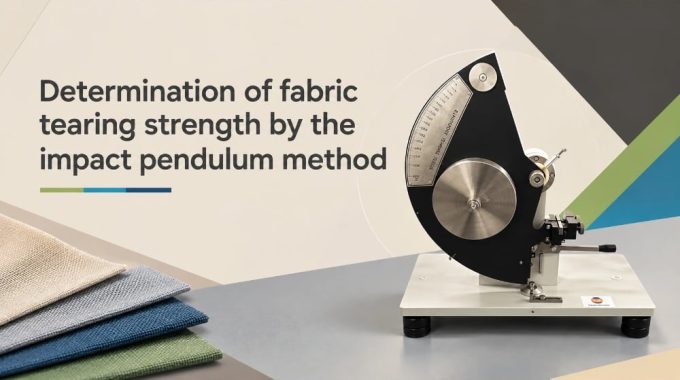
Tear strength is a key indicator of the physical performance of woven fabrics. “Tearing” refers to the phenomenon where localized yarns within a fabric are subjected to a concentrated load, causing the material to rip. During actual wear, certain parts of a garment may be subjected to sudden tearing forces, where localized external stress causes the individual yarns within the fabric to reach their breaking point one by one. Because tear strength tests provide an objective assessment of how textiles might behave when subjected to sudden tearing during actual use, this metric serves as a crucial parameter in the testing of woven fabrics. The impact pendulum method (ASTM D1424–09) is the most common approach for measuring tear strength; it is a rapid test that requires relatively small specimen sizes.
Tear Strength Test – Impact Pendulum Method
1.1 Test Scope
The ASTM D1424—09 method specifies the procedure for determining the tearing strength of fabrics using an impact pendulum apparatus. This method is applicable to woven fabrics as well as fabrics produced by other techniques; however, it is not suitable for woven elastic fabrics, knitted fabrics, or fabrics with significant differences in strength between the warp and weft directions—such as open-structure (sparse) fabrics—where the tear may deviate from the intended path (tear transfer). For warp-knitted fabrics, this standard can only be used to measure tearing strength in the warp direction; it is not suitable for measuring tearing strength in the weft direction. Other types of knitted fabrics (excluding warp-knitted fabrics) are also unsuitable for testing under this standard.
1.2 Test Principle
The specimen is secured in the clamps, and a pre-cut (notch) is made in it. A pendulum, positioned at its point of maximum potential energy, is then released. As the movable clamp moves away from the fixed clamp, the specimen is torn along the direction of the notch. The work done to tear the fabric over a specific distance is then converted into a tearing force.
1.3 Instruments, equipment, reagents, and materials
(1)Elmendorf Tearing Strength Tester

Instrument Features: Equipped with interchangeable weights to accommodate measurements across different force ranges; features a high-precision tearing blade, ensuring a tear length of (43 ± 0.5) mm.
Accessories: Type A pendulum weight (1,600 g) and Type B pendulum weight (6,400 g).
The maximum error for any tearing strength value displayed or recorded within the instrument’s operating range shall not exceed ±1%.
(2) See Figure 1 for the specimen template (units in mm).

1.4 Health and Safety Information
(1)Personnel must adhere to safe operating practices and employ safe, appropriate methods during testing.
(2) Do not touch the equipment while it is in operation to avoid injury.
1.5 Specimen preparation
(1)Rules for sample selection: In general, for initial sampling and testing, the quantity of samples required for testing should be selected according to the table below.
| Number of rolls/sheets per production batch | Number of rolls/sheets to be sampled for testing |
| 1–3 | Test all |
| 4–24 | 4 |
| 25–50 | 5 |
| >50 | Sample approximately 10% (up to a maximum of 10 rolls/sheets) for testing |
(2) Sampling: Cut a 1-yard full-width specimen from each roll of fabric for testing, ensuring that the sample is not taken from the outermost or innermost layers.
(3) Test Specimens: Condition the samples until they reach equilibrium in an environment with a temperature of (20±1)°C and a relative humidity of (65±2)%; all preparation and testing must be conducted under these conditions. The procedure is as follows: Place a template on the fabric and use scissors to cut two sets of five specimens each—one set in the warp direction and the other in the weft direction. No two specimens should contain the same warp or weft yarns. Avoid creases, edges, and any non-representative areas of the fabric (generally, specimens should be taken at least 150 mm away from the selvage) using the trapezoidal sampling method. For woven fabrics, each specimen must be cut such that its short side is parallel to either the warp or the weft yarns. A tear occurring when the short side of the specimen is parallel to the warp direction is termed a “weft-direction tear,” while a tear occurring when the short side is parallel to the weft direction is termed a “warp-direction tear.” Mark the warp direction on each specimen using a small arrow. The long side of the specimen represents the testing direction (e.g., if the long side is parallel to the weft, the weft-direction tearing force is measured).
1.6 Test Steps
(1) Check that the instrument is level and adjust it to the zero position.
(2) Check the pendulum; it should be able to swing freely, completing more than 20 oscillations.
(3) Ensure that the pointer does not slide automatically from any given position.
(4) The upper edge of the cutter blade must be positioned below the top surface of the clamps; it should be capable of automatic resetting, and the cut must be centered exactly between the two clamps.
(5) Verify the length of the cut: secure a piece of paper (used as a proxy for the fabric) in the clamps, perform the cut, and use a vernier caliper to measure the cut length, which should be (20 ± 0.5) mm.
(6) Use a vernier caliper to verify that the distance between the clamps is (2.5 ± 0.25) mm.
(7) Using a specialized force-measuring calibration tool, check the scale accuracy at the 20%, 50%, and 80% marks; the permissible error range is ±1%.
(8) Select an appropriate pendulum mass (1,600 g or 6,400 g) so that the test results fall within the 20%–80% range of the scale.
(9) Check that the instrument is level and adjust it to the zero position.
(10) Set the pendulum to its initial position.
(11) Secure the specimen in the clamps, ensuring its long edge is parallel to the tabletop. The specimen should be clamped evenly between the fixed and movable clamps, with the specimen’s notch facing upward.
(12) Quickly depress the cutter handle to create a 20 ± 0.5 mm cut along the centerline of the specimen.
(13) Press the pendulum release button to allow the pendulum to swing and tear the specimen. Catch the pendulum as it swings back to prevent disturbing the pointer’s position. Verify that the pointer has landed within the acceptable range on the scale, and record the value indicated by the pointer on the pendulum’s scale. (14) Observe whether the tear propagates in the direction of the applied force and whether the yarns slip out from the fabric rather than being torn. If the fabric does not slip from the clamps and the tear proceeds in the direction of the force, the test is considered valid; otherwise, the result should be discarded. If three or more of the five test specimens are discarded, this test method is not applicable.
1.7 Test results
(1) Multiply the scale reading indicated by the pointer on the pendulum by the mass value marked on the pendulum (1,600 g or 6,400 g) to obtain the tearing force; record this value (rounded to the nearest 1 g).
(2) Calculate the mean tearing force for the specimen in the warp and weft directions, respectively, expressed in pounds (rounded to the nearest 0.1 lbf; 1 lbf = 4.45 N).
1.8 Test Report
The report shall include, at a minimum, the following information: the standards applied for testing, the date and location of the test, specific details for each test specimen, the mean tear force, and any deviations from the test method or anomalous occurrences.
Note: A tear occurring within the notched area is considered a “normal” tear. If the tear propagates elsewhere or occurs outside the notched area, it is classified as an “anomalous” tear. Data from such anomalous tears are considered invalid; they shall not be included in the report but instead noted as “Untearable in this direction.” The image below illustrates one example of a normal tear and two common types of anomalous tears, provided to help prevent the collection of invalid data in future experiments.

Test Results
2.1 Test specimen
Three fabric samples were selected; see Table 1 for their specific specifications.
Table 1 Sample Specifications
| Sample | Weave | Warp Yarn Linear Density (tex) | Weft Yarn Linear Density (tex) | Areal Density (g⋅m⁻²) | Fabric Density (threads per 2.54 cm) |
| Polyester-cotton fabric | Twill | 87.9 | 83.9 | 471 | 74×47 |
| All-polyester fabric | Plain | 80.4 | 70.4 | 75.5 | 148×91 |
| All-cotton fabric | Twill | 16.2 | 28.5 | 191 | 145×74 |
2.2 Test method
The three fabric samples mentioned above were subjected to tear testing in both the longitudinal and transverse directions in accordance with the ASTM D1424-09 standard; the test results are presented in Table 2.
Table 2 Results of longitudinal and transverse tear tests
| Sample | Tear Strength / N (Warp) | Tear Strength / N (Weft) |
| Polyester-cotton fabric | 39.6 | 32.0 |
| 100% polyester fabric | 17.8 | 11.6 |
| 100% cotton fabric | 7.1 | 8.46 |
Conclusion
Analysis of the results from the pendulum-type impact tear test reveals that a higher yarn linear density (tex) in a fabric correlates with greater tear strength. Among the three fabric samples tested, the polyester-cotton blend—which featured the highest yarn linear density—exhibited the greatest tear strength. Conversely, the all-polyester fabric, despite having the highest fabric density among the samples, showed lower tear strength than the polyester-cotton blend (which had the lowest fabric density). This indicates that both yarn linear density and fabric density are key factors influencing a fabric’s tear strength.
To enhance tear strength, two approaches are recommended: increasing the number of yarns involved in the tear zone and minimizing strength loss during the dyeing and finishing processes.
When warp and weft yarns—as well as their respective densities—are identical, having the same twist direction for both sets of yarns causes the fibers to orient in opposing directions. This increases mutual resistance, hinders yarn slippage, and consequently reduces tear strength. If the twist directions of the warp and weft yarns differ, the fibers tend to align more parallel to one another; this reduces mutual resistance, facilitates yarn slippage, and increases tear strength. This physical principle is applicable to the vast majority of woven fabrics.
Regarding strength loss during dyeing and finishing, oxygen bleaching—specifically using hydrogen peroxide—is a common initial treatment. Stabilizers are typically added to the hydrogen peroxide to prevent rapid, uncontrolled decomposition, which could otherwise damage the fabric. By carefully adjusting the hydrogen peroxide concentration and the level of alkaline agents, one can mitigate strength loss and keep the fabric’s tear strength within an acceptable range. A higher concentration of hydrogen peroxide increases whiteness but also causes greater damage to the fabric (up to a certain saturation point). Alkaline agents are used to maintain a pH range of 10.5–11, ensuring a stable decomposition process and preventing fabric damage—or latent structural impairment—caused by an overly rapid reaction. Furthermore, a softening treatment during the finishing stage can improve tear strength; for fabrics made from synthetic continuous filaments, such treatments enhance yarn slippage, thereby increasing tear strength. For staple-fiber fabrics, softening treatments increase yarn slippage while reducing inter-fiber cohesion. If the reduction in inter-fiber cohesion is minimal, the tear strength may increase; however, if the impact on inter-fiber cohesion is significant, the tear strength will decrease.
Reference: Textile Testing and Standards (2015 No. 3)— “Determination of fabric tearing strength by the impact pendulum method”. If any copyright infringement is detected, please contact us.