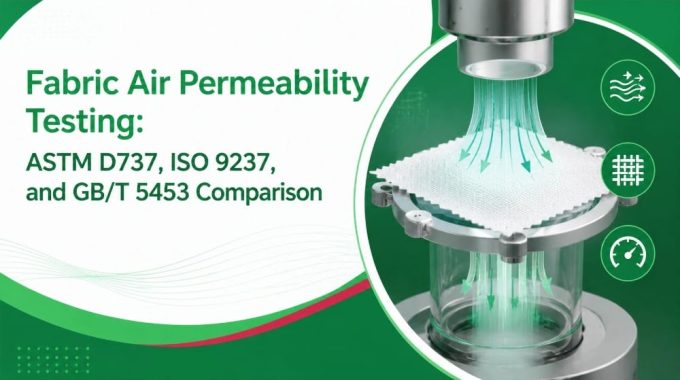
Fabric Air Permeability Testing: ASTM D737, ISO 9237, and GB/T 5453 Comparison
Air permeability refers to a fabric’s ability to allow air to pass through it, a characteristic that directly influences its performance in apparel. For instance, fabrics intended for summer wear require high air permeability, whereas winter fabrics need lower permeability to ensure wind resistance and heat retention. Air permeability is also critical for fabrics used in defense and industrial applications; parachutes, for example, require high permeability, while canvas and sailcloth must balance durability with good air permeability. A fabric’s air permeability is determined by the number and size of the voids between warp and weft yarns and between fibers—factors influenced by warp and weft density, yarn linear density (tex), and twist—as well as by fiber properties, yarn structure, fabric thickness, and bulk density.
The principle behind measuring air permeability involves passing air perpendicularly through the fabric to create a specific pressure differential between its two sides; the volume of air passing through the fabric per unit of time at a given pressure differential defines the air permeability rate. Air permeability is a high-value-added attribute, and the use of breathable fabrics in apparel is attracting increasing attention. However, requirements and testing standards for breathable fabrics vary across countries; common standards include ASTM D737—2004, ISO 9237—1995, and GB/T 5453—1997. To clearly understand the differences between these standards and to provide effective service and technical guidance to the market and customers, further in-depth exploration and applied research into these testing methods are required.
1 Experimental Section
1.1 Materials and Instruments

Fabrics: Silk, cotton, ramie, wool, viscose, polyester, and nylon (staple fiber) interlining fabrics; 300D low-elasticity polyester fabric (base fabric).
Instrument: Air permeability tester.
1.2 Air Permeability Test Methods
The air permeability of the fabrics was measured using GB/T 5453—1997 “Textiles—Determination of the permeability of fabrics to air,” ASTM D737—2004 “Standard Test Method for Air Permeability of Textile Fabrics,” and ISO 9237—1995 “Textiles—Determination of the permeability of fabrics to air,” respectively. Test conditions for the different standards are shown in Table 1.
| Test Standard | Test Area (cm²) | Test Pressure (Pa) | Unit |
| GB/T 5453—1997 | 20 | Apparel fabrics: 100; Industrial fabrics: 200 | mm/s, cm³/(cm²·s) |
| ASTM D737—2004 | 38 | 125 | cfm, ft³/min, cm³/(cm²·s) |
| ISO 9237—1995 | 20 | Apparel fabrics: 100; Industrial fabrics: 200 | dm³/(m²·s), cm³/(cm²·s) |
Table 1 Breathability test standards of different fabrics
1.3 Test Methods

1.3.1 Air Permeability Test
Fabrics were conditioned for 24 hours under a Grade 1 standard atmosphere (temperature: 21 ± 1°C; humidity: 65 ± 2%) prior to testing.
Tests were conducted on each fabric specimen ten times in accordance with three standards, and the average values were calculated.
1.3.2 Coating Finish
Coating finishing involves the uniform application of one or more layers of film-forming polymer onto the fabric surface. Fabrics treated with different coatings can exhibit properties such as water repellency, water pressure resistance, moisture permeability, stain resistance, reflectivity, or flame retardancy. Additionally, the finish can impart specific aesthetic effects—such as pearlescence, dual-sided appearances, or leather-like looks—as well as characteristics like high resilience and an oily or soft hand feel.
Common coating techniques include direct coating, transfer coating, and adhesive coating; the direct coating process was employed in this study.
Process flow:
Paste preparation → Coating → Heat setting (160°C, 60 s) → Cooling
2. Results and Discussion
2.1 Air permeability testing of different fabrics using different standards
An air permeability tester was used to measure the air permeability of the fabrics in accordance with GB/T 5453—1997 and ASTM D737—2004, respectively.
For GB/T 5453—1997, the pressure was 100 Pa and the test area was 20 cm²; for ASTM D737—2004, the pressure was 125 Pa and the test area was 38 cm².
The correspondence between the two standards was investigated, and the results are presented in Table 2.
| Specimen | ASTM D737—2004 Air Permeability R1(m³·s⁻¹·cm⁻²) | GB/T 5453—1997 Air Permeability R2(cm³·s⁻¹·cm⁻²) | Correlation |
| Base fabric | 4.8 | 3.4 | R1= 1.41 R2 |
| Silk interlining | 18.7 | 15.2 | R₁ = 1.23 R2 |
| Wool interlining | 47.8 | 35.0 | R₁ = 1.37 R2 |
| Nylon interlining | 52.6 | 37.0 | R₁ = 1.42 R2 |
| Viscose interlining | 52.0 | 46.0 | R₁ = 1.13 R2 |
| Cotton interlining | 53.8 | 47.0 | R₁ = 1.14 R2 |
| Ramie interlining | 104.3 | 82.5 | R₁ = 1.26 R2 |
| Polyester interlining | 73.0 | 59.0 | R₁ = 1.23 R2 |
| Average value | – | – | R₁ = 1.27 R2 |
Table 2 The results of different standards
As shown in Table 2, the test results from the two standards exhibit a certain correlation (η = 1.27), which aligns essentially with the ratio of the pressure increase (125:100). Accounting for factors such as uneven fabric thickness and the randomness of sampling, the relationship is adjusted to R₁ = 1.25R₂. Air permeability varies depending on the fabric type; generally, fabrics made from natural fibers—such as cotton-linen blends and viscose—exhibit better air permeability than those made from synthetic fibers like polyester and nylon. Fabric material is one of the factors influencing air permeability. Although both the polyester interlining and the base fabric are made of polyester, the base fabric has a tighter weave structure, resulting in lower air permeability compared to the interlining. Thus, fabric structure is also a factor affecting air permeability.
2.2 Effect of specimen area on air permeability
Test areas of 20 cm² and 38 cm² were selected, and tests were conducted at pressures ranging from 100 to 200 Pa to investigate the effect of test area on fabric air permeability; the results are shown in Table 3.
| Pressure / Pa | 20 cm² Air Permeability R1(m³·s⁻¹·cm⁻²) | 38 cm² Air Permeability R2(cm³·s⁻¹·cm⁻²) |
| 100 | 40.5 | 40.6 |
| 125 | 45.8 | 47.8 |
| 150 | 54.4 | 55.6 |
| 200 | 71.5 | 69.0 |
Table 3 Effect of testing area on permeability of the fabrics
As shown in Table 3, for a given test area, the air permeability of the fabric increases with rising pressure; conversely, when the pressure is constant, the air permeability remains unaffected by the test area.
Based on the data in Tables 2 and 3, the results obtained from testing under various conditions of area and pressure indicate that air permeability is determined by the pressure applied, whereas the size of the test area is not a primary influencing factor.
2.3 Effect of coating treatment on fabric air permeability
Using the method specified in GB/T 5453—1997—with a pressure of 100 Pa and a test area of 20 cm²—tests were conducted on 300D low-elasticity polyester fabric (base fabric) subjected to coating treatment to investigate the effects of mass per unit area and thickness on air permeability; the results are presented in Table 4.
| Fabric | Uncoated | First coating | Second coating | Third coating |
| Mass per unit area / (g·m⁻²) | 150 | 158 | 170 | 182 |
| Air permeability / (mm·s⁻¹) | 110.0 | 10.5 | 2.2 | 1.3 |
Table 4 Effect of fabric mass per unit area and thickness on air permeability
As shown in Table 4, the air permeability of the coated fabric decreases as the mass per unit area and thickness of the fabric increase.
This is because the coating finish forms a tough film on the fabric surface, increasing both thickness and weight; this seals the surface voids, thereby reducing the fabric’s air permeability.
2.4 Correlation between different air permeability units
Standard cotton, silk, and wool backing fabrics were selected and tested using an air permeability tester in accordance with the ISO 9237–1995 standard; the measured air permeability rates for the different fabrics are presented in Table 5.
A linear relationship with a factor of 1.25 exists between the test results obtained via GB/T 5453–1997 and ASTM D737–2004.
With the test area held constant, fabric air permeability increases as pressure increases; the test area is not a primary factor influencing fabric air permeability.
| Fabrics | mm/s | L/(m²·s) | L/(dm²·min) | cm³/(cm²·s) | cfm | m³/(m²·min) | in³/(in²·h) | dm³/(m²·s) |
| Cotton interlining | 942.5 | 943.0 | 564.5 | 93.3 | 188.5 | 56.3 | 3393 | 1.8 |
| Silk interlining | 300.6 | 300.0 | 179.7 | 30.4 | 60.0 | 18.2 | 1086 | 0.6 |
| Wool interlining | 700.1 | 698.6 | 419.9 | 71.5 | 139.2 | 42.0 | 2024 | 1.4 |
Table 5 The relationship among the different units of fabric permeability
As shown in Table 5, air permeability values for different fabrics vary depending on the units used, yet they exhibit a consistent correlation.
Based on this correlation, a customer can convert any given air permeability value to determine the airflow rate in their required unit.
3 Conclusions
(1) Standards for testing textile air permeability differ in terms of scope, test area, pressure, and test conditions. GB/T 5453—1997 is equivalent to the commonly used ISO 9237—1995; a linear relationship with a factor of 1.25 exists between the test results of GB/T 5453—1997 and ASTM D737—2004. When the test area remains constant, fabric air permeability increases with rising pressure; the test area is not a primary factor influencing fabric air permeability.
(2) Air permeability rates vary according to the units of measurement used; however, conversion allows for the determination of the rate corresponding to a specific unit.
(3) Air permeability differs among fabrics under identical conditions. Fabrics made from natural fibers—such as cotton, linen, and viscose—exhibit better air permeability than those made from synthetic fibers like polyester and nylon.
(4) Fabrics without coating finishes demonstrate significantly better air permeability than those with coating finishes.
Reference: Dyeing & Finishing (2017 No. 15)— “Testing methods for air permeability of textiles” If any copyright infringement is detected, please contact us.