Comparison of Test Methods for Fuzzing and Pilling of Woven Fabrics
In daily life, garments often develop fuzz or pills on specific areas or across the entire fabric after a period of wear; consequently, fabric pilling resistance testing has become increasingly important and widespread, as it directly affects the aesthetic appeal and consumer acceptance of the final product. Among US standards, the most commonly used method is ASTM D 3512, “Standard Test Method for Pilling Resistance and Other Related Surface Changes of Textile Fabrics: Random Tumble Pilling Tester” (hereinafter referred to as ASTM D 3512). European standards primarily utilize two methods: ISO 12945-1, “Textiles—Determination of fabric propensity to surface fuzzing and to pilling—Part 1: Pilling box method” (hereinafter referred to as ISO 12945-1), and ISO 12945-2, “Textiles—Determination of fabric propensity to surface fuzzing and to pilling—Part 2: Modified Martindale method” (hereinafter referred to as ISO 12945-2). The most common Chinese national standard is GB/T 4802.1–2008, “Textiles—Determination of fabric propensity to surface fuzzing and to pilling—Part 1: Circular locus method” (hereinafter referred to as GB/T 4802.1). This study employs the four aforementioned methods to test the pilling resistance of two types of fabrics and compares the results.
Test

Experimental materials
No. 1#: 100% cotton woven fabric, areal density of 118 g/m²
No. 2#: 100% polyester woven fabric, areal density of 59 g/m²
Instruments and equipment
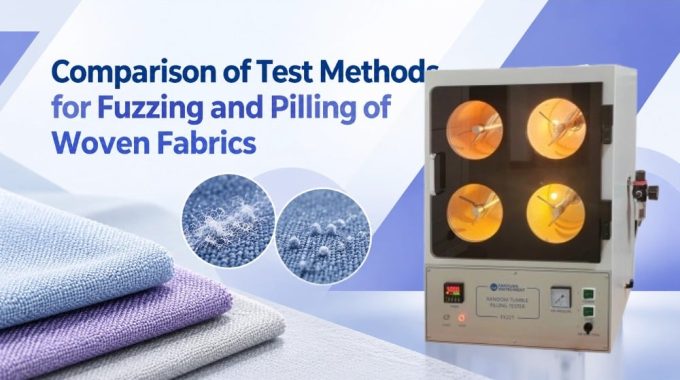
Martindale abrasion and pilling tester, YG502 fabric pilling tester, ICI pilling box tester, random tumble pilling tester.
Test Principle
ASTM D 3512 employs a random tumble pilling tester in which the fabric specimen is tumbled and rubbed randomly within a cylindrical chamber lined with cork and containing a small amount of short gray cotton slivers. Test results are subjectively rated by comparing them against standard photographs under a specified light source.
ISO 12945-1 involves mounting the specimen onto a polyurethane tube and tumbling it randomly inside a cork-lined wooden box rotating at a constant speed. After a specified number of revolutions, the pilling and fuzzing performance is subjectively rated.
ISO 12945-2 involves rubbing a circular specimen against a fabric of the same material or a wool fabric under a specific pressure, following a defined geometric pattern—specifically a Lissajous figure trajectory (moving from a straight line to an ellipse and then to a straight line in the opposite direction). After reaching the specified number of revolutions, the pilling and fuzzing grade of the specimen is assessed under standard visual conditions.
GB/T 4802.1 subjects the specimen to friction to induce pilling and fuzzing using a nylon brush and a fabric abrasive, or a fabric abrasive alone, in accordance with specified methods and test parameters. The pilling and fuzzing performance is then subjectively rated under a specified light source.
Results and Discussion

Pilling resistance testing is conducted under standard atmospheric conditions—specifically, a temperature of (21 ± 1)°C and a relative humidity of (65 ± 2)%—and requires the samples to be conditioned under these conditions for at least 48 hours prior to testing.
ISO 12945-1
Cut four specimens from the sample, each measuring 125 mm × 125 mm. Mark the reverse side and the longitudinal direction (warp direction) on each specimen. Cut an additional 125 mm × 125 mm specimen to serve as a reference standard for rating.
Take two specimens and fold each with the face side inward; sew them 12 mm from the edge—using a stitch density that ensures a balanced seam—to form a tube, with the fold aligned to the longitudinal direction of the fabric. Take the remaining two specimens and sew them into tubes in the same manner, but with the fold aligned to the transverse direction (weft direction) of the fabric. Turn the sewn tubes inside out so that the face side of the fabric forms the exterior of the tube. Cut a 6 mm slit at each end of the tubes, then mount the prepared tubes onto polyurethane specimen holders, ensuring the ends of the specimens are equidistant from the ends of the polyurethane holders and that the seam area is as smooth as possible. Secure each specimen tube to the polyurethane holder by wrapping PVC tape around both ends, leaving 6 mm of the polyurethane holder exposed at each end.
Place the four mounted specimen assemblies into the same pilling box, close the lid securely, start the instrument, and rotate the box for 14,400 revolutions.
ISO 12945-2
Prepare three sets of samples; each set consists of two 140 mm diameter specimens and one 140 mm diameter wool felt pad. Place one 140 mm specimen face-up on the felt pad of the friction disc. Place the other 140 mm specimen face-out on the specimen holder, which is lined with a 140 mm felt pad. After positioning the specimen holder on the friction disc, insert the connecting shaft, apply a 415 g load, and subject the assembly to 1,000 revolutions. Subsequently, perform the rating using a rating box located in a darkroom. Place the tested specimen and an untested specimen side-by-side along the lengthwise direction of the fabric in the center of the rating box’s specimen panel, with the tested specimen on the left and the untested specimen on the right. Evaluate the specimen’s grade by viewing it downwards at a 45° angle, utilizing two standard grades or cards for comparison; if the appearance of the tested specimen falls between two standard grades, an intermediate grade may be assigned. Test three samples and calculate the average grade.
ASTM D 3512
Install the cork liner inside a clean test chamber. Place three specimens and 25 mg of short gray cotton fibers into each chamber, ensuring the fibers are dispersed freely. Secure the lid, set the timer to 30 minutes, and turn on the air compressor. Adjust the compressor’s air valve until the machine’s pressure gauge reads between 6.895 and 20.7 kPa, then activate the operating switch to begin the test. After 30 minutes, remove the specimens from the chamber, clear away any excess matted lint, and clean the chamber. Rate the tested specimens by visually comparing them to the ASTM D standard photographs for fuzzing and pilling, viewing them from above at an angle of approximately 45 degrees inside a light box. If the specimen’s surface appearance falls between two grades, a half-grade rating may be assigned. Test two specimens each from the warp and weft directions, and calculate the average grade based on the four specimens.
GB/T 4802.1
Cut five circular specimens from the sample, each with a diameter of (113 ± 0.5) mm. Mark the face and back of each specimen, and set aside an additional specimen of the same size as a reference for rating. Mount the foam pad, specimen, and fabric abrasive onto the test holder and abrasion table, respectively, with the face of the specimen facing outward. Apply a pressure of 490 cN; perform 10 cycles for fuzzing and 50 cycles for pilling, then remove the specimens for rating.
Test results
Table 3 presents the pilling resistance test results for the same fabrics obtained using the four aforementioned test methods.
As shown in Table 3, for the same fabric, the pilling resistance grade determined by the ISO 12945-2 Martindale method is half a grade lower than those obtained via the ASTM D 3512 Random Tumble method, the ISO 12945-1 Pilling Box method, and the GB/T 4802.1 Brush method; this indicates that the ISO 12945-2 Martindale method is the most stringent of the four.
Table 3: Pilling resistance test results for samples #1 and #2 under different standards
| Standard | Pilling resistance grade (Sample #1) | Pilling resistance grade (Sample #2) |
| GB/T 4802.1 | 4.5 | 4.5 |
| ISO 12945-1 | 4.5 | 4.5 |
| ISO 12945-2 | 4.0 | 4.0 |
| ASTM D 3512 | 4.5 | 4.5 |
Currently, the ISO 12945-2 Martindale method is generally selected for pilling resistance testing of woven products exported to Europe, whereas the relatively gentler ISO 12945-1 Pilling Box method is mostly used for knitted products. Products exported to the Americas predominantly utilize the ASTM D 3512 Random Tumble method, while the GB/T 4802.1 Brush method is most commonly used domestically. Although current practice favors relatively gentler pilling test methods, this can lead to situations where products yield good test results yet are prone to pilling during consumer use, thereby compromising their performance in wear. Therefore, it is advisable to adopt more stringent testing standards to ensure the quality of the final products sold.
Conclusion
When testing the pilling resistance of the same fabric, the results obtained using the ISO 12945-2 method are lower than those from ASTM D 3512, ISO 12945-1, and GB/T 4802.1. This phenomenon serves as a reminder to manufacturers and sellers to pay attention to the regulatory requirements of relevant customers and countries when supplying products, thereby avoiding unnecessary losses.
Reference: Textile Testing and Standards (2017.03)— “Comparison of Test Methods for Tear Strength and Pilling of Woven Fabrics” .If any copyright infringement is detected, please contact us.