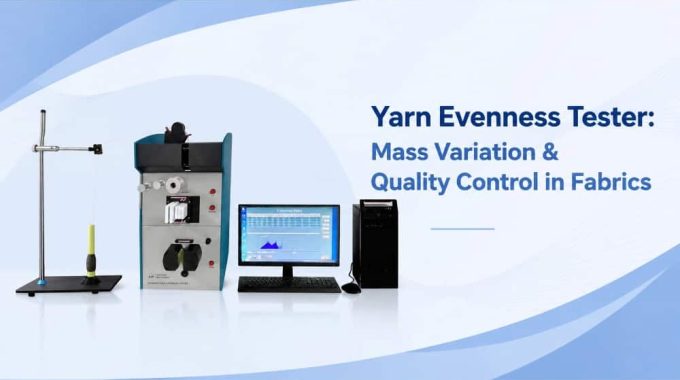
Yarn Evenness Tester: Mass Variation & Quality Control in Fabrics
To check the uniformity and consistency of yarn, sliver, or roving, an Evenness Tester helps to ensure quality. It also detects irregularities, including thin, thick, and rough parts. Sometimes fiber knots cause problems at different stages of the spinning process, and the final fabrics turn out uneven.
Therefore, optical or capacitive sensors detect these variations in Yarn Evenness Testers, which provide information in U%, CV%, and imperfection counts. This article briefly covers the types, uses, and advantages of the Evenness Tester.
What is a Yarn Evenness Tester?
Even if Yarns have the correct count, different parts can still have different masses and diameters. When tested with the Evenness Tester, the moving strand reports weight changes at various points as numbers and metrics.
This tester provides five key metrics after converting fluctuations into electrical signals. These include:
- Overall unevenness of the strand
- Variation of yarn from its average
- Imperfection count
- Hairiness index (loose fibers that split out from somewhere on the surface)
- Finally, pattern identification and irregularity are assessed using spectrogram and curve length area.
This tester requires a specific test speed that varies by yarn type, silver, and roving. Yarn is usually tested at a higher speed of about 25 to 400m/min. For ring-spun cotton yarn, the test speed is 1000 meters at 400m/min. However, for roving or silver, the speed is kept slow due to their weight and thickness.
Principle of Mass Variation Measurement in Yarn Testing
The principle of Mass Variation in Yarn Testing involves checking different sections of the strand to determine whether the amount of material is consistent or varies.
Approximately 1 cm of yarn is passed through this machine for testing, and any weight variation is calculated.
Mass Per Unit Length as the Basis of Evenness Testing
As twisted fibers together form the yarn, there is a possibility of an uneven number of fibers in each section of that twisted pair, including thinner and thicker sections. The tester thus records these changes and tracks evenness.
Then there is CVlim, the theoretical minimum level of irregularity, which states that under ideal conditions, the variation is at its lowest.
CVlim = 100/√n
n = number of fibers in cross section
For example, if a cross section of 30 Ne cotton yarn contains 100 fibers in it, then the equation will be as follows:
CVlim = 100/√100 = 10%
The tester then compares this theoretical value with the actual CV% value. Therefore, a higher value indicates greater irregularity in the yarn than the theoretical minimum.
Relationship Between Yarn Diameter and Mass Variation
Diameter and Mass of Yarn are somehow related, but they are not the same in actual. Diameter is actually about how the yarn looks, while mass per unit length shows how much material a yarn length contains.
Two fiber sections can have the same diameter but more mass if they are tightly packed, and less mass if they are loosely packed. Unevenness most often occurs in bulky, textured fibers.
Capacitance Sensor Technology in Yarn Evenness Testers
When yarn passes through a parallel-plate capacitor, it detects mass changes; this process is called capacitive sensing. When fiber, acting as a dielectric, passes through these plates, it changes the capacitance and produces a voltage signal that represents the linear density.
Working of the Capacitance Sensor
The tester’s measuring head consists of different slots, which are selected during the process based on the yarn count.
After amplifying and filtering the signal, the tester compares it with the running mean. Instead of absolute mass, it shows the difference as a relative deviation, indicating how much it varies from the average.
Moreover, oversized or undersized slots can cause false peaks. Also, it affects accuracy in terms of reduction.
Effect of Fiber Content and Moisture on Capacitive Readings
Compared to dry cellulose, water has a much higher dielectric constant, specifically 3 compared to 80. Controlled testing environments and conditioned samples are crucial because moisture regain strongly affects sensor responses.
Blends make the measurements more difficult. Regain levels and dielectric constants differ between polyester and cotton.
So if the fiber content changes, there is a possibility that the signal may mix composition variation with the mass variation, and the tester may fail to give you the precise difference.
Limitations of Capacitive Measurement
Capacitive measurement has some limitations.
- Capacitive heads cannot measure hairiness because their weight is almost negligible and they contribute very little.
- If two sections are such that one is flat, like a ribbon, and the other is round, a capacitive head will declare both even due to the same mass despite their shapes.
- Thirdly, dielectric readings can be affected by factors such as conductive fibers, high-finish content in heavy oil, or spin finish.
Optical and Filament Evenness Testers
Rather than measuring the mass, the filament evenness tester measures the projected diameter or shadow width. This benefits testing by reducing the effect of moisture and fiber composition on the measurement. That’s how optical sensing proves to be useful for filament, blended, and finish-loaded yarns.
Optical Sensor Working Principle
An optical sensor works by directing a collimated infrared or laser source onto the yarn; the yarn blocks some of the light, producing a shadow. The detector records the shadow width, which is directly proportional to diameter variation, such as yarn thickness and thinness.
Unlike capacitive sensing, optical sensors can measure protruding fiber hairiness using multi-angle optical heads.
Filament Evenness Tester for Synthetic and Continuous Filament Yarns
Continuous filament yarns can be checked using the filament evenness tester. Because of spin finish, low twist, and changes in dielectric properties, readings can be interrupted, resulting in inaccurate capacitive measurements.
Thus, high-speed, fine-resolution optical heads can help detect broken filaments, interlace regularity, and tight spots.
Key results include thickness variation (CV%), denier variation, and periodic faults in POY, FDY, and air-textured yarns caused by godet or texturing disc eccentricity.
Types of Yarn Evenness Testers

Yarn evenness testers fall into two categories: offline laboratory testers and online sensors. Laboratory testers require controlled conditions, while online sensors monitor effectively and continuously during production.
Laboratory System vs. Online Monitoring System
Laboratory systems provide detailed, oriented results, including spectrograms, variance-length curves, imperfections, and hairiness.
Some selected samples are tested in these laboratories, such as 10 bobbins, each 1000 m. Such testing requires an automatic evenness tester with a bobbin changer, reducing manual handling.
Online monitoring systems provide less detailed information; however, they can detect problems. Draw frame auto-levelers and winding machine clearers are online systems that monitor the material during production and act on it in real time.
Testers for Silver, Roving, and Yarn
A capacitive yarn evenness tester handles sliver, roving and spun yarn through interchangeable slots. Silver and roving require slower test speeds of around 25-30m/min and wide-slot capacitive heads, as they are heavier and bulkier.
Before other processes interrupt detection, silver and roving results are used to identify irregularities during blowroom, carding, and drawing.
Short Term, Medium Term and Long Term Yarn Variation Analysis
Yarn variation depends on how long the unevenness lasts. Three types of yarn variation occur at different stages in the spinning process.
Short Term Variation (Within 1- 10 cm)
The smallest change that can occur in the first 1-10 cm of the testing process is called short-term variation. Fiber-level randomness, fiber fineness, and draft wave may cause this variation, which can affect U% and CV%, yarn strength, and breakage rate.
Medium-term Variation (1-10m)
Eccentric rollers, worn aprons, or defective drafting components can cause medium-term variations, usually over longer lengths. Visible streaks and cloudiness in knitted fabric are to be expected due to these irregularities.
Long-Term Variation (Above 10 m)
Variation between packages, silver-mixing errors, or blended inconsistency could cause long-term variation. These variations can result in barreé and shade-bending in woven and knitted fabrics.
Variance-Length Curve Explained
When you analyze materials of different lengths, the variance-length curve shows how changes are reflected in the CV%. By comparing the actual results with the Martindale curve, you can determine the length at which the production process becomes irregular.
Spectrogram Analysis and Periodic Faults
A spectrogram breaks the mass signal into different wavelength patterns and identifies repetitive patterns called periodic faults or chimneys. These chimneys can identify defective machine elements once you divide their wavelength by the total draft downstream.
Yarn Imperfections Detected by Evenness Tester

The evenness tester counts and detects imperfections when they cross a preset sensitivity threshold relative to the mean yarn mass, measured per 1000 meters.
Thin Places
During weaving, thin places due to low mass can increase end breakage, with -50% commonly used as the standard threshold.
Thick Places
Because of increased mass in short sections, thick places can result from fiber bunches or poor drafting control. At various sensitivity levels, they can be reported as +35%, +50%, and +70%.
Neps
Neps are actually entangled knots with increased mass, 1-3 mm long, counted at +140 %, +200 %, and +280%.
Hairiness Index
Hairiness (H) basically measures the total length of protruding fibers around the yarn, which can affect the fabric handle, pilling, and weaving performance.
Dust and Trash Content
Small dust and trash particles are detected and counted by optical trash channels, helping to evaluate cleaning efficiency in blowroom and carding.
Standards for Yarn Evenness Testing
To ensure testing is conducted under the same conditions across mills and laboratories, follow standards.
ASTM Standard Test Methods ( ASTM D1425)
This standard provides testers with information on slot selection, test speed, test duration, and U% and CV% calculations.
ISO and Other International Standards
To measure yarn irregularity using capacitance, ISO 16549 is the relevant standard. ISO 2649 addresses the evenness of textile strands, and ASTM D2255 compares the yarn with standard photographic board to check its visual appearance.
Standard Atmospheric Test Conditions
Standard atmospheric conditions include a controlled temperature of 20 ± 2 °C and a relative humidity of 65 ± 4% (ASTM specifies 21 ± 1 °C, 65 ± 2%).
What Causes Yarn Unevenness?
Fibers, machinery, and incorrect process settings can cause yarn unevenness. Irregularities can increase for various reasons, including worn rollers, short fibers, damaged aprons, incorrect draft, and poor autoleveller settings.
Uses and Applications of Yarn Evenness Testers
Yarn Evenness testing is a great diagnostic tool and also serves as a quality gate to identify unevenness.
Quality Control in Yarn Production
These testers check CV%, hairiness, and imperfections against the Uster Statics Percentile Bands for quality standards.
Process Troubleshooting in Spinning Mills
It can identify faults in the process and machines.
Prediction of Fabric Appearance in Barré
Before weaving or knitting begins, it can detect possible streaks.
Setting Clearer Limits for Automatic Winding Machines
For automatic winding machines, they help set suitable limits, such as which faulty parts to remove.
Research and Product Development
To achieve better results, these testers let you compare different machines, fibers, and settings.
Advantages of Yarn Evenness Testers
- First, these testers enable fast, non-destructive testing.
- You can get objective, numerical results.
- These testers let you measure imperfections, hairiness, and irregularities.
- The variance length curve and spectrogram can help identify faults.
- With appropriate sensor heads, these testers can test silver, roving, spun yarn, and filament yarn.
Disadvantages of Yarn Evenness Testers
- Proper calibration is required to run the testing, and it can be expensive.
- Moisture regain, blend ratio, and spin finish can affect the capacitive heads.
- Humidity and Temperature are both factors that require attention.
- Not every package includes sample testing.
- The exact cause of the fault is difficult to identify based on CV%.
Conclusion
A yarn evenness tester using capacitive and optical sensing provides quality data by measuring changes in mass or diameter. Under the right testing conditions, it can identify unevenness. This tester, using a spectrogram and a variance-length curve, can detect all faults in the spinning process.