
Yarn Crimp Tester: Complete Guide to Testing Crimp in Textile Fabrics
A yarn crimp tester is a special testing instrument in the textile industry that tells you the ‘crimp’ percentage or crimp ratio of yarns. Crimp here can be defined as the waviness that yarns have because of interlacing during the weaving process.
The crimp tester relies on the individual warp extracted and placed into the tester grip, where the yarn is pulled to straighten the yarn, and the length is measured. It has many functions and supports fabric design, yarn consumption estimations, and quality control in textiles.
What Is Yarn Crimp?

A yarn crimp is the waviness of the woven yarn. This is because when warp and weft yarns interlace during weaving, they don’t weave in straight lines, but each yarn bends over and under the crossing yarns, which introduces the wavy corrugated path of weaving. The waviness in the yarn is called crimp.
A more technical definition of yarn crimp is the percentage excess of the yarn axis length over the cloth length. You can imagine the length of the fabric and then the length of the yarn, which has to be larger than the fabric’s length because of the waviness.
Don’t confuse crimp as a defect; it is a property that controls fabric performance and yarn consumption in factories.
Crimp in Warp vs. Weft Yarn: Key Differences
In a woven fabric, warp yarns run lengthwise and are continuously stretched or under tension on the loom. These warp yarns are more uniform and stronger because they have to resist the abrasion during the weaving process.
Weft yarns are also called filling yarns, and by contrast are inserted under no tension and often use specialty yarns because they must bend over and under every warp yarn across the width of the fabric. Weft yarns have more crimp.
| Parameter | Warp Yarn | Weft Yarn |
| Tension during weaving | High | Low |
| Typical crimp % | Lower | Higher |
| Yarn quality | Stronger, higher twist | Lower twist, specialty possible |
| Sizing applied? | Yes | No |
Understanding Crimp Percentage
Crimp percentage, shortened to crimp, is the difference between the straightened thread length and the distance between the ends of that thread, expressed as a percentage of the in-fabric length.
Crimp% = [L-S] / S] x 100
L – Straightened yarn length
S – in-fabric (carimped) length
Crimp Ratio and Crimp Amplitude Explained
Crimp ratio is the ratio of yarn length to the fabric length produced from that yarn. For example, if 100 m of yarn produces 50 m of fabric, the crimp ratio = 2.0.
This tells you 2m of yarn is consumed per meter of fabric. A higher crimp ratio indicates greater waviness and more yarn consumption.
Crimp amplitude refers to the extent to which a yarn deviates from the central plane of the cloth. A higher crimp altitude means your yarn protrudes further from the fabric surface, which means your fabric feels different, and it also affects abrasion resistance.
Key Crimp Properties Measured in Textile Testing
| Property | Description |
| Crimp Percentage (%) | Mean difference between straightened and in-fabric yarn length, as a percentage |
| Crimp Ratio | Ratio of yarn length to fabric length produced from that yarn |
| Crimp Amplitude | Degree of thread deflection from the central plane of the cloth |
| Crimp Frequency | Number of crimp waves per unit length of yarn |
| Crimp Stability | Resistance of the crimp structure to deformation under load |
| Crimp Elongation | The extension of the yarn as crimp is progressively removed under tension |
| De-crimping Point | Tension level at which the yarn begins to stretch beyond its elastic limit |
| Crimp Contraction | Reduction in yarn length when tension is released after stretching |
How a Crimp Tester Works: Step-by-Step
A yarn crimp tester extracts a yarn from a fabric of known length, straightens it under tension, and measures the straightened length to compute the final crimp percentage.
- Select the test direction (choose warp or weft) and cut a fabric strip of known length. The standard is to use at least 5 threads per direction, and 10 provides a greater confidence in the final result.
- Use a dissecting needle to separate the central portion of the thread from the fabric fringe. Be careful not to remove the twist.
- Transfer the thread to the crimp tester: Place one end in the fixed grip and the other in the movable grip. The yarn should be placed as carefully as possible without altering the twist in the yarn.
- Enter the tension value based on the yarn count and type. Machines like the FYI Crimp tester provide a user-friendly interface and standardized tension tables. Apply the tension gradually until the yarn is straight but not stretched or elongated beyond the elastic limit.
- Check the straightened length using a scale or digital Crimp tester and calculate the crimp % using the crimp formula above.
- You can repeat this process for all test threads and average the readings.
Types of Yarn Crimp Testers in Textile Laboratories
Manual Crimp Tester
The manual crimp tester is the most common and standard in many places. It is almost always present in yarn labs, and researchers still rely on it for readings. It uses a fixed grip, a movable grip, a beam with a sliding weight, and a graduated scale. In a manual crimp tester, you adjust the sliding weight position to apply tension. It has many possibilities of human error, but it is suitable for most woven fabrics.
Digital Yarn Crimp Tester

Digital yarn crimp tester completely automates the tension application and length measurement process. There is little operator variability, and most of the process is automated. The digital readout removes parallax errors from manual scale reading. Some features of the digital yarn crimp tester include a touch screen display, adjustable stretching speed, automatic positioning, and a high-precision tension sensor for accurate standardized research testing.
Fiber Crimp Tester
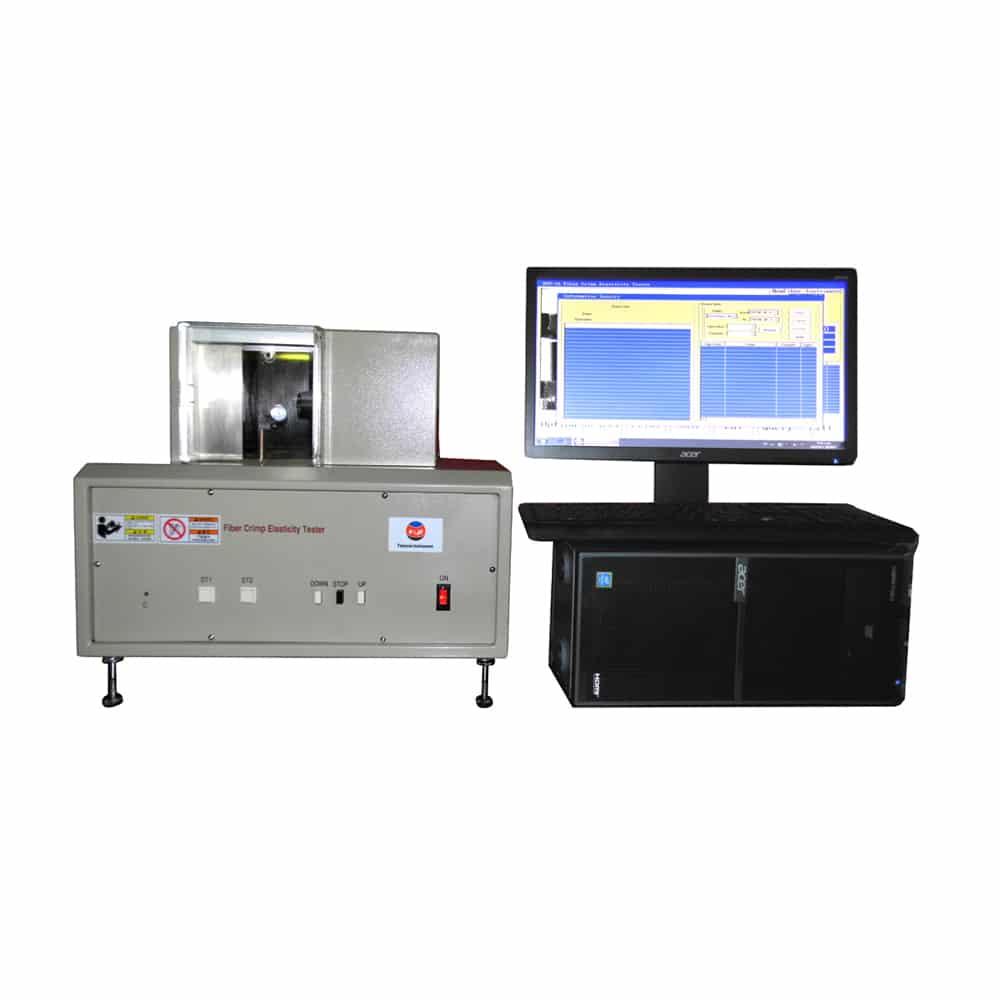
Fiber crimp testers are specifically designed for single fibers. These are different from yarns extracted from fibers. It has a force sensor to measure fiber lengths under light and heavy loads, calculates crimp ratio, and uses images to analyze the count of crimp waves in a standard 25 mm fiber segment.
Fiber crimp tester is particularly for research institutions and chemical fiber production industries.
Tension Ranges and Test Lengths
The correct straightening tension is important because it can affect the test results. When your tension is too little, it leaves residual crimp, and too much can stretch the yarn beyond its electrical limit, giving an offset crimp reading.
| Yarn Type | Tension Range | Typical Test Length |
| Fine cotton / synthetic (light) | 0-35 g | 120 cm (48 in) |
| Medium-weight yarns | 35-100 g | 120 cm (48 in) |
| Heavy / coarse yarns | 100-175 g | 120 cm (48 in) |
| Textured / texturized yarns | Per manufacturer specification | Variable |
Yarn Crimp Testing Standards
There are three main yarn testing standards in most textile laboratories:
- ISO 7211: ISO determines the method for crimp yarn in woven fabrics. It sets the testing standards at 20 C and 65%RH. It also covers how to prepare the sample, yarn extraction, and the crimp % formula.
- ASTM D3883: Standard test method for Yarn Crimp and Yarn Take-up in Woven Fabrics. You can choose A or C for measurement, which is mainly used for commercial shipments. ASTM D3883 states that crimp values from extracted yarns
- EN Standards:
How Yarn Crimp Affects Fabric Quality
- Abrasion Resistance: Yarns that are tested and have higher crimp protrude more from the fabric surface. These protruding spikes take the initial abrasion, protecting the yarns that lie closer to the fabric center. Fibers with higher crimp have higher abrasion resistance.
- Strength: Crimp allows the fabric to extend before the yarns. So, when there’s tensile force (a pull on the fabric). As the fabric is stretched, the crimp is progressively removed; this is also why the fabric has more strength in one direction. If the fabric yarn count and size are not the same in both directions, it does not have balanced strength.
- Shrinkage: When yarns swell as they absorb water, they require a longer bending path around the adjacent yarns. When there is no tension, the yarns move close together instead of lengthening, resulting in crimp and ultimately shrinkage.
Cost and Price of Crimp Testers
Crimp testers’ pricing depends on the quality of the servo motors, precision of the tension-producing mechanism, number of standards, and the brand reputation.
Chinese suppliers like FYI and TESTEX price their machines in the range of $500 – $1500 or more, depending on the size and features. Specialized equipment like fiber crimp testers and chemical industry-specific crimp testers can cost upwards of $2000.
Crimp Tester Maintenance
By investing significant capital in your lab or research institute, there are a few unsaid expectations. One of them is ease of maintenance and operation.
- Grip condition: Fixed and movable clamps should securely hold the yarn and should not damage the delicate grip point. Corroded grips should be replaced, and your machine should allow grip face cleaning to remove fiber residue.
- Calibration: This is the most common error in most readable instrumentation. Calibration of the load cell or force needs to be checked regularly, especially before testing.
- Environmental control: If you are performing tests under ISO standards, you need to control the temperature and humidity. Exposure to moisture and humidity during testing can cause corrosion, and if your lab is not climate-controlled, the samples need to be tested quickly.
- Cleaning: Fiber will accumulate after a certain time between moving parts and scale channels. The machine should allow you to easily clean and clear after each test session, and some manufacturers allow compressed air sprays and brushes to be used without any damage to the machine.
Conclusion
Yarn crimp is an important property that is useful for fiber development, industrial testing, and directly influences how much yarn is consumed in the fabric and whether it meets your quality specifications. Yarn crimp tester is the best device and method to quantify this property, and with digital and specialized fiber crimp testers, you can decrease the footprint of these machines and improve sample testing efficiency and speeds.
Get In Touch
Phone: +86-551-68 105003
Phone: +86-551-68 105008
Fax : +86-551-6523 2507
Email: [email protected]
Email: [email protected]
MAIL US
If you have any need please contact with us, or if you have any problem, please send email to us anytime.