Textile Quality Control and Inspection
Textiles, a product in high demand, draws considerable public attention. Strict quality control is necessary.
The value of textile quality control
A vital procedure that guarantees textiles fulfill requirements and client demands is textile quality control. It covers every phase, from the acquisition of raw materials to the delivery of the finished product, with the goals of controlling and improving quality, lowering waste and defective goods, increasing production efficiency, and improving customer satisfaction. Five factors primarily demonstrate the importance of textile quality control

Adherence to rules and guidelines
National, industrial, and worldwide standards are among the many laws and guidelines that apply to the textile sector. By ensuring compliance, quality management helps prevent legal ramifications and financial losses brought on by poor quality.
For instance, the “GB18401-2010 National Textile Product Basic Safety Technical Specifications,” a mandated national standard that covers formaldehyde, pH value, color fastness, and odor, must be complied with by the apparel sector. The health of customers is at risk if these requirements are not met.
Fulfilling Client Needs
Consumers have varying standards for textile quality, including durability, strength, feel, and appearance. By ensuring that textiles satisfy consumer demands, quality management increases customer happiness and loyalty. Customers in the high-end apparel sector, for instance, closely examine the fabric’s texture, the precision of the cuts, and the quality of the stitching. Market competitiveness and brand image are impacted when customer needs are not met.
Increasing production effectiveness
By quickly identifying and resolving production difficulties, quality control increases production efficiency and lowers costs by minimizing rework, scrap, and delays brought on by quality concerns. For example, identifying defects or color variations in fabric throughout the textile manufacturing process enables timely repair or replacement, preventing larger losses in later stages of production.
Ensuring the safety of products
By preventing hazards and safety incidents brought on by quality problems, quality control guarantees product safety. For instance, product safety—including flame retardancy and accessory firmness—is crucial in the emerging textile sector. By ensuring that these items adhere to pertinent safety regulations, quality control protects the health and safety of infants.
Encourage the development of sustainable
Quality control encourages businesses to use eco-friendly production techniques, which lessen waste and their influence on the environment. For example, quality control can optimize manufacturing processes and procedures in the textile industry, lowering energy consumption and wastewater discharge, increasing raw material use and recovery rates, and attaining sustainable development.
The main processes for textile quality assurance

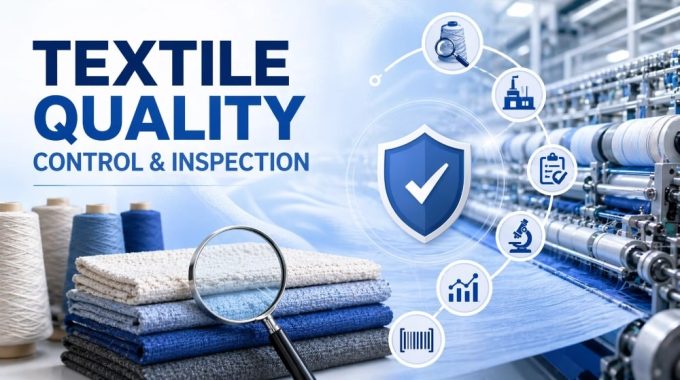
Raw material inspection: Conduct systematic testing on the fibers, yarns and fabrics to be produced, covering physical properties, chemical properties and appearance indicators, to ensure they meet the established quality requirements.
Production process monitoring: Implement continuous monitoring and inspection for each stage of weaving, dyeing, printing, finishing, etc., promptly identify deviations and make corrections to maintain process stability.
Finished product inspection: Conduct a comprehensive assessment of the final products, covering physical properties, chemical composition, dimensional stability and appearance quality, to ensure they meet the usage requirements and standards.
Testing tools and techniques: Introduce equipment such as spectroscopy analysis, chromatography analysis and strength testing to enhance detection accuracy and execution efficiency, for the determination of key physical and chemical indicators.
Statistical process control: Track and analyze key parameters based on SPC methods, identify abnormal fluctuations and adjust the process to achieve continuous quality stability.
Quality traceability system: Establish a data recording and tracking mechanism that runs through the entire production and inspection process, enabling rapid identification and handling of problems.
Methods for checking textile quality

The following groups make up most textile quality inspection methods:
Sensory inspection relies on inspectors to make judgments on products through visual, tactile and olfactory senses. The operation is straightforward, but the conclusion is greatly influenced by experience and judgment ability. Physical inspection uses specialized instruments to measure indicators such as fiber length, fineness, strength and flexibility. The data is stable and reliable, but it also comes with relatively high equipment and execution costs.
Chemical detection methods assess quality by analyzing parameters such as fiber content, formaldehyde level, pH value and heavy metals. The results are precise, but they require higher equipment and technical conditions. Microbial detection methods determine the hygiene status by measuring the total amounts of yeast, mold and bacteria. The detection accuracy is high, but it is highly dependent on the experimental environment and equipment. Function detection methods test properties such as waterproofing, breathability, moisture absorption and anti-static performance to verify the specific functional performance of the product. It usually requires professional equipment support.
In actual testing, a single method or a combination of multiple approaches should be selected based on the specific target to enhance the reliability of the results. At the same time, a unified standard should be established to clearly define the testing procedures, conditions, and result determination, ensuring the consistency and comparability of the data.
Regulations and standards

International standards are formulated by the International Organization for Standardization and serve as a unified basis for textile product testing. Examples include ISO 139 and ISO 2060. These standards are universally applicable in cross-border trade and quality control. Based on these standards, various countries establish their own systems, such as GB/T standards, standards issued by ASTM International, and Japanese Industrial Standards, which are adjusted according to local industries and regulatory requirements. At the industry level, specialized standards are formulated by institutions like China National Textile and Apparel Council, such as FZ/T standards, which are used to establish technical specifications for specific product categories.
The regulatory framework constitutes mandatory constraints, including international agreements such as the Agreement on Textiles and Clothing, as well as laws such as the Product Quality Law of the People’s Republic of China and the Law on Protection of Consumer Rights and Interests of the People’s Republic of China, which define quality responsibilities and market behaviors. With the strengthening of environmental constraints, the scope of testing has expanded to include indicators such as the control of harmful substances and the assessment of degradability. The certification and labeling system further provides market identification tools, such as OEKO-TEX Standard 100 and China Environmental Label, for conveying environmental and quality information of products.