What Is a Carbon Black Content Tester? Types & Testing Methods Explained
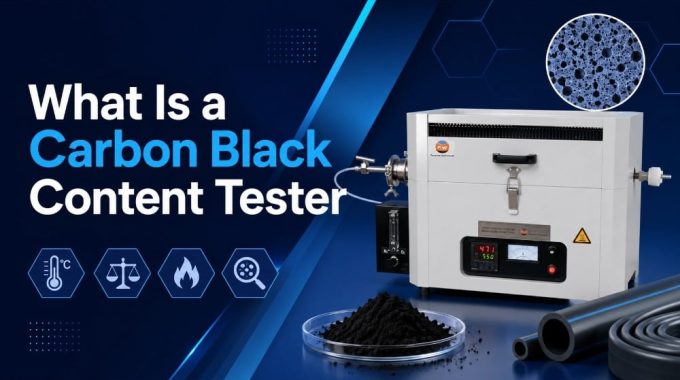
A carbon black content tester measures the percentage of carbon black (fine black powder after combustion of carbon-containing compounds) present in plastic and rubber through combustion methods. The content tester is used in quality control, laboratory research, and institutional settings to demonstrate ideal results of ISO and ASTM standards.
This guide breaks down how a carbon black content tester works, what kind of materials can be tested, and the industrial requirements and specs for purchasing a carbon black content tester.
What Is a Carbon Black Content Tester?
Carbon black is a compound added to polyethylene, polypropylene, and rubber compounds to provide UV protection and reinforce the polymer matrix. The concentration of this carbon black determines how well the matrix performs in outdoor environments.
When the carbon black is low, the material can be degraded by UV, and when the amount is in excess, it can affect mechanical properties.
Carbon black content tester is a laboratory instrument that measures the percentage of carbon black present in a plastic or rubber sample. The measurement is made by weight and using gravimetically.
The sample is subjected to a high-temperature combustion, and the mass difference before and after each stage of the process yields the carbon black percentage. Carbon black tester is used to assess quality control and perform research on materials in plastic manufacturing, cable insulations, and membrane production.
Carbon Black Content Tester Vs. Carbon Black Dispersion Tester

The Carbon black content testers and carbon black dispersion testers are two different instruments that can test the same carbon black in a material, but present two different parameters. It is completely possible for a material to pass the carbon black content test and fail the dispersion test.
| Property | Carbon Black Content Tester | Carbon Black Dispersion Tester |
| What it measures | Quantity of carbon black present (% by weight) | Uniformity of carbon black distribution within the polymer matrix |
| Test principle | High-temperature combustion (gravimetric) | Optical microscopy / image analysis |
| Output | Percentage figure (e.g., 2.3%) | Dispersion rating or grade (e.g., Grade 1–5) |
| Primary standard | ASTM D1603, ASTM D4218, ISO 6964 | ISO 18553, ISO 11420 |
| Equipment required | Tube furnace, muffle furnace, combustion boat, analytical balance | Microscope with camera, image analysis software, and microtome |
Agglomeration of carbon black particles in the material creates weak points in the polymer structure and reduces UV protection properties. Carbon black dispersion tester uses a microscope to observe a thin slice of the sample.
The image from the sample is analyzed to measure the size, shape, and spatial distribution of carbon black particles and any clumps, and the result is compared to photomicrographs under quality standards like the ISO 18553.
How a Carbon Black Content Tester Works?

High-Temperature Combustion Method
For ASTM D1603 and D4218, the combustion method of carbon black testing is used. Using an inert closed atmosphere, it is possible to burn the material volatilizing compounds in the sample, leaving behind a carbon black residue. After this, an oxidation stage burns away the carbon black, leaving inorganic ash. The result comes from measuring the mass difference between the 1st residue and the 2nd residue after the oxidation stage.
The high-temperature combustion method is a two-stage process
- Pyrolysis
This stage involves placing the sample in a combustion boat inside a tube furnace at temperatures between 550°C and 600 °C. Nitrogen constantly purges through the furnace, making an inert environment, and under these conditions, the polymer decomposes and volatilizes without the carbon black oxidizing. The remaining residue consists of carbon black plus any inorganic fillers.
- Oxidation
In this process, the combustion boat is placed in a muffle furnace at 600°C. Because of the presence of oxygen, the carbon black burns completely, leaving behind inorganic ash only. The mass difference between the two stages equals the carbon black mass.
Calculation Formula (ASTM D1603)
%Carbon Black = ((mass of residue from tube furnace − mass of residue from muffle furnace) / Original sample mass) × 100
Optical Dispersion Measurement Method
Carbon black dispersion tester works completely differently from a carbon black percentage tester. For testing the dispersion of carbon block, the tester works using a thin section of the sample, around 20–25 µm thick, on a glass microscope slide. The carbon black dispersion tester uses transmitted light at magnifications up to 450 x to image the carbon black particles within the polymer matrix.
Carbon black content test apparatus comes with a built-in software that measures the equivalent diameter, area, perimeter, and aspect ratio of each detected clump. The degree of dispersion is then assigned a grade by comparing the captured microscopic images against the reference micrographs according to ISO standards.
The grading system ranges from Grade 1 to Grade 5. Grade 1 indicates excellent dispersion, and Grade 5 indicates the worst dispersion agglomeration.
Technical Parameters of the Carbon Black Content Tester
When buying a carbon black content tester, the following parameters determine the instrument’s accuracy, what materials it can process, and the suitable testing standards. The table below lists a sample specification from the FYI DW1421 carbon black content tester.
| Parameter | DW1421 Specification | |
| Display mode | LED display | Real-time readout of temperature and time during each test stage |
| Combustion tube dimensions | 35 × 650 mm (customizable) | Tube diameter determines compatible combustion boat size; length affects usable hot zone length |
| Hot zone length | 200 mm | The uniform-temperature region where pyrolysis occurs |
| Heating element | Electric resistance wire | |
| Working temperature | ≤ 1100 °C | Exceeds the 600 °C required by ASTM D1603/D4218, providing margin for high-temperature ash testing applications |
| Maximum temperature | 1200 °C | |
| Temperature sensor | K-type thermocouple | |
| Temperature control | Intelligentized PID, 30-step programmable | |
| Temperature accuracy (constant) | ±1 °C | |
| Furnace structure | Openable | |
| Flow meter range | 0.2 – 2 L/min | |
| Combustion tube material | Quartz glass | |
| Applicable standards | ISO 6964, ISO 247, IEC 60811-4-1, ASTM D1603, GB/T 1302, GB/T 2951.41 | |
| Applicable materials | Geomembranes, polyethene, polypropylene, polybutylene pipes and fittings, rubber | |
| Over-temperature protection | Yes |
For the carbon black dispersion tester, the key parameters are the microscope magnification, result clarity, and software image processing accuracy. The typical magnification ranges from 100x to 450x, and the minimum agglomeration size is typically ≥ 50 µm².
Standards For Carbon Black Content Testing
- ASTM D1603: This is a test standard for carbon black content in olefin plastics like polyethylene, polypropylene, and polybutylene plastic using a tube furnace under an inert atmosphere. This standard does not apply to compositions containing non-volatile and non-carbon residues that are not inorganic.
- ASTM D4218: This standard is an alternative to D1603, designed specifically for black polyethylene compounds containing channel black. The test is conducted entirely in a muffle furnace and is suitable for high-throughput tests. It is not suitable for plastics that char.
- ISO 18553: ISO defines two procedures under 18553 for the degree of arbon black or pigment dispersion in polyolefin compounds. First is to measure particle size and clump size physically. Second procedure is to grade the magnified images against reference photomicrographs of the standard.
- ISO 11420: When the carbon black content is below 3%, you can use the ISO 11420 test standard, but ISO 11420 is now replaced by the ISO 18553 standard, which has additions to the photomicrograph grading procedure.
Carbon Black Tester Price
The price of a carbon black tester varies depending on equipment accuracy, method of testing, and the level of automation (like software) and data acquisition systems.
- Entry-level carbon black testers with basic analytical range and suitable for D4218 testing only cost between $800 – $2000.
- Mid-range carbon black testers with dedicated tube + muffle furnace and inert atmosphere control, digital output, and the most common configuration for QC cost more than $2500 and up to $7500.
- Advanced carbon black testers start from $15000. These carbon black test apparatus have a thermogravimetric analyzer (TGA), they can switch atmosphere automatically and provide real-time, accurate mass vs temperature curves with weight sensitivity detections in the sub-milligram range.
How To Maintain Carbon Black Content Test Apparatus
It is very easy to keep the carbon black content tester in its best performance with regular checks, cleaning, and working within the recommended temperature ranges of the machine. Since it has many different components, as long as these are regularly maintained, the overall machine remains pristine.
- Combustion boats require inspection before each test. You are looking for any cracks, contamination, and hardened glaze deposits from previous runs.
- The furnace tube requires cleaning because this is where carbon and polymer deposits accumulate on the inside walls of the tube furnace. You can clean the tube by heating it up to 700°C in air to oxidize deposits, then inspect for cracks in the quartz tube.
- Calibrate the temperature to prolong the tester’s lifespan. You can do this every 3 months or after every 100 tests, whichever comes first.
- Check the seal integrity by inspecting all gas fittings, tubing, and connections for leaks every month. You can manually check this by applying soapy water to connections and performing a visual check for any bubbles. Gas leaks can compromise test quality and introduce oxygen during pyrolysis.
- Keep software and firmware updated for testers with digital data loggers, and keep a backup of all calibration data before updating.
Conclusion
A carbon black content tester is a precision gravimetric instrument. Its accuracy depends on the combustion process, the purity of the nitrogen, and the calibration. The carbon black test apparatus contains a tube furnace, muffle furnace, combustion boats, and data logging systems to increase throughputs. The best carbon black tester is the one that can completely achieve your required testing standards consistently, like ISO 18553 for dispersion testing and ASTM D1603 for content testing.