
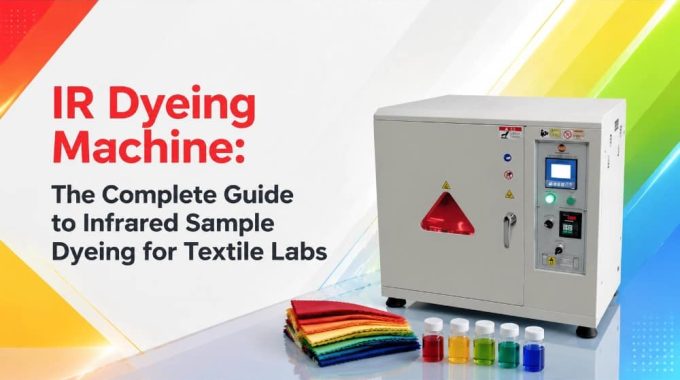
IR Dyeing Machine: The Complete Guide to Infrared Sample Dyeing for Textile Labs
The Ir dyeing machine is a standard tool in textile labs, which checks the sample dye accuracy to determine if the bulk dye batch matches its approved standard. The process is faster, cleaner, and more efficient than the old glycerin and water bath system for testing dyes. This article will go over the process, the technologies involved, and how it stands against other techniques.
What Is an IR Dyeing Machine and How Does It Work
An ir dyeing machine is commonly used in textile labs and has 12- 24 beakers in a rotation carrier with infrared lamps all around the beaker. The machine is used to set up small volume baths in the sealed beakers and uses infrared radiation to dye fabric under controlled temperature and time periods.
The process works by heating the dyeing liquid to the set temperature for a certain period of time and then slowly cooling it. Each beaker rotates during the process to ensure the dye can fully coat the fabric sample.
Each step is programmed and managed by a microprocessor, ensuring precision every step of the way, separating an IR lab dyeing machine from a simple heated bath.
Infrared Heating Principle in IR Dyeing Machines Explained
The working principle of the infrared dyeing machine is that the energy from thin infrared rays is directly absorbed into the beaker wall, which then transfers to the dye solution, providing an even and constant heat.
Important components of that function in the heating loop include:
- Infrared lamps or tubes: rated between 1,000W and 1,200W per unit and wired in series to reach the total heating capacity needed for the cup count.
- Oil-bath or air-gap conduction layer: it helps to conduct the heat evenly around each beaker
- PT-100 temperature probes: they sit inside the beaker to monitor the solution’s temperature in real time.
- Closed-loop control logic: This is useful in controlling the lamp and keeping a steady temperature.
The Significance of Infrared Sample Dyeing Machines
IR sample dyeing machines are a crucial tool in almost all modern textile labs. This is because they allow manufacturers to test the dye before starting a full batch. The cost of a failed sample is far more appealing than the cost of a failed batch.
Sample Dyeing and Color Lab Testing
For color labs, these machines help them run multiple dye compositions at the same time, each with the same time and temperature while varying a single variable such as the dye concentration or auxiliary chemical.
Wash Fastness and Quality Testing
A dyed sample is further rubbed under the wash fastness and rub fastness test to check how well the fabric is dyed and if the color holds up well. The benefit of the machine here is that since the process is continuous, any document or problem can be traced back to the dye formulation.
Impact on Speed-to-Market for Textile Manufacturers
The machine allows you to test more samples and recipes, which shortens the testing phase and leads to faster recipe approval between a dyehouse and its client. This is especially important for brands that have a seasonal timeline, where the turnaround time determines how fast they can set forth their large batch dyeing schedules.
IR Dyeing Machine vs Conventional Dyeing Machine

Infrared dyeing machine heats its dye solution through infrared waves and conduction, whereas a normal dyeing process uses an external water bath or an immersed electric heater that heats the dye.
Heating Method: Infrared vs Traditional Water Bath
The traditional water bath and glycerin system works by heating up an entire tank of liquid, which then slowly heats the beakers. This wastes a lot of energy, whereas in an infrared system, the beakers are heated directly by radiant energy. Less mass to be heated means less energy and a faster, more efficient process.
Speed, Accuracy, and Energy Efficiency Compared
| Factor | Conventional (Water/Glycerin Bath) | IR Dyeing Machine |
| Heat-up time to 100°C | Slower — limited by bath thermal mass | Faster — direct radiant heating |
| Temperature uniformity | Variable across beaker positions | ±0.5°C typical, consistent across cups |
| Maintenance | Bath fluid replacement, glycerin cleanup | No bath fluid; air-cooled, minimal cleanup |
| Energy consumption | Higher — heat bath medium plus beakers | Lower — heats beakers/conduction layer only |
| Water source requirement | Often required for bath or cooling | Typically air-cooled, no external water needed |
Which Option Is Better for Modern Textile Labs
The infrared system is more suited for modern labs, as they run high sample volumes that need precise conditions. Older water bath options are generally limited to shops that don’t have the budget for infrared systems.
Main Components of an IR Dyeing Machine

Infrared Heating Elements
The infrared heating elements are nano-coated, sealed infrared lamps or tubes that surround the beaker. The wiring configuration of these lamps is in series. A 12-cup setup is around 4.8KW while a 24-cup setup is 5.4KW. IR Dyeing machine 12/24 RHS series provides both setups.
Dyeing Beakers and Bath System
The beakers are made of SUS 304 and SUS316 stainless steel and have various sizes ranging from 150cc to 800cc, depending on the sample size and solution ratio.
Temperature Sensors and Digital Control Panel
All the data is monitored in real time. The PT-100 temperature probe measures the temperature of the dye or jacket, which is displayed on an LCD screen. A machine operator can program time, temperature ramp rate and cooling temperature all into the machine through a digital control panel.
Rotary or Oscillating Drive Mechanism
The beaker rotates through a frequency control motor that has an adjustable speed. The rotary or oscillation motion of the beakers keeps the dye solution moving and covers the sample surface evenly, preventing uneven dyeing or marking.
Types of Sample Dyeing Machines
| Type | Advantages | Disadvantages |
| Elevating Type | Beakers can be raised/lowered independently; useful for staggered sample removal | Mechanically more complex; higher maintenance over time |
| Rotary Type | Even heat and liquor distribution via continuous rotation is widely supported by most brands | All beakers run on one shared cycle, limiting per-sample flexibility |
| Oscillating Type | Gentler agitation, suited to delicate fabrics; lower mechanical wear | Slower liquor circulation than rotary designs in some models |
Elevating Type Dyeing Sample Machine
This machine design is used by labs to manage staggered sample timing. It works by lowering the beaker into the heating chamber.
Rotary Sample Dyeing Machine
The rotary style dyeing machine is the most popular design used in most textile labs. It spins the beakers back and forth to evenly distribute the dyeing solution onto the sample piece.
Oscillating Type Sample Dyeing Machine
Oscillation type machine doesn’t spin the beakers fully, but rather they move them back and forth. This is great for lighter and more delicate substrates that can’t handle vigorous tumbling.
Advantages of IR Heating in Textile Dyeing Processes

Uniform and Rapid Heat Distribution Across Beakers
The temperature variation is minimal since all the beakers are heated directly rather than through a water bath. On a dyeing machine that is running a 24-cup set, the maximum temperature variation will be 0.5 °C at most, ensuring consistency.
Energy Savings and Lower Operating Costs
The energy required to heat just the beakers is far less than heating a whole tank of liquid in a water bath. Paired with air cooling, this reduces the cost of electricity and water consumption.
Improved Color Consistency and Reproducibility
Temperature control determines how well the pigment in the dye bonds with the fabric and exhibits the correct shade. IR dyeing machines are able to manipulate and hold temperature with high precision across every beaker, ensuring consistency and reproducibility of a result on demand.
What is the Price of an IR dyeing Machine?
An IR dyeing machine starts from the range of $1500 and $4000 for a rotating 12-16 cups variant, while further advanced systems with 20+cup capacity can go beyond $15000+ such machines feature IoT connectivity and automatic dosing.
These figures are approximate market ranges, and actual prices can vary depending on the following factors.
- Cup count and beaker material: the cup material and number of cups in the system directly affect the cost.
- Control sophistication: touchscreen interfaces, app connectivity, and ERP/LIMS integration sit at the higher end.
- Dosing and auxiliary features: automated liquid/powder dosing during the cycle adds to both build complexity and price.
- Brand and after-sales support network more prominent brands provide global service and warranty on machines, which is why they are priced higher than locally available machines.
Applications of IR Dyeing Machines in the Textile Industry
All the color testing done prior to production in the textile mill is done through IR dyeing machines. IR dyeing machines are used for sampling yarn and fabric dye testing, lab color solutions and thermosol process simulation.
Fabric and Yarn Sample Dyeing
Woven fabric and yarn samples are all dyed by using cup inserts, which allow multiple test samples in a single machine run.
Lab Dispensing and Color Matching
Most color labs don’t only use the dyeing machine alone; they are paired with a lab dispenser that precisely prepares color stock solution to add to the beakers, which helps in recipe development.
Narrow Fabric and Specialty Textile Dyeing
Special fabrics and other odd textures such as mesh, zippers and ribbons are dyed using the same high temperature dyeing cycle.
Thermosol Dyeing Applications
Best Ir dyeing machines are able to perform similar thermosol dyeing to dye synthetic fabrics such as polyester, which helps the lab check and test how the fabric will be on a continuous thermosol production line.
Conclusion
IR dyeing machines are the modern trend in all dye houses and textile industries. The direct heating is more efficient, and with the tight temperature control of the dyeing machine, it is easy to reproduce colors with consistency. The choice between a rotary, oscillatory or elevating configuration for a lab depends on the infrared color dyeing machines’ ability to produce consistent and traceable conditions across every sample run.
FAQs About IR Dyeing Machines
How Does an IR Dyeing Machine Differ from a Lab Dyeing Machine?
The term lab dyeing machine covers a broad range of different dye machines. An IR dyeing machine specifically refers to a machine that uses infrared waves to heat beakers to dye the fabric.
How Do I Find a Reliable IR Dyeing Machine Manufacturer or Supplier?
Analyze the manufacturer’s document temperature with (0.5 °C) accuracy specs, beaker material such as SUS304 and the service network of the company as well.
Can IR Dyeing Machines Be Used for Wash Fastness Testing?
No IR dyeing machines are only used to dye the sample fabric. The wash fastness test is done after the dye is applied on a separate machine, using a laundrometer.


