How Friction Shapes Fabric Feel
Friction is the phenomenon in which two object surfaces come into contact and move relative to each other under external force, generating tangential resistance at the contact interface. This tangential resistance is friction force, and its magnitude depends on the characteristics of the object surfaces. It is one of the classical mechanical properties. For fabrics, surface friction performance is also one of the most basic mechanical properties. It is generally characterized by the friction coefficient and surface roughness.
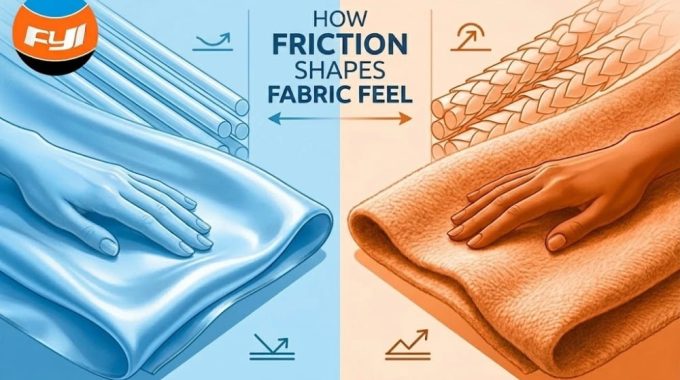
The surface friction performance of fabrics affects their smoothness or slipperiness, contributing to the richness of textile surface hand. A low friction coefficient results in a smooth hand, while a high friction coefficient leads to a rough hand. Regarding auditory style, specially treated silk fabrics produce low-frequency vibrations when rubbed together, creating the “silk sound” effect, which provides a pleasant sensation when they contact the skin during wear. In terms of visual style, the unevenness of the fabric surface causes variation in light reflection, thus influencing fabric luster. Surface friction properties also affect wear performance, such as abrasion resistance and the comfort of close-fitting garments. Additionally, surface friction can influence post-finishing processes and certain special functions. Therefore, simulating the friction behavior of fabrics when they contact different surfaces during actual use is an important way to understand fabric hand, style, and performance.
Fabric Surface Friction Performance

Fabrics are composed of fibers. Thus, friction between fabrics is essentially friction between fibers, which is a combination of macroscopic and microscopic interactions. From a microscopic mechanics perspective, friction involves interactions between molecules on the contacting surfaces, generating shearing and separation under tangential forces. When relative sliding occurs, the resistance to molecular shear on the contact surface increases. From a macroscopic viewpoint, friction between fabrics and objects results from collisions and compressions between fiber materials and the object surface. The friction coefficient depends on factors such as hardness of the two objects, shear-compression modulus, number of bonding points, and normal pressure.
Fabric surface friction performance is expressed using the friction coefficient or frictional resistance. Fabric frictional resistance can generally be classified into two types: (1) friction resistance of surface fibers, and (2) friction resistance caused by surface geometry. When fabrics contact hard, rough objects such as concrete, fiber snagging strength and the degree of fiber constraint on the fabric surface become the dominant factors. When fabrics rub against each other, the smoother the surface, the more the fiber friction resistance contributes to overall friction. Additionally, due to the raised areas created by warp and weft interlacing, the fabric surface becomes uneven. When rubbing occurs, the surface irregularities interlock like gears, greatly increasing frictional resistance.
Factors Influencing Fabric Surface Friction Performance

Fabric surface friction performance is influenced by many factors, including fiber material, yarn structural parameters, fabric structure, dyeing, and finishing processes, all of which affect fabric hand and style.
Fibers
The properties of individual fibers largely determine fabric friction characteristics. Different types of fibers exhibit different friction behaviors due to differences in morphology and structural features. For example, the unique hand of silk fabrics is determined by the triangular cross-section and fineness of silk fibers. The harshness or smoothness of wool fabrics is due to the directional friction effect of wool scales, in which friction differs in the scale-forward and scale-backward directions. Fiber crimp affects fiber arrangement and entanglement, thereby influencing fabric friction performance.
Yarns
For yarns, factors such as yarn linear density, twist level, filament fineness, and spinning method all affect fabric friction performance. Changes in linear density influence the actual contact area during friction. Coarser yarns result in rougher fabric surfaces and a more rugged style. Twist level affects fiber arrangement, yarn surface smoothness, and stiffness, which in turn influence fabric surface friction. Additionally, specially finished yarns may exhibit altered friction properties.
Fabrics
The tightness of fabric structure, average float length, and fabric density all affect surface friction performance. The longer the float length in the direction of friction, the greater the surface friction coefficient. Higher weft density leads to a smoother surface. As fabric tightness increases, yarns are more compressed, and fabrics more easily form uniform, compact surfaces, resulting in lower surface roughness.
Development of Fabric Surface Friction Performance

In the field of fabric surface friction performance, researchers in various countries have conducted extensive studies and explorations, resulting in a large number of research achievements. During the Italian Renaissance in the 15th century, Leonardo da Vinci first proposed scientific principles regarding friction on solid surfaces, marking the beginning of tribology research. However, studies on fabric tribology began in the 1930s. Research has included testing methods for fabric surface friction coefficients, tribological characteristics of fabric-reinforced composite materials, and friction between fabrics and skin.
In 1930, Peirce proposed various parameters to control fabric properties and evaluated their hand, linking fabric hand and friction performance for the first time. This initiated the study of the relationship between fabric mechanical properties and style. The friction performance of fabrics affects the hand, appearance, and functionality of end products and mainly depends on the contact surfaces during use.
In 1997, Ajayi and Elder demonstrated that friction between fabrics and object surfaces is crucial for fabric applications and for characterizing the hand of fabrics and yarns.
In 2004, Hermann and others used a new composite friction factor to objectively characterize the surface friction performance of cotton fabrics. They investigated the effects of different sliding speeds on cotton fabric surface friction performance. The results showed that as sliding speed increased, the static friction coefficient increased, while the dynamic friction coefficient showed no significant change.
In 2005, Das, Kothari, and Vandans studied the friction characteristics of fabric/metal surfaces and fabric/fabric interfaces in four types of textile materials and analyzed the factors influencing fabric friction performance.
In 2017, Zhang Yuxuan and colleagues studied the friction characteristics between camouflage fabric and human elbow skin. Under dry conditions, pure cotton fabrics and twill structures had lower friction coefficients against skin. Under wet conditions, fabrics with strong hydrophobicity exhibited higher friction coefficients. After friction with plain weave fabrics, the skin surface became rougher, increasing the risk of skin surface damage.
Testing of Fabric Surface Friction Performance
A fabric touch tester, also known as a fabric and yarn comprehensive hand evaluation system, simulates actions such as pulling, compressing, pinching, and kneading when the hand touches fabrics. It measures bending, compression, friction, and tension to evaluate the skin-contact sensory characteristics of fabrics and obtain indicators such as softness, stiffness, smoothness, and compactness, providing an objective assessment of fabric hand and tactile properties.