
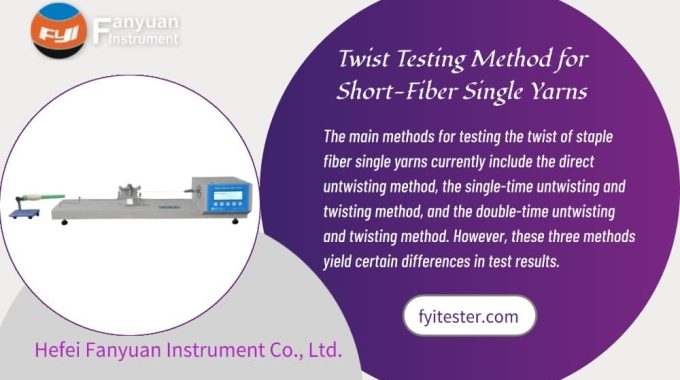
Twist Testing Method for Short-Fiber Single Yarns
The number of turns within a unit length of yarn is called twist. Twist is expressed as twists per meter (t/m) or twists per 10 cm (t/10 cm). Twist is an important physical property of yarn. The physical and mechanical properties of yarn are determined by the properties of the constituent fibers and the yarn structure, among which the twisting action is the most important factor affecting yarn structure. Short fibers can form yarns with certain physical and mechanical properties precisely because of twisting. Twist is not only the fundamental condition for yarn formation, winding, and strength development, but is also closely related to yarn strength and elongation at break. Therefore, twist testing must accurately reflect the true inherent twist of the yarn while being simple, fast, and accurate to operate.
Different twist testing methods apply to different yarns. Some yarns can be tested by several methods, but differences among methods may lead to varying results. At present, the main twist testing methods for short-fiber single yarns are the direct untwist method, the single untwist–retwist method, and the double untwist–retwist method. By using these three methods to test the twist of short-fiber single yarns, experiments can be conducted to compare differences in testing procedures and results.
Experimental Section
The twist measurement methods for short-fiber single yarns include the direct untwist method, the single untwist–retwist method, and the double untwist–retwist method. The applicable standards are GB/T 2543.1-2015 “Textiles—Yarns—Determination of Twist—Part 1: Direct Counting Method” and GB/T 2543.2-2001 “Textiles—Yarns—Determination of Twist—Part 2: Untwist–Retwist Method.”
Principles of the Methods
The direct untwist method consists of holding a specimen of a specified length under a prescribed tension and rotating one end to remove the twist until the constituent elements of the yarn become parallel. The number of turns required to remove the twist is used to calculate the yarn’s twist.
The untwist–retwist method is an indirect method. In the single untwist–retwist method, the specimen is untwisted and then twisted in the opposite direction until it returns to its original length. It is assumed that the number of reverse twists equals the original twist of the specimen, so half of the number recorded by the counter represents the twist of the yarn. In the double untwist–retwist method, the first specimen is tested according to the single untwist–retwist method. For the second specimen, one-quarter of the twist count obtained from the first specimen is removed, after which the yarn is retwisted to its initial length to correct the error caused by the pre-tension.
Instruments and Testing Environment
Instrument: Y331 yarn twist tester.
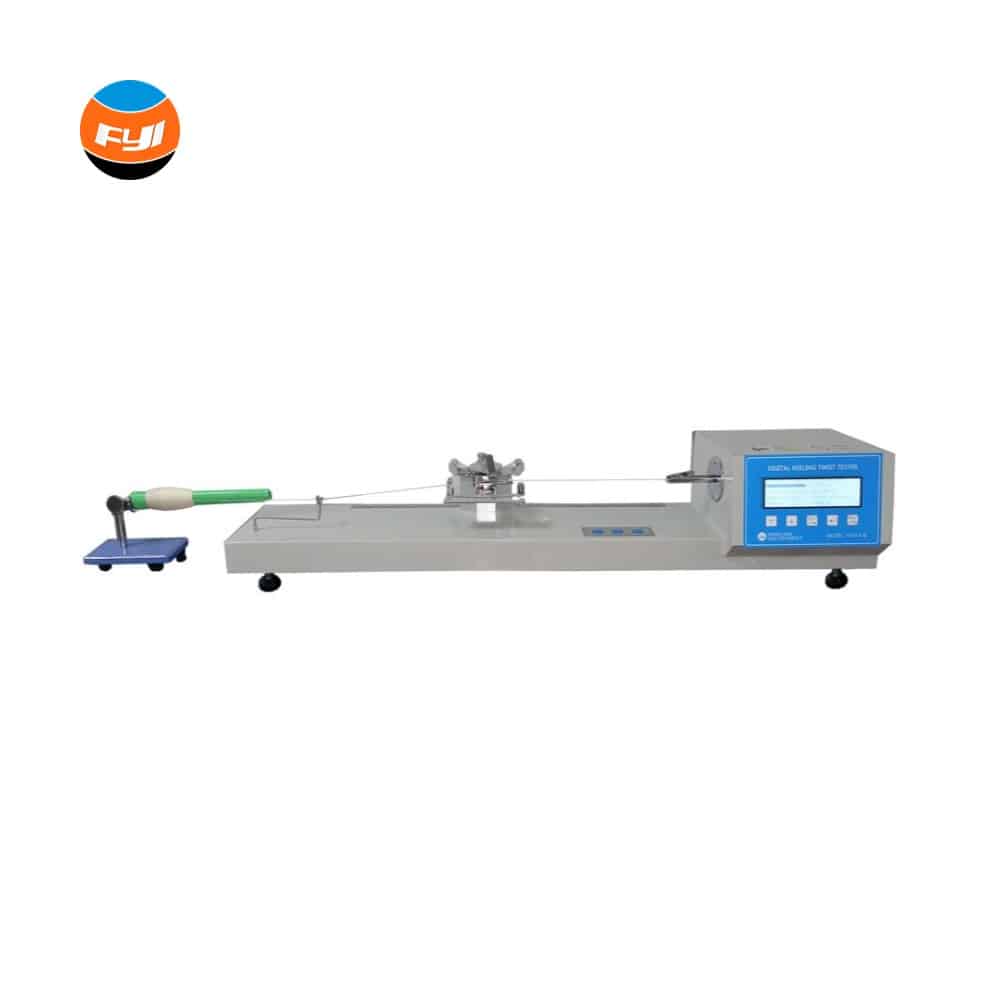
Conditioning and testing atmospheres follow GB/T 6529-2008 “Standard Atmospheres for Conditioning and Testing of Textiles.”
Testing Plan
Because short-fiber yarns exhibit uneven fineness and uneven twist, in order to avoid differences among samples, two bobbins of yarn are randomly selected from a package of 18.0 tex cotton yarn with a designed twist of 96.5 t/10 cm. These are designated as Sample 1 and Sample 2, tested separately using the direct untwist method, the single untwist–retwist method, and the double untwist–retwist method. The pre-tension is 9.0 cN.
Specimen lengths: 25 mm for the direct untwist method; 500 mm for both the single and double untwist–retwist methods.
Results and Analysis
The conditioned Sample 1 and Sample 2 were tested using the three methods: the direct untwist method, the single untwist–retwist method, and the double untwist–retwist method. Each method was performed 10 times. The test data are shown in Table 1 and Table 2.
| Direct untwist method, initial length/mm: 25 | Single untwist–retwist method, initial length/mm: 500 | Double untwist–retwist method, initial length/mm: 500 | ||||||
| Twist turns | Measured twist/(10 cm)-1 | Twist turns | Measured twist/(10 cm)-1 | Twist turns | Measured twist/(10 cm)-1 | |||
| 1 | 25.2 | 100.8 | 1 | 905.5 | 90.6 | 1 | 917.8 | 91.8 |
| 2 | 20.8 | 83.2 | 2 | 923.0 | 92.3 | 2 | 1055.9 | 105.6 |
| 3 | 25.0 | 100.0 | 3 | 928.9 | 92.9 | 3 | 935.5 | 93.6 |
| 4 | 20.4 | 81.6 | 4 | 934.3 | 93.4 | 4 | 999.0 | 99.9 |
| 5 | 23.0 | 92.0 | 5 | 955.5 | 95.6 | 5 | 1073.8 | 107.4 |
| 6 | 20.9 | 83.6 | 6 | 941.1 | 94.1 | 6 | 955.3 | 95.5 |
| 7 | 19.5 | 78.0 | 7 | 958.8 | 95.9 | 7 | 928.7 | 92.9 |
| 8 | 23.2 | 92.8 | 8 | 881.3 | 88.1 | 8 | 944.5 | 94.5 |
| 9 | 21.9 | 87.6 | 9 | 896.5 | 89.7 | 9 | 989.1 | 98.9 |
| 10 | 25.6 | 102.4 | 10 | 886.6 | 88.7 | 10 | 933.5 | 93.4 |
| Average twist | – | 90.2 | Average twist | – | 92.1 | Average twist | – | 97.4 |
| Coefficient of variation | – | 9.7 | Coefficient of variation | – | 3.0 | Coefficient of variation | – | 5.6 |
| Direct untwist method, initial length/mm: 25 | Single untwist–retwist method, initial length/mm: 500 | Double untwist–retwist method, initial length/mm: 500 | ||||||
| Twist turns | Measured twist/(10 cm)-1 | Twist turns | Measured twist/(10 cm)-1 | Twist turns | Measured twist/(10 cm)-1 | |||
| 1 | 20.4 | 81.6 | 1 | 916.5 | 91.7 | 1 | 946.3 | 94.6 |
| 2 | 22.3 | 89.2 | 2 | 954.8 | 95.5 | 2 | 1031.7 | 103.2 |
| 3 | 24.0 | 96.0 | 3 | 972.2 | 97.2 | 3 | 1041.9 | 104.2 |
| 4 | 23.4 | 93.6 | 4 | 912.4 | 91.2 | 4 | 959.3 | 95.9 |
| 5 | 21.6 | 86.4 | 5 | 887.5 | 88.8 | 5 | 929.7 | 93.0 |
| 6 | 20.8 | 83.2 | 6 | 910.0 | 91.0 | 6 | 934.1 | 93.4 |
| 7 | 24.3 | 97.2 | 7 | 931.8 | 93.2 | 7 | 1066.9 | 106.7 |
| 8 | 24.0 | 96.0 | 8 | 912.9 | 91.3 | 8 | 930.7 | 93.1 |
| 9 | 24.6 | 98.4 | 9 | 908.8 | 90.9 | 9 | 916.3 | 91.6 |
| 10 | 20.3 | 81.2 | 10 | 960.2 | 96.0 | 10 | 976.7 | 97.7 |
| Average twist | – | 90.3 | Average twist | – | 92.7 | Average twist | – | 97.3 |
| Coefficient of variation | – | 7.6 | Coefficient of variation | – | 2.9 | Coefficient of variation | – | 5.6 |
The designed twist of the samples used in the experiment is 96.5 twists/10 cm. From the data in Table 1 and Table 2, Sample 1 yielded twist values of 90.2, 92.1, and 97.4 twists/10 cm using the direct untwist method, single untwist–retwist method, and double untwist–retwist method respectively; Sample 2 yielded values of 90.3, 92.7, and 97.3 twists/10 cm using the same three methods. Although the same bobbin of short-fiber yarn was tested, the three methods gave different results. Among them, the direct untwist method produced the lowest twist and the highest coefficient of variation. The applicable standard GB/T 2543.1-2015 “Textiles—Yarns—Determination of Twist—Part 1: Direct Counting Method” applies to wound yarns such as single yarns, plied yarns, and cord yarns. For short-fiber single yarns, the initial specimen length should be as short as possible, but slightly less than the average fiber length. Typically, the initial length for cotton yarns is 10 mm or 25 mm, and for combed wool yarns 25 mm or 50 mm. During testing, it was found that too short an initial length makes operation difficult, so 25 mm was selected, with a pre-tension of 9.0 cN. However, in short-fiber spinning, fibers are tightly bound and wrapped around each other, making it difficult to clearly and accurately observe whether fibers are straight and parallel after twist removal. The small specimen length also makes it hard to judge whether the twist has been completely removed, resulting in larger measurement errors.
The single untwist–retwist method and double untwist–retwist method produced twist values higher than those from the direct untwist method and are relatively more accurate. The applicable standard GB/T 2543.2-2001 “Textiles—Yarns—Determination of Twist—Part 2: Untwist–Retwist Method” is suitable for measuring the twist of short-fiber single yarns. The initial length used is 500 mm with a pre-tension of 9.0 cN. The untwist–retwist method is very sensitive to pre-tension. The single untwist–retwist method is commonly used. The double untwist–retwist method is less affected by pre-tension and can produce more accurate results, but it is more time-consuming because an additional specimen is tested.
Conclusion
Through measurement of short-fiber yarn twist using the direct untwist method, the single untwist–retwist method, and the double untwist–retwist method, it is found that the direct untwist method requires a short initial length, is difficult to operate, and has relatively large measurement errors. The single untwist–retwist method is simple, produces relatively accurate results, and is commonly used for measuring the twist of short-fiber yarns. The double untwist–retwist method requires testing an additional specimen and takes longer, but is less affected by pre-tension and provides more accurate measurements. In actual production testing, the advantages and disadvantages of the three methods can be compared according to practical needs, and the most appropriate method can be selected for determining the twist of short-fiber yarns.