Shaped Fibers: Types and Technologies
Shaped fibers are chemical fibers produced by spinning through spinnerets with specific geometric shapes, resulting in special cross-sectional shapes and functions. Conventional chemical fibers with circular cross-sections have disadvantages such as low surface luster, a waxy feel, susceptibility to soiling and pilling, poor water absorbency, and low covering power. Therefore, modifying these fibers to obtain improved performance has long been a continuous goal. Modification of synthetic fibers mainly includes physical and chemical methods, with physical methods being more common than chemical ones. Changing the fiber cross-section is a simple way to obtain different fiber properties and belongs to physical modification. Among physical modification methods, it ranks first and is the most important means for producing shaped fibers.
Types, Functions, and Applications of Shaped Fibers
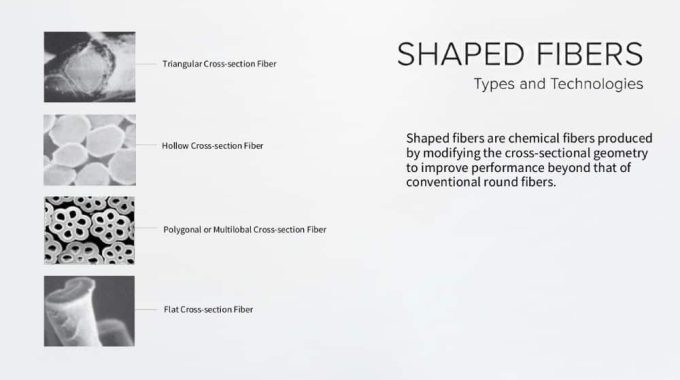
Because there are many ways to modify fiber cross-sections, a wide variety of shaped fibers have been developed. According to cross-sectional shape, they can generally be classified as triangular, polygonal, flat, hollow, and diamond-shaped. In recent years, with improvements in shaped fiber production technology, fibers with better performance but greater manufacturing difficulty have continuously entered the market, such as complex-shaped fibers, porous hollow fibers with hollowness greater than 50 percent, and fine and ultra-fine denier shaped fibers. Depending on cross-sectional differences, shaped fibers exhibit different functions.
Triangular cross-section fibers
Triangular-shaped fibers exhibit excellent optical effects. When light is incident, total internal reflection occurs along certain edges inside the fiber, weakening luster in those areas while enhancing luster on other edges.

When the angle of incidence changes, the reflecting edges change accordingly, producing a “sparkling” effect. These fibers are mainly used in fabrics requiring a shimmering appearance, such as silk-like fabrics, wool-like fabrics, corduroy, velveteen and other pile fabrics, yarns, and decorative textiles.
Polygonal or multilobal cross-section fibers

Different cross-sectional shapes result in different fabric styles. Polygonal fibers have soft luster and are suitable for silk-like and linen-like fabrics, offering a smooth, soft, lightweight, and crisp hand. Multilobal fibers provide excellent hand feel and good thermal insulation, and can reduce the tendency of circular fibers to pill. They are suitable for wool-like and pile fabrics, giving strong three-dimensionality and a full, bulky appearance.
Flat cross-section fibers
Flat fibers possess good bending stiffness and flexibility, a soft touch, and a dry, breathable, and moisture-permeable feel. Products made from these fibers can match natural silk and linen fabrics in both performance and style, and are mainly used for wool-like and linen-like fabrics.

Hollow cross-section fibers

Hollow fibers are chemical fibers with axial cavities in their cross-sections. Shaped hollow fibers not only contain internal voids but also have non-circular outer shapes, combining the characteristics of both hollow and shaped fibers. Compared with conventional fibers, they reduce the density of fiber assemblies and increase heat capacity coefficient, porosity, bulkiness, polar moment of inertia of the fiber cross-section, and specific surface area.
As a result, they exhibit excellent heat retention, thermal insulation, moisture absorption, and breathability. These fibers enable lightweight textile materials while enhancing stiffness and opacity. Of particular significance are shaped hollow three-dimensional crimped polyester fibers, which integrate shaped, hollow, and three-dimensional crimp features. Compared with circular hollow fibers and shaped fibers, they offer superior performance. Fabrics made from these fibers are 15 to 20 percent bulkier than ordinary fabrics, and their abrasion resistance is twice that of circular fibers. In addition, due to their special structure, shaped hollow three-dimensional crimped polyester fibers exhibit excellent elastic recovery and soil-hiding properties. Therefore, hollow fiber series have a wide range of applications, mainly in wool-like fabrics, thermal products, industrial textiles, and decorative textiles.
Composite shaped fibers
Composite shaped fibers are new types of chemical fibers produced by composite spinning of two or more polymers. According to their composite structures, they can be classified as side-by-side, segmented pie (also known as split), sheath-core, and sea-island types. Segmented pie fibers can further be divided into orange-segment, gear-shaped, and star-shaped cross-sections. Sheath-core fibers include concentric, eccentric, and various shaped cross-sections. Because composite shaped fibers are made from different polymers, they can fully utilize the advantages of each polymer. In addition, different composite structures result in diverse cross-sectional shapes, leading to broad application fields. Eccentric composite fibers exploit differences in thermal shrinkage between two polymers to create three-dimensional crimp, simulating the natural crimp and elasticity of wool. Differences in dyeability can also be used to produce heather or multi-colored fibers. Composite ultrafine fibers, with extremely fine filament fineness and large specific surface area, impart fabrics with a soft hand, good moisture permeability, and absorbency. They are mainly used to manufacture artificial suede, high-density waterproof and breathable fabrics, cleanroom wipes, and silk-like fabrics.
Functional shaped fibers
Functional shaped fibers possess special functions not found in ordinary shaped fibers, such as antibacterial, antistatic, stain-resistant, ultraviolet-resistant, fragrance, and negative ion properties. These functions improve fabric performance and overall fabric style. Such fibers are high value-added and high-technology products and can be applied in technical textile fields such as medical textiles, waste treatment, and cigarette filter materials.
In summary, due to their excellent inherent properties, shaped fibers have already been partially applied in three major areas: home furnishings, apparel, and industrial textiles.
Production Technologies of Shaped Fibers
Shaped Spinneret Method
This method uses specially designed and manufactured shaped spinnerets combined with specific spinning processes and is the most widely used approach for producing shaped fibers both domestically and internationally. By improving and optimizing the machining technology of spinneret guide holes and micro-orifices as well as spinning techniques, shaped fibers with virtually any cross-sectional geometry can be produced. The degree of fiber shape complexity can also be continuously enhanced through processing improvements. Common shaped fibers include flat, oval, triangular, and cross-shaped types, while complex shapes include multilobal, king-character-shaped, and hollow fibers. Newly developed shaped fibers include fine-denier shaped fibers, porous hollow fibers, and high-shape-factor trilobal fibers. Compared with other processing methods, the shaped spinneret method features a short production process and highly versatile cross-sectional variations. Because no chemical additives are introduced, there is no damage to the polymer melt. This method preserves the inherent properties of synthetic fibers while imparting the desirable aesthetic qualities of natural fibers such as cotton, wool, silk, and linen, making it a highly promising modification technique.
Composite Shaped Fiber Processing Technology
Composite shaped fiber processing involves melting two polymers separately using two screw extruders to form spinning melts, which are then conveyed through separate pipelines into a composite spinning pack. At a designated location within the spinning pack, the two components merge in a specific composite configuration and are extruded through the same spinneret orifice to form filaments, which are then cooled and wound to produce composite shaped fibers. Depending on the composite structure, composite shaped fibers can be classified into several types:
- Side-by-side composite shaped fibers are produced using two polymers with different thermal and moisture shrinkage properties. The two polymers bond firmly without causing separation. After heat treatment, individual fibers develop permanent helical crimp in the filament body. This crimp is not mechanically induced but arises from intrinsic material properties, resulting in improved and durable elasticity and recovery. The fiber cross-section is often figure-eight shaped, with distinct surface grooves that provide moisture absorption, moisture transport, and quick-drying functions.
- Segmented or split-type composite shaped fibers are produced by combining two or more non-bonding polymers into a single filament in a specific arrangement. In the cross-section, the components are distributed in different shapes, such as orange-segment or multi-core structures. Physical splitting or chemical dissolution is then used to separate the components, forming ultrafine fibers with shaped cross-sections. The greater the number of segments, the finer the fibers obtained after separation.
- Sheath-core composite shaped fibers can be divided into concentric and eccentric types. The sheath-core structure can be used to improve fiber performance or to protect a functional core material with a sheath layer, enabling the production of composite shaped fibers with excellent properties and special functions.
- Sea-island composite shaped fibers consist of two polymer components distributed in a sea-and-island configuration in the fiber cross-section. By dissolving either the sea or the island component, different fiber structures can be obtained. Dissolving the sea component produces bundles of ultrafine fibers, while dissolving the island component yields porous hollow fibers and enables microfibrillation of the sea component.
Expansion Adhesion Method
In this method, spinneret orifices are designed as closely spaced circular holes, annular holes, or rectangular holes. During extrusion, the spinning melt undergoes an expansion effect, also known as die swell, causing adjacent melt streams to adhere to each other. Under appropriate temperature and cooling conditions, hollow or kidney-shaped cross-section fibers are formed. Due to manufacturing constraints, the range of achievable cross-sectional variations with this method is relatively limited.
Extrusion Method
This method involves post-processing as-spun fibers with circular cross-sections, deforming them through extrusion to obtain the desired shaped cross-sections. Owing to limitations imposed by processing conditions and the inherent properties of the polymer, the variety of fibers produced by this method is relatively limited.
Conclusion

In conclusion, shaped fibers represent a key direction in the development of modern textile materials. Through cross-section engineering and advanced spinning technologies, these fibers overcome the limitations of conventional round fibers and deliver improved comfort, functionality, and visual appeal. Their diverse structures enable enhanced thermal performance, moisture management, elasticity, and durability, meeting the growing demand for high-performance textiles. In particular, wet spinning technology plays a vital role in producing certain high-value shaped and composite fibers with precise structural control. With continued development of wet spinning machines and related equipment, shaped fibers will gain broader applications in apparel, home textiles, and technical textile fields.