Controlling Yarn Tension: Mechanics and Machinery
In textile manufacturing, tension isn’t just a setting; it’s the difference between a high-quality fabric and a pile of waste. As yarn moves through spinning, winding, and weaving, it’s constantly pulled and redirected by machine parts. If that pull isn’t steady, the yarn stretches, deforms, or simply snaps.
Maintaining a stable “pull” is what keeps production lines moving. It’s less about one single trick and more about a mix of smart mechanical design and real-time monitoring.

The Core Physics
At its simplest, yarn tension is the pull applied to the strand as it travels from point A to point B. This force comes from friction against guides, the drag of rollers, and the speed of the winding systems.
To keep things steady, manufacturers rely on three main approaches:
- Static Control: Setting a fixed physical resistance.
- Dynamic Control: Adjusting on the fly as speeds change.
- Feedback Loops: Using sensors to tell the machine to tighten or loosen its grip instantly.
What Actually Messes with Tension?
It isn’t just the machine settings that dictate how yarn behaves. Several “hidden” variables can throw off the balance:
- Material Temperament: A fine silk reacts differently than a heavy cotton. Elasticity and strength determine how much stress a fiber can take before it loses its shape.
- The Path of Travel: The longer the yarn has to travel through the machine, the more chances it has to vibrate or stretch unevenly.
- Geometric Variables: Finer yarns are notoriously finicky; even a tiny spike in tension can cause a break that halts the entire floor.
- Process Speed: Spinning faster increases centrifugal forces and friction, which naturally spikes the tension.
Hardware: How the Industry Manages the Pull

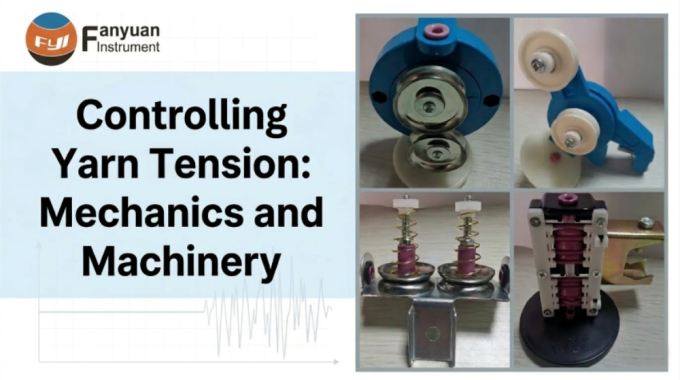
Yarn Tensioners are the “brakes” of the textile world. They are generally grouped by how they apply force or where they sit in the production line.
| Equipment Category | How it Works | Best Use Case |
| Mechanical | Uses physical weights, springs, or felt washers to create drag. | Simple, low-cost setups where extreme precision isn’t the priority. |
| Hydraulic | Relies on fluid pressure to maintain a smooth, dampened resistance. | High-load environments where you need to avoid jerky movements. |
| Electronic/Magnetic | Uses electromagnetic fields or sensors for near-instant adjustments. | Modern, high-speed automated lines that require “set it and forget it” accuracy. |
Specialized Applications
Different machines need different types of “grip.” Winding machines focus on package density—if the tension is wrong, the final spool will be too hard or too soft to use later. Spinning frames, meanwhile, use tension control primarily to prevent breaks during the delicate process of twisting fibers together.
What Actually Pulls the Strings? (The Variables)
Stable tension is the result of balancing several competing factors. If one shifts, the whole line can suffer.
1. The Yarn’s “Personality”
- Weight (Linear Density): Thicker yarns (higher counts) generally need a tighter grip. If you switch from a fine thread to a heavy cord without recalibrating, you’ll end up with slack or snap-offs.
- Stretch (Elasticity): High-stretch yarns are more forgiving. They act like a shock absorber, soaking up minor speed bumps in the process.
- Break Point (Strength): This is your hard limit. High-strength yarns let you push the machines faster, whereas delicate fibers require a much softer touch.
2. The Machine’s Condition
The hardware is the primary source of tension, but it’s also the primary source of error.
- The “Eyes” (Sensors): If a sensor is sluggish or dirty, the system won’t see a tension spike until the yarn has already snapped.
- The “Brain” (Controllers): A good controller reacts in milliseconds. Slow response times lead to “hunting”—where the machine over-corrects, making the tension bounce up and down.
- Mechanical Wear: Vibration and worn-down guides create inconsistent friction, which is the enemy of steady tension.
3. Process & Environment

- Speed: As the RPMs go up, so does the tension. Centrifugal force and air drag start to play a massive role at high speeds.
- Heat & Friction: Moving yarn creates heat. If the fiber gets too hot, its physical properties change, often making the tension go haywire.
- The Room Itself: Yarn is thirsty. High humidity makes fibers heavy and slightly “sticky,” which drops the tension. Dry air makes them brittle and prone to static, which spikes it.
Modern Control Strategies
We’ve moved past simple weighted discs. Today’s mills use a mix of “old school” mechanics and “new school” physics.
Mechanical & Automatic Systems
The standard approach involves tension regulators—physical components that apply friction—coupled with automatic feedback loops. The sensor feels a change, the controller calculates the fix, and a motor adjusts the pressure. It’s a constant, microscopic tug-of-war.
“Smart” and Predictive Control
Advanced setups now use Neural Networks or Fuzzy Logic. Instead of just reacting to a problem, these systems look at historical data to predict when a tension spike is coming. They “learn” that at a certain speed with a certain batch of cotton, the tension tends to rise, and they adjust before the sensor even registers a change.
Non-Contact Methods (Optical & Air)
Sometimes, touching the yarn is the problem.
- Optical/Laser: These use light to watch the yarn’s vibration or displacement. By measuring how much the yarn “wiggles,” the system calculates the tension without ever adding friction.
- Airflow: Using air pressure to guide the yarn path. This is the ultimate “soft touch” for high-performance or ultra-delicate fibers that would be damaged by mechanical plates.
Summary Table: Control Tech Comparison
| Method | Best For | Pros | Cons |
| Mechanical | Standard weaving/spinning | Cheap, reliable, easy to fix. | Low precision; wears out. |
| Intelligent (AI) | High-speed, variable lines | Predictive; handles complex fibers. | Expensive; requires tech experts. |
| Optical | Delicate or high-spec fibers | No contact; extremely fast. | Sensitive to dust/lint in the air. |
| Airflow | Specialty/Fragile yarns | No friction damage. | High energy/compressed air cost. |