
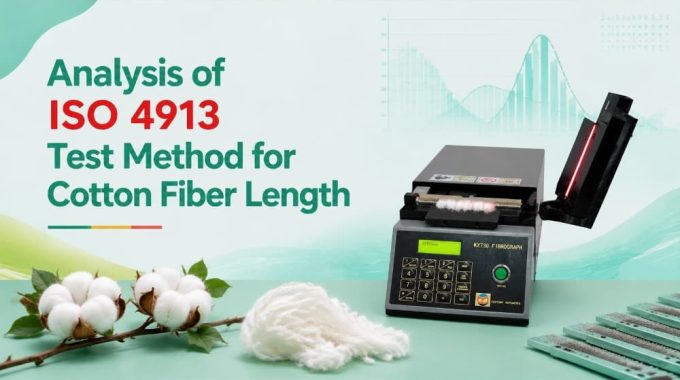
Analysis of ISO 4913 Test Method for Cotton Fiber Length
ISO 4913 is an international standard method for determining the span length and uniformity index of raw and semi-processed cotton fibers. Based on optical scanning technology, this standard obtains continuous information on fiber length distribution through non-destructive measurement of processed cotton fiber bundles, thereby assessing the spinnability and processing stability of cotton fibers. Cotton fiber length is one of the important fundamental indicators determining yarn strength, evenness, and breakage rate, while the concentration of length distribution further affects the drafting stability and yarn structure consistency during spinning. Therefore, this standard is not only a testing method but also a key component of the textile raw material quality evaluation system.
In actual testing, ISO 4913 emphasizes the measurement of “fiber group distribution characteristics” rather than the ideal length of a single fiber. This distinguishes it from traditional manual measurement methods. By scanning randomly arranged and combed cotton fiber bundles with optical instruments, the system can record the distribution ratio of fibers of different lengths in the bundles and further calculate key parameters such as span length and uniformity index. This testing approach, based on statistical distribution, makes the results more representative and more suitable for industrial quality control scenarios.
The Core Significance of Span Length and Regularity Index

Span length is one of the core length indicators in ISO 4913, defined by the geometric distribution characteristics of fiber bundles under controlled clamping conditions. Specifically, it represents the minimum distance required for a certain proportion of fibers to be covered or “straddled.” Internationally accepted expressions include 2.5% span length and 50% span length.
The 2.5% span length typically represents the characteristic length of the longest portion of fibers in the bundle. Its value is highly correlated with the staple length in traditional cotton grading, and is therefore commonly used for raw cotton grading and spinning process adaptation analysis. A higher value indicates a greater proportion of long fibers available for effective yarn production, theoretically increasing yarn strength and reducing breakage rate.
The 50% span length reflects the median distribution level of the fiber group, leaning more towards the overall average, and is used to describe the “typical length level” of the raw material. In industrial applications, this indicator is often used for cross-sectional comparisons between different batches of raw cotton, helping companies identify raw material fluctuations.
The uniformity index describes the evenness of fiber length distribution, essentially expressing the ratio between long and medium-length fibers. This index is typically calculated as the ratio of the 2.5% span length to the 50% span length. A higher value indicates a lower short fiber content, a more concentrated length distribution, and more consistent fiber stress during spinning, thus improving drafting stability and reducing the risk of hairiness and breakage. In actual production, the uniformity index is often highly correlated with spinnability and is one of the important bases for cotton blending decisions by spinning mills.
Scope of Application and Material Limitations

ISO 4913 has a clearly defined scope, applicable only to raw cotton or semi-finished cotton fibers that have undergone preliminary processing, such as cotton bundles after opening or the fiber state before combing. This limitation is determined by the structure of the test method itself, as optical scanning requires a relatively stable and disintegratable fiber bundle morphology.
This standard is not applicable to blends of cotton with other fibers. The significant differences in length, crimp, and optical properties among different fibers in blended systems can introduce systematic biases into the scanning results. Furthermore, this method is also unsuitable for recycled cotton fibers from cotton yarn or fabrics, as they have undergone mechanical breakage and reprocessing, and their length distribution no longer reflects the natural characteristics of the original cotton. These limitations ensure the comparability and standardization of the test results.
Standard version evolution and changes in technology path

ISO 4913:1981 was the initial version of this standard, its core feature being the establishment of a semi-mechanized testing framework based on optical scanning. At this stage, sample preparation still relied heavily on manual operations, including humidification, fiber opening, fiber combing, and fiber spreading. Although the testing equipment possessed optical measurement capabilities, data processing and result calculation still required manual or semi-automatic systems. Therefore, this version was more suitable for laboratory research and basic quality assessment.
With the increasing automation in the textile industry and the widespread adoption of High Volume Instruments (HVI), the cotton fiber testing system has gradually undergone structural changes. HVI systems can complete the testing of a large number of samples in a short time and simultaneously output multiple indicators such as length, strength, and fineness, gradually replacing traditional single optical methods.
Against this backdrop, international standards have gradually migrated to HVI-based testing methods such as ISO 16549:2004. These methods not only improve testing efficiency but also enhance data consistency and cross-laboratory comparability. Meanwhile, in some quality arbitration or scientific research scenarios, ISO 4913 is still used in conjunction with traditional methods such as ASTM D1447 to ensure the historical continuity of data and the ability to compare different systems.
Comparison of testing methods and differences in industrial applications
The main differences between ISO 4913 and the modern HVI system lie in three aspects: testing efficiency, indicator system, and application scenarios.
Regarding testing efficiency, ISO 4913 relies on manual preparation of fiber bundles and optical scanning, resulting in a more complex process and slower testing speed, making it suitable for small-batch or research-oriented testing. In contrast, the HVI system is highly automated, requiring almost no manual intervention from sample input to result output, making it suitable for large-scale industrial testing and rapid quality control.
Regarding the parameter system, ISO 4913 primarily provides two core indicators: span length and uniformity index, focusing on the basic description of fiber length distribution. The HVI system, however, expands upon this with more industrial parameters, including body length, short fiber index, length uniformity index, and strength index, thus forming a more complete raw material evaluation system. This expansion makes HVI more suitable for cotton blending optimization and supply chain management in modern spinning mills.
In terms of industry applications, ISO 4913 is more commonly used for laboratory calibration, method comparison, and quality arbitration, and its results have strong standard reference value. The HVI system is widely used in commercial trade, raw cotton grading, and daily production control in spinning mills, becoming the mainstream technical approach for cotton quality evaluation globally.
This comparison shows that ISO 4913 plays more of a “benchmark method” role in modern systems, while the HVI system plays a “production tool” role. The two complement each other in their functional positioning, together forming a complete technical framework for cotton fiber length testing.