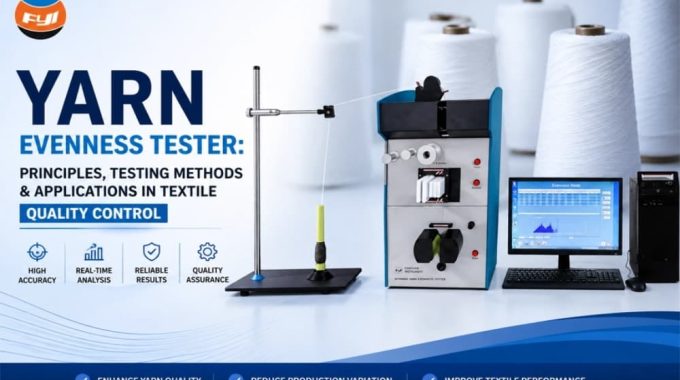
Yarn Evenness Tester: Principles, Testing Methods & Applications in Textile Quality Control
The uniformity of yarn is measured by the yarn evenness tester by determining the deviations in mass, thickness, neps, and other irregularities. It is also frequently utilized in research institutes, universities, textile laboratories, spinning mills, and quality control departments for the assessment of yarn quality and the improvement of production processes. It explains how the machine works, the various test procedures, the important test parameters, the use of the machine in the industry, and what to look for in choosing a yarn evenness tester.
Yarn evenness testers help to stabilize the yarn manufacturing process, minimize defects, and maintain consistent yarn performance by providing accurate and repeatable test data. They also play a vital role in quality control, product development, and adherence to industry standards for testing, serving as a key tool in modern textile testing and research.
What Is a Yarn Evenness Tester and How Does It Work?
A yarn evenness tester is a high-precision textile testing machine that is used to test the uniformity of yarn and measure the differences in mass, thickness, neps, thin places, thick places, and hairiness. It gives valuable quantitative information about yarn, which is useful for evaluating the quality of the yarn, detecting irregularities in the spinning process, and for normal production. Evenness testers are the most popular instruments in spinning mills, textile laboratories, research institutes, universities, and quality control units. Learn how a filament evenness tester works.
How Does a Yarn Evenness Tester Work?
A yarn evenness tester feeds yarn continuously through a high-precision sensor at a controlled speed. The yarns go through the sensing zone, and if the mass or diameter changes, it is detected and transduced to electrical signals. This instrument analyzes them in real-time and presents the information as numbers and graphically as reports.
Most of the modern testers are based on capacitive sensing technology, and some of the advanced testers also have optical sensors that are capable of assessing other yarn properties. Collected data is used for the computation of a number of quality parameters such as:
- U% (Unevenness): It determines the average mass difference between adjacent cross sections of the yarn.
- CV% (Coefficient of Variation): Shows the uniformity of yarn evenness.
- Thin Places: Weaving places where the yarn is not as thick as the standard.
- Thick Places: Places in which there is too much yarn mass.
- Neps: Small clusters of fibre entanglements which may impact the fabric’s appearance.
- Hairiness: Degree of fibre protruding from the surface of the yarn.
The test results are used by the manufacturer to detect process variations, to optimize spinning parameters, to minimize defects, as well as to assure the yarn’s quality prior to weaving, knitting or dyeing.
Yarn Evenness Testing Principle: Capacitance Measurement Explained
The main principle of modern yarn evenness testers is the capacitance measurement principle, which is used for detection of differences in yarn mass. The linear density of the yarn changes, which influences the capacitance when it is passed through an electric field between two plates of capacitors. These changes are measured as electrical signals and evaluated for yarn evenness and imperfections. Learn about our yarn evenness tester spin 5600 here.
How Capacitance Measurement Works
Yarn is fed at a constant speed through a capacitive sensor. The fibers used to make the yarn are not the same as the air because their dielectric constant is different from that of air, so when the yarn’s mass or thickness changes, the capacitance between the sensor plates changes. These variations are continuously monitored by the tester and are converted into measurable quality parameters.

Signal Processing and Data Analysis
The amplified, filtered, and analyzed electrical signals from the sensor are processed by the instrument’s software. It provides calculation of important yarn quality parameters like Unevenness, Coefficient of Variation, Thin Places, Thick Places, Neps and Hairiness in the system. Most modern testers can also create statistical reports and evenness graphs to get a thorough look at quality.
Advantages of the Capacitance Method
The capacitance method is highly accurate, non-destructive, and provides real-time measurement, which can be used in laboratory research and industrial quality control. It allows for continuous monitoring of yarn uniformity, which helps the manufacturer to identify defects in the spinning process early, optimize the production parameters, and maintain the uniformity of the yarn.
Main Components of a Yarn Evenness Tester
The yarn evenness tester is made up of numerous integrated parts that make up the whole instrument to measure the uniformity of the yarn in high accuracy within a short period of time and give test results.
1. Yarn Feeding System
The uniformity of the speed of yarn through the instrument is guaranteed by the yarn feeding system. To obtain accurate and repeatable measurements, it is important to have yarn stability. Check our Automatic Evenness Tester SPIN6000 also.
2. Capacitive Sensor
The capacitive sensor is regarded as the main part of the measurement. It detects mass changes in yarn by measuring the capacitance changes as the mass of yarn is pulled between two sensor plates. These modifications are converted to electrical signals, which are then analyzed.
3. Signal Processing Unit
The electrical signals from the sensor are sent to the signal processing unit for amplifying and filtering the signals. It eliminates noise and converts raw data into measurable data such as U%, CV%, thin places, thick places, and neps.
4. Data Analysis Software
The software processes the data received, computes yarn quality indices, and provides the graphs, histograms, and statistical reports. It also stores the results of tests for quality control, comparison, and traceability.
5. Control Panel and Display
The control panel allows for the setting of test parameters, start/stop of testing and monitoring of the testing process. The display provides up-to-the-minute results and system status.
6. Data Output and Connectivity
Today’s yarn evenness testers are also able to communicate through USB cable, Ethernet or a computer, allowing the test results to be exported, stored and linked to the laboratory information management system (LIMS) or quality management system.

How to Test Yarn Evenness Step by Step
In order to measure the evenness of yarn accurately, the sample must be properly prepared, the conditions under which the evenness shall be tested shall be chosen, and the instrument shall be properly set. Here are the steps to ensure predictable and consistent results.
Step 1: Prepare the Yarn Sample
Stable temperature and humidity should be achieved with conditioning, as per the testing standard (e.g., ISO/ASTM). Select a sample that does not appear to be damaged or contaminated.
Step 2: Set Up the Instrument
Turn on the yarn evenness tester and set the test parameters: the yarn count, the speed of testing, the length of the test, and the criterion for evaluation. Check the calibration of the instrument.
Step 3: Thread the Yarn
Pass the yarn through the yarn guide, tension device and capacitive sensor as specified by the manufacturer. Make sure that the yarn flows easily, without too much tension or twisting.
Step 4: Start the Test
Begin the test and allow the yarn to pass through the sensor at a constant speed. The instrument will continually measure the change of mass and record anomalies throughout the test.
Step 5: Analyze the Results
Once the test is finished, examine the results, such as U%, CV%, thin places, thick places, neps, hairiness, and imperfections (IPI). Check for quality issues on the evenness graph and statistical report.
Step 6: Interpret and Report Findings
Compare the results with product specifications or applicable testing standards. Use results to optimize spinning parameters, control spinning processes, and record quality results for production or research.
Yarn Evenness Tester Results Explained: CV%, U%, CVm and Spectrogram
The yarn evenness tester produces several parameters relating to the quality of the product and irregularities in the yarn spinning process. These results enable the manufacturers to further optimise process control and guarantee the yarns behave the same in every production run.
1. CV% (Coefficient of Variation)
The percentage change in the mass of the yarns from the average mass is CV%. This is the most frequently used indication of the evenness of yarn. A bigger CV% value indicates more irregularity and inconsistency in the yarn, whereas a small CV% value indicates more uniformity in the yarn.
2. U% (Unevenness)
U% is the average % deviation from the mean of the masses of the yarns. It is an easy measurement of yarn irregularity and is a useful measure of the comparison of different lots of production.
3. CVm (Coefficient of Mass Variation)
The percent change of yarn mass longitudinally is called CVm. It is a more comprehensive measure of mass variation; it is a parameter that is employed by modern yarn testing systems to analyse and optimise the process.
4. Spectrogram Analysis
A spectrogram is a graph of irregularities as a function of wavelength and represents periodic variations in mass of the yarn. It aids in the detection of repeatable faults from mechanical problems like faulty rollers, drafting system problems, worn parts of the machine or spindle vibration. The spectrogram shows distinct peaks representing periodic faults, which need to be corrected.
How to Interpret the Results
The best quality yarn will have a low CV%, a low U%, and a smooth spectrogram with few periodic peaks. These parameters, combined, enable textile producers, quality control labs, and researchers to identify defects, streamline spinning operations, and guarantee uniformity of yarn quality.

Conclusion
The yarn evenness tester is an essential instrument in textile research, quality control, and production. It is used to accurately measure the uniformity of yarn and detect any irregularities, thus improving the spinning process, reducing faults, and ensuring the quality of yarn. By selecting the right tester and following the standard testing procedures, it is easy to obtain accurate results, meet industry standards, and make manufacturing quality textiles easier. Contact us for further information.