
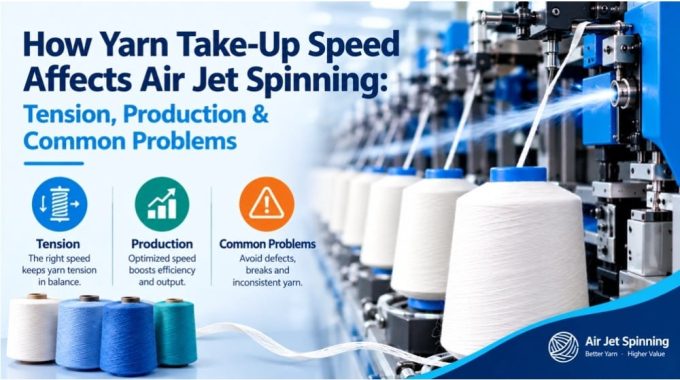
How Yarn Take-Up Speed Affects Air Jet Spinning: Tension, Production & Common Problems
When you operate an air jet spinning machine, yarn take-up speed directly affects your production rate, yarn tension, and process stability. If you set the speed incorrectly, you may experience tension fluctuations, inconsistent yarn formation, and production issues. By controlling take-up speed effectively, you can maintain consistent yarn quality, stable operation, and efficient production.
Role of the Yarn Take-Up System in Air Jet Spinning
How You Control Yarn Withdrawal
The take-up system is used to continually remove the spun yarn from the spinning zone at a predetermined rate. This withdrawal defines the length of time the fiber strand will be in the air vortex before being wound up. Take-up speed can be matched to the delivery of fiber to ensure a steady yarn formation and eliminate tension and slack.
How You Maintain Yarn Tension
The withdrawal force must be held constant, as it can alter the arrangement of the fibres and the structure of the yarn. Too fast a speed results in tension and can lead to yarn breaks; too slow can lead to slack and unsteady delivery. Good tension control will ensure that good, uniform yarn is produced throughout.
How You Support Consistent Package Formation
The yarn is transferred from the spinning zone to the winding zone at a controlled speed, while maintaining the uniformity of the package geometry and density. The stable take-up also helps in avoiding irregular yarn accumulation and minimising variations which may impact the unwinding and processing downstream.
How Take-Up Speed Affects Yarn Production
How You Increase Production Rate
Raising the take-up speed will increase the output of yarn as more will be removed from the spinning zone in the same production time. But you have to maintain a speed within the speed range of the machine’s stable operation. If the set speed is too high, yarn tension will also increase; it will affect the wrapping of the fibers, and yarn breaks will also be more frequent, resulting in a higher set speed but a lower output.
How You Balance Speed and Yarn Quality
Take-up speed must be matched with the fiber feed rate and spinning conditions—it is not an independent setting. If these parameters are in sync, it is possible to produce more without causing too much strain or irregularities in the yarn. If the speed ratio is not suitable, the structure of the yarn is likely to be unstable, which causes the production to be uneven.
How You Monitor Production Efficiency
Take-up speed should be judged by the actual amount of yarn produced, yarn breaks, machine stoppages, and consistency of yarn quality. Additional running speed does not increase productivity when frequent breaks and/or adjustments are needed. These factors can be monitored to select the operating speed that gives stable output and minimum losses in production.

Relationship Between Take-Up Speed and Yarn Tension
How Take-Up Speed Directly Affects Yarn Tension
The more you increase the take-up speed, the more the withdrawal force will increase, especially when the fiber delivery rate is not increased. The spinning zone has to be spun at a higher rate, which means that it can be subjected to higher tensile stress and be more sensitive to fiber formation.
How Fiber Feed Rate Influences the Speed–Tension Balance
The take-up speed must be synchronized with fiber feed speed to achieve a stable condition of yarn formation. Rise in tension if take-up increases when there is not enough fiber supply. If you match both rates, you will not over-extend your yarn or cause problems of yarn formation.
How Air Pressure Changes Yarn Tension
Take-up speed adjustment also requires taking into account air pressure and vortex conditions. The fiber movement and wrapping in the spinning zone change under the condition of varying air pressure. An increase in take-up speed when the air conditions are not appropriate can add to variations in fiber control and be a cause of tension variations.
How Excessive Tension Causes Yarn Breaks
Take-up tension can exceed the yarn’s strength under the spinning conditions, and more yarn breaks can be experienced. When the tension is high, it puts extra strain on weak areas of yarn, especially in areas where fiber integration may not be uniform. The operating range should be maintained that will minimize unnecessary breakage.

How You Stabilize Tension During Production
Yarn tension should be observed when adjusting take-up speed, and changes in yarn breaks, yarn irregularity, and winding behavior should be checked. By maintaining the take-up, fiber feed, air pressure, and winding conditions in sync, you can achieve a more uniform tension profile during production.
Common Take-Up Problems and Their Causes
Yarn Breakage During Take-Up
If the take-up tension is excessive or if it is changing quickly, you will find that you’re breaking yarn frequently. Too fast a take-up speed, lack of uniformity in fiber formation, improper tensions, or damaged contact parts may create tension in the yarn and result in yarn breaks.
Uneven Yarn Tension
Unstable tension may result from one of the following: take-up speed is not steady, or the yarn path has too much friction. Tension fluctuation can also be caused by variations in drive performance, worn rollers, misalignment, and inconsistent winding resistance.
Yarn Slippage at the Take-Up Rollers
Sometimes irregular withdrawal may be noticed when the yarn comes in contact with the take-up rollers. The surface may be contaminated, the coverings may be worn, the roller pressure may be inadequate, or the routing of yarns may be wrong, all of which can cause inconsistent yarn delivery and reduce traction.
Irregular Package Formation
Irregular packages or under-compacted packages can be created when the yarn flow to the winding unit is not smooth. Differences in take-up speed, traverse setting, yarn tension or winding pressure can lead to differences in package density or shape.
Excessive Yarn Slack
Loops or slack yarn can be observed if the take-up rate is inadequate compared to the yarn formation and winding rates. Additional slack can result in poor drive response, improper speed synchronisation, or too much friction in the yarn path, which will further cause problems with continuous winding.
| Take-Up Problem | Common Causes | Effect on Production |
| Yarn breakage | Excessive speed, high tension, weak yarn formation | Machine stoppages and lower output |
| Uneven tension | Speed fluctuation, worn rollers, poor alignment | Yarn irregularity and unstable winding |
| Roller slippage | Low pressure, contamination, worn surfaces | Inconsistent yarn withdrawal |
| Irregular package | Unstable speed, tension, or winding pressure | Poor package density and shape |
| Excessive slack | Low take-up speed, poor synchronization | Loose yarn and winding disruption |
How to Maintain a Stable Yarn Take-Up Process
Keep Take-Up Speed Consistent
After the machine reaches steady-state operation, the take-up speed should not be changed. Often changing speed can change the withdrawal force on the yarn and cause tension fluctuations. Make smooth changes during set-up processes and do not implement unnecessary changes during the continuous production process.

Match Take-Up Speed With Fiber Delivery
Take-up rate has to be matched with fiber feed rate and yarn formation rate. When the yarn is pulled faster than it is spun, there is a possibility of increasing tension and frequent yarn breaks. Too slow withdrawals can result in slack and disrupt downstream winding.
Keep Take-Up Rollers & Guides in place
The take-up rollers, guides, bearings, and contact surfaces should be checked periodically. Friction may be altered, and the ability to maintain a consistent yarn traction may be affected due to wear, fiber deposits, contamination or misalignment. Clean contact surfaces and change worn surfaces when these no longer provide good yarn movement.
Take-Up & Winding Synch
The take up/winding system must be synchronized with the production process. The winding machine must be able to feed in yarn at a controlled speed, with no excess pulling tension, and no slack. Ensuring the correct synchronization leads to an even package density and to a lower number of interruptions due to winding.
Track Air Pressure and Spinning Situation
The air pressure and vortex condition of the machine will be within the specified operating range, as they have an impact on the movement of fiber and the formation of yarn before the take-up. When these conditions change while take-up speed remains constant, yarn tension and structure may also change. Having control over both spinning and take-up parameters gives you better control over the process.
View Yarn Quality and Production Data
Take-up settings should be compared with yarn tension, yarn breaks, irregularity, production rate, and package quality. This enables you to determine if a speed change is making a difference to production, or just adding stress to the operation. These measurements are not used to optimize take-up speed, but rather combined to set stable operating conditions.
Conclusion: Optimize Yarn Take-Up for Stable Air Jet Spinning
Air jet spinning performance can be enhanced by controlling the take-up speed, fiber delivery, and winding being maintained in synchronization to maintain a consistent yarn tension. Rolling, guide, and yarn path inspection also help to prevent yarn breakage, slippage, and package defects. FYI Tester can offer you the necessary testing equipment and spinning equipment for textiles to test the performance of yarn and the stability of the spinning process to meet the production and quality inspection needs.


