
Air Permeability Tester: Complete Guide for Textile Testing
Air permeability testing is essential for measuring how easily air flows through fabrics and materials. This testing helps determine if materials are suitable for specific uses like clothing, filters, or industrial applications.
Whether you work in a textile mill, research lab or quality control department, understanding air permeability testers is key to your success. These instruments measure air flow rate through fabric samples under controlled pressure conditions.
The results help manufacturers make better products, researchers develop new materials and quality control teams ensure product consistency.
This article covers everything you need to know about air permeability testers, from the basics to advanced features and maintenance.
What is Air Permeability?

Air permeability is a fundamental property that measures how much air can pass through a material. This determines if a fabric is suitable for outdoor clothing, filters or industrial use.
Air permeability is the rate at which air flows through a material under a specific pressure difference. When you think about it simply, some fabrics let air pass through easily (like mosquito nets) and others block air completely (like raincoats). This difference in air flow is what we call air permeability.
The measurement shows how much air passes through a given area of material in a specific time period under controlled pressure conditions. Scientists and manufacturers measure this property to see how materials will perform in real life.
Why Does Air Permeability Matter?
Air permeability affects many aspects of material performance. In clothing it determines breathability and comfort. Fabrics with high air permeability let air flow freely, keeping the wearer cool and comfortable. Fabrics with low air permeability provide wind protection but may feel stuffy if not designed properly.
For industrial applications air permeability is crucial for filters which must allow air to pass while blocking particles. The right balance ensures effective filtration without restricting airflow too much.
What Affects Air Permeability?
Several things affect how air passes through materials:
- Fabric Structure plays the biggest role. Tightly woven fabrics have lower air permeability than loosely woven ones. The spaces between yarns create pathways for air flow.
- Fiber Type affects permeability through its surface properties and how fibers interact with each other. Natural fibers behave differently from synthetic ones.
- Yarn Count and Density determines how much open space is in the fabric structure. Higher yarn counts usually mean tighter fabrics with lower air permeability.
- Finishing Treatments like coatings or chemical treatments can dramatically change air permeability. Waterproof coatings reduce air flow, some treatments increase it.
- Fabric Thickness affects air permeability but the relationship isn’t always straightforward. Sometimes thicker fabrics have higher permeability due to their structure.
Understanding these factors helps manufacturers control air permeability during production and helps users choose the right material for their needs.
Types of Air Permeability Testers
Understanding different types of air permeability testers will help you choose the right one for you. Each type has its own features and capabilities for different testing requirements and budget.
1. Automatic Air Permeability Tester YG461F
The Automatic Air Permeability Tester YG461F is the latest automated fabric testing technology. This advanced instrument automatically measures air permeability for knitted fabrics, woven textiles, non-woven materials, coated fabrics, paper, films and leather products.
This automatic system measures air flow rate through fabric samples under controlled pressure. The instrument calculates results in mm/s units, meets international standards GB/T 5453, ISO 9237, ASTM D737.

YG461F Features:
- 7-inch color touch screen for easy operation and control
- Automatic range selection based on fabric air permeability flow
- Automatic test head detection for quick and easy test head changes
- Advanced leak prevention design with near-zero air leakage
- WiFi connectivity for remote data transmission
- Excel file export for data analysis
- SD card storage for backup and portability
YG461F operates by clamping specimen over the test head opening. Pressing down the clamping arm starts the vacuum pump. The instrument maintains pre-selected test pressure and display results in seconds. This automation reduces operator error and increases testing efficiency and repeatability.
2. Air Permeability Tester YG461E
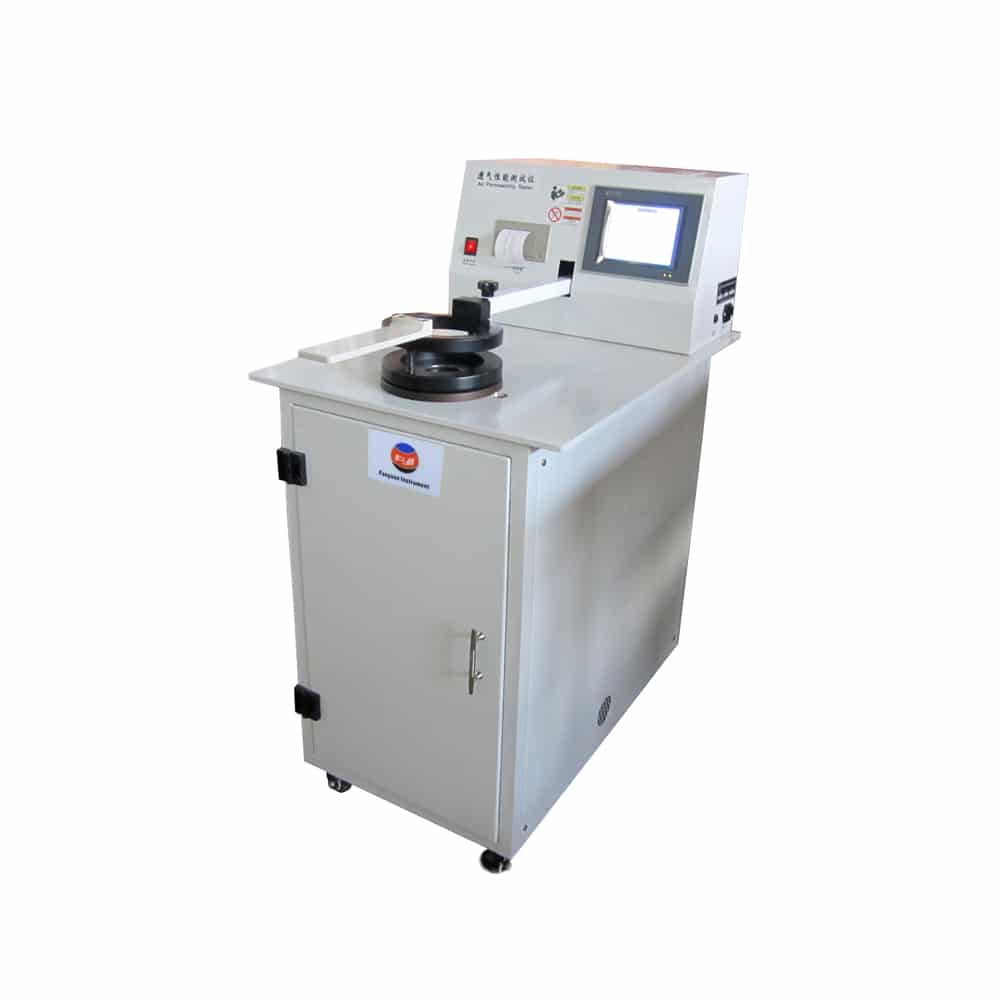
The Air Permeability Tester YG461E is a digital air permeability testing solution for testing air passage resistance in textile materials. This instrument works for woven fabrics, knitted materials, non-woven textiles, industrial filter papers and filter cloths.
This digital system replaces traditional water column method with high precision sensor technology, more accurate and reliable. The instrument has power fail safeguard function, protect your test and data during power failure.
YG461E Features:
- 32-bit industrial-grade MCU (Mitsubishi, Japan) for high stability
- Microcomputer control system with branded high-accuracy pressure sensors
- Digital feedback and air volume adjustment for precise control
- Automatic pressure difference monitoring with high stability* Full range calibrated nozzles for high accuracy
- Large HD LCD display for easy to read result
- Auto unit conversion between air permeability rate and volume
- Bilingual (Chinese and English) with menu operation
- Built-in printer for print result
- Data storage up to 99 groups
YG461E meets multiple international standards: GB/T5453, ISO9237, AFNOR G07-111, ASTM D737, BS 5636, JIS L 1096-A, DIN 53887. Suitable for global manufacturing and research.
Working Principles and Testing Methods

The basic working principle of air permeability testing is to create a controlled pressure difference across a material sample and measure the resulting air flow. This requires precise pressure control, accurate flow measurement and proper sample mounting to get reliable results.
1. Basic Operating Principle
Air permeability testers work by creating a known pressure differential between two surfaces of a test specimen.
The testing system uses calibrated pumps or fans to create positive or negative pressure on one side of the sample and atmospheric pressure on the other side.
The volume of air passing through the material per unit time at this specific pressure difference is the material’s air permeability characteristics.
The measurement process involves several critical components working together. The pressure control system maintains stable differential pressure across the sample.
Flow measurement sensors detect and quantify the air volume passing through the specimen. Temperature and humidity sensors provide environmental compensation to get accurate results under varying conditions.
2. Pressure Control Systems
Modern air permeability testers use advanced pressure control systems to maintain consistent testing conditions.
These systems usually employ variable speed pumps or fans controlled by electronic feedback loops. Pressure sensors continuously monitor the differential pressure across the sample and adjust pump speed to maintain the set pressure.
Pressure control accuracy affects measurement reliability. High quality systems maintain pressure stability within ±1% of the set point during the entire test duration.
This stability ensures consistent results regardless of minor variations in sample properties or environmental conditions.
3. Flow Measurement Technology
Accurate flow measurement is the heart of air permeability testing. Modern instruments use various flow measurement technologies, each with its own advantages for different applications and measurement ranges.
Orifice Plate Systems use calibrated orifices with pressure drop measurements to calculate flow rates. These systems are very accurate across wide flow ranges and have good long term stability. The multiple orifice configuration allows automatic range selection based on sample permeability.
Mass Flow Sensors directly measure air mass flow through the sample and automatically compensate for temperature and pressure variations. These sensors are very accurate and have fast response time, ideal for automated testing systems.
Rotameter Systems use variable area flow meters with floating indicators to show flow rates. While less common in modern systems, these mechanical indicators provide visual flow indication and don’t require electrical power.
4. Sample Mounting Techniques
Proper sample mounting is critical for air permeability testing. The mounting system must create an airtight seal around the test area and not compress or distort the sample structure.Clamping Systems use mechanical pressure to hold samples between test heads and sealing gaskets. The clamping force must be enough to prevent air leakage without compressing the sample too much. Modern systems use pneumatic or spring loaded clamping mechanisms to ensure consistent mounting pressure.
Guard Ring Technology prevents edge leakage by creating a secondary sealed chamber around the main test area. This technology ensures all measured air flow goes through the sample material and not around the edges. Guard ring systems are necessary for testing low permeability materials.
5. Testing Methods
Standard testing methods ensure consistent and reliable results across different operators and labs. These methods involve sample conditioning, mounting, pressure stabilization and measurement phases.
Sample Conditioning requires samples to be kept at standard atmospheric conditions (20°C ± 2°C, 65% ± 4% relative humidity) for at least 24 hours before testing. This conditioning ensures consistent moisture content which affects air permeability results.
Pressure Stabilization is the time the system takes to reach equilibrium pressure before taking measurements. This stabilization time is between 10 to 30 seconds depending on sample permeability and system volume.
Multiple Measurements are often required to get statistical confidence in results. Standard practice is to test multiple specimens from the same sample and calculate average values with statistical analysis.
Performance and Technical Parameters

Understanding technical specifications helps you choose the right equipment for your testing needs. Key performance parameters include measurement accuracy, pressure range, flow measurement range and automation features.
1. Measurement Accuracy and Precision
Measurement accuracy is how close the test results are to the true air permeability value of the sample. Modern air permeability testers typically achieve ±2% of reading across their measurement range.
This accuracy depends on pressure control stability, flow measurement precision and temperature compensation effectiveness.
Repeatability is how consistently the instrument produces the same results when testing the same sample under the same conditions. High quality systems achieve repeatability of ±1% coefficient of variation. This is important for quality control applications where small variations must be detected.
Reproducibility is how well the results agree when the same sample is tested on different instruments or by different operators. Good reproducibility requires standardized procedures, proper calibration and consistent environmental conditions.
2. Pressure Range and Control
The pressure range determines what materials can be tested on a particular instrument. Most textile testing applications use pressure differentials between 100 and 2500 Pascals. Lower pressures are for highly permeable materials like open-weave fabrics, higher pressures for tight-weave or coated materials.
Pressure Control Stability affects measurement consistency and accuracy. Professional grade instruments maintain pressure within ±1% of the set point during the test. This requires sophisticated feedback control systems and high quality pressure sensors.
Multiple Pressure Capability allows testing at different pressure levels to understand pressure dependent permeability behavior. Some materials show non-linear relationship between pressure and flow rate, making multi-pressure testing valuable for complete characterization.
3. Flow Measurement Range
The flow measurement range must cover all materials you plan to test. Typical ranges are 0.1 to 10,000 mm/s air velocity, from nearly impermeable films to highly open fabrics.
Automatic Range Selection improves testing efficiency by automatically selecting the right measurement range based on the sample permeability. This eliminates manual range selection and ensures optimal measurement accuracy across different sample types.
Multi-Unit Display shows results in different units like mm/s air velocity, L/m²/s volume flow and cfm/ft² imperial units. This accommodates different international standards and user preferences.
4. Environmental Compensation
Air permeability measurements are sensitive to environmental conditions, especially temperature and barometric pressure. Professional testing equipment includes automatic environmental compensation to correct the readings to standard conditions.### 5. Data Management and Communication
Modern air permeability testers have advanced data management features to increase productivity and meet quality system requirements.
Internal Data Storage capacity ranges from dozens to thousands of test results depending on the instrument. Large storage capacity allows batch testing without frequent data download and supports historical data analysis.
Connectivity Options are USB, WiFi, Ethernet and SD card for data transfer and backup. WiFi enables real-time data sharing and remote monitoring.
Software Integration with laboratory information management systems (LIMS) simplifies data flow and automated reporting. Some systems have built-in statistical analysis and report generation.
Industry Testing Standards Compliance

Compliance with international testing standards ensures results are valid and products are globally accepted. Understanding these standards helps you choose the right equipment and testing procedures.
1. Major International Standards
ASTM D737 is the US standard for textile air permeability testing. This standard specifies test conditions including 125 Pa pressure differential, 38.3 cm² test area and sample preparation procedures. It emphasizes measurement accuracy and has procedures for different fabric types.
ISO 9237 is the international standard for textile air permeability testing. This standard is more flexible than ASTM D737, allowing various pressure levels (100 Pa or 200 Pa) and test area options. ISO 9237 includes uncertainty analysis and international comparability provisions.
GB/T 5453 is the Chinese national standard that follows ISO 9237 with some local modifications. This standard is mandatory for textile products sold in China and increasingly important for global manufacturers.
2. Specialized Application Standards
Medical Textile Standards like ASTM F2101 have stricter requirements for surgical drapes, gowns and other medical textiles. These standards often require testing at multiple pressure levels and bioburden resistance evaluation.
Filtration Standards such as ASHRAE 52.2 and EN 779 cover air filtration applications. These standards specify testing at multiple flow rates with particle efficiency measurements integrated with air permeability testing.
Automotive Standards cover cabin air filters, engine air filters and interior materials. These specialized standards often require testing at elevated temperatures or with specific challenge aerosols.
3. Calibration and Traceability Requirements
Measurement Traceability to national standards ensures results are accurate and supports lab accreditation. This traceability requires annual calibration with certificates from accredited calibration labs.
Reference Standards provide convenient traceability verification between formal calibrations. These standards include perforated metal sheets with known flow characteristics or certified fabric samples with established permeability values.
Quality Control Procedures should include regular verification using check standards, control charts for system stability and participation in inter-lab comparison programs.
Product Quality and Brand Reputation

Equipment quality affects measurement accuracy, reliability and long term satisfaction. Evaluating manufacturer reputation and product quality ensures successful equipment investment.
1. Manufacturing Quality Indicators
Construction Materials should include corrosion resistant components, precision machined test chambers and high quality sealing systems. Top manufacturers use materials like anodized aluminum, stainless steel and specialized rubber compounds that maintain properties over time.
Component Specifications reflect overall quality. Look for branded sensors, certified calibration standards and components with documented specifications and warranties. Good manufacturers provide component information and replacement part availability.
Quality System Certification like ISO 9001 means systematic quality control during manufacturing. These certifications require documented procedures, regular audits and continuous improvement programs that benefit the end user.
2. Service and Support Infrastructure
Technical Support Availability varies greatly between manufacturers. Top suppliers have multilingual support with applications specialists who can help with method development, troubleshooting and optimization. Some manufacturers offer remote diagnostic capabilities for fast problem resolution.
Service Network Coverage is important for complex equipment that requires specialized maintenance. Good manufacturers have global service networks with trained technicians who can do on site calibration, repair and maintenance.
Parts Availability ensures long term equipment viability. Good manufacturers have parts inventory for discontinued models and provide advance notice of parts obsolescence. Consider parts availability when evaluating equipment with expected service life over 10 years.
3. Training and Documentation Quality
User Training Programs impact operator success with complex equipment. Good programs should cover operation procedures, maintenance requirements, troubleshooting techniques and method development principles.
Documentation Standards vary greatly between manufacturers. Top suppliers provide detailed user manuals with troubleshooting guides, maintenance schedules and application examples. Some manufacturers offer video training resources and online documentation access.
Application Support includes method development assistance, sample preparation guidance and result interpretation help. This support is especially valuable for research applications or when testing unusual materials.
Cost and Maintenance Requirements

Understanding total cost of ownership helps you make informed equipment decisions that balance upfront investment with long term operational expenses.
1. Upfront Investment
Equipment Pricing varies greatly based on automation level, accuracy specs and features. Basic manual systems for routine quality control cost $15,000-30,000 while fully automated research grade instruments can be over $100,000.
Installation Costs include electrical work, compressed air supply, environmental controls and operator training. Budget 10-20% of equipment cost for proper installation and startup.
Accessory Requirements like extra test heads, sample prep tools and calibration standards add to upfront costs. Evaluate your total testing needs when calculating upfront investment.
2. Operating Cost
Calibration Costs are $2,000-5,000 per year depending on system complexity and service provider rates. Some manufacturers offer calibration programs with discounted rates for multi-year contracts.
Maintenance Costs for modern systems require minimal routine maintenance, just filter replacement and periodic cleaning. Annual maintenance contracts are 8-12% of purchase price but provide predictable budgeting and priority service response.
Consumable Costs are sample mounting gaskets, filters and calibration standards. High quality systems minimize consumable costs through durable components and longer replacement intervals.
3. Productivity Benefits
Throughput Improvements from automated systems can increase testing capacity 200-300% compared to manual instruments. This can justify higher upfront costs through reduced labor and faster turnaround times.
Quality Improvements from better measurement accuracy and reproducibility can prevent product recalls, reduce raw material waste and improve customer satisfaction. These benefits can provide big ROI through reduced warranty claims and improved reputation.
Data Management Benefits eliminate manual transcription errors and provide immediate access to historical data for trending and process optimization. These capabilities support continuous improvement programs and regulatory compliance.
4. Maintenance Best Practices
Preventive Maintenance schedules should include regular cleaning, calibration verification and component inspection to prevent major failures and maintain measurement accuracy. Create maintenance schedules based on usage and manufacturer recommendations.
Operator Training reduces equipment damage and measurement errors. Invest in comprehensive training programs and establish standard operating procedures for all testing activities.
Environmental Controls in the testing lab extend equipment life and improve measurement reproducibility. Consider lab climate control as part of the total system investment.Stock spare parts for gaskets, filters and sensors to minimize downtime when they need to be replaced.
Future Trends and Technology

The air permeability testing world is changing with new technologies and applications driving innovation in testing equipment and methods.
1. Automation and AI
Artificial Intelligence is being used in result interpretation, method optimisation and predictive maintenance. AI can identify unusual test results, suggest optimal test parameters and predict equipment maintenance needs based on usage patterns.
Robotic Sample Handling systems are being developed for high throughput testing. These systems can automatically position samples, run multiple tests and sort samples based on test results.
Machine Learning is being used to correlate air permeability results with end use performance, reducing the need for extensive product testing and improving product development efficiency.
2. Enhanced Measurement
Multi-Parameter Testing combines air permeability with other fabric properties like water vapour transmission, thermal resistance and liquid penetration in one instrument.
This reduces testing time and sample requirements and gives full material characterisation.
Real-Time Monitoring allows continuous measurement during manufacturing processes so you can adjust production parameters on the fly to meet product specifications.
Micro-Scale Testing allows air permeability measurement on very small samples, supporting research into new fibre technologies and advanced material structures.
3. Sustainability and Environment
Energy Efficiency improvements in the equipment reduce environmental impact and operating costs. New pump technologies and control systems use significantly less power than traditional equipment.
Sustainable Materials in the equipment reduce environmental impact and performance is maintained. Manufacturers are using recycled materials and designing for end of life recycling.
Reduced Sample Requirements through better testing methods minimizes material waste during product development and quality control.
Conclusion
Air permeability testing is key to modern textile and material development, quality control and research.
The right equipment will help you develop better products, ensure consistency and meet international standards.
Whether you choose the advanced YG461F auto or the reliable YG461E digital, investing in quality equipment will pay off in accuracy, productivity and long term cost savings.
Think about your testing needs, budget and future expansion when choosing equipment.
With proper selection, installation and maintenance your air permeability tester will serve you for years to come supporting your quality and research goals.
Contact FYI Tester today to talk about your testing requirements and find the right air permeability testing solution for your lab.