
Comparison of footwear anti-slip test methods
The slip resistance of shoes directly affects safety and comfort during wear. Poor slip resistance can easily lead to slipping and falling while walking. Slips, trips, and falls are already recognized as one of the main causes of accidents in workplaces, public areas, and home environments. The slip resistance of footwear can be represented by the dynamic and static coefficients of friction between the sole and the ground. A higher coefficient of friction indicates better slip resistance.
Basic Principle of Slip Testing
From a mechanical perspective, the sliding friction force between two contacting objects depends on two factors: the coefficient of friction between their contact surfaces and the normal force applied to the object. The slip resistance between two contacting objects can be represented by the magnitude of the coefficient of friction. According to tribological principles, μ = f/N, where μ is the coefficient of friction, f is the friction force, and N is the normal force. It can be seen that the coefficient of friction is a dimensionless ratio, representing the force required to initiate movement relative to the normal force. The sliding friction coefficient is related to the materials of the contacting objects, surface smoothness, dryness/wetness, surface temperature, relative motion speed, and the normal force between the objects.
Comparison of Slip Resistance Test Methods for Footwear
Currently effective domestic and international test methods for the slip resistance of footwear are detailed below.
GB/T 3903.6 “Footwear – General Test Methods – Slip Resistance”
This method’s principle involves placing the sample on a test plane (glass plate), using glycerol as a lubricant, applying a given load (25 kg), and then moving the sample horizontally relative to the test plate via a lateral traction force to measure the dynamic friction force and calculate the dynamic coefficient of friction . Although this is a general test method for footwear, it has the following shortcomings:
- When calculating the coefficient of friction, the standard specifies “Vertical load = Last mass + Fixture mass + Counterweight mass”. Different samples require different test lasts, leading to different vertical loads, yet the coefficient of friction is related to the vertical load.
- The specification for the test plate is insufficiently detailed, only specifying a glass plate without surface scratches, lacking an effective calibration method to ensure uniformity of test plates.
- It specifies sample shoe sizes as men’s 255, 260, 265 and women’s 235, 240, 245, making it impossible to test finished children’s shoes with smaller sizes.
- According to a report by Shi Yiwei (“Research and Discussion on Footwear Slip Resistance and Testing Equipment”), the repeatability of test results using this method is poor.
HG/T 3780 “Test Method for Static Slip Resistance of Footwear”
This method’s principle involves placing the specified sample horizontally on a required friction panel (ground glass) with the test surface facing down, applying a certain load, pulling the sample at a certain speed using a horizontal pulling method, measuring the maximum pulling force, and calculating the static coefficient of friction to measure the sample’s static slip resistance. This method has the following issues:
- It is only applicable for testing the static slip resistance of footwear outsoles, heels, or related outsole materials, not for complete footwear.
- Although the friction panel is specified as “float ground glass with a specular gloss of 4”, actual calibration results show significant variations in the specular gloss across different areas of the ground glass surface, making it difficult to achieve uniform specular gloss accurately.
- For heel surfaces with small areas, it cannot meet the sample cutting requirements.
GB/T 28287 “Test Method for Slip Resistance of Protective Footwear” (MOD ISO 13287:2006) and Similar Standards
The test principle involves placing the test shoe on a test plane, applying a specified normal force, moving the shoe horizontally relative to the plane (or moving the plane horizontally relative to the shoe), measuring the friction force, and calculating the dynamic coefficient of friction. Foreign standards with essentially the same test principle and instrumentation include: ISO 13287:2012, ASTM F2913-11, SATRA TM144:2011. A comparison of these standards is shown in the table below.
| Standard | Scope of Application | Medium | Standard Flooring | Flooring Calibration | Friction Force Measurement Method | Main Differences |
| GB/T 28287-2012 | Footwear with traditional type soles (not suitable for shoes with studs, metal cleats, or similar structures) | Glycerol, Detergent (Sodium Lauryl Sulfate solution) | Steel plate, Tile 1 | Test with standard rubber block on Tile 1 coated with detergent; COF must be within 0.18~0.22 | Average friction force between 0.3~0.6 s after sliding starts | 1. Different COF requirements for tiles 2. Different media used for tile calibration 3. Different scope: first two apply to finished footwear, latter two also apply to various shoe materials and specify methods/procedures for material testing 4. SATRA TM144 adds apparatus and procedure for testing on ice 5. Different friction force measurement methods |
| ISO 13287:2012(E) | Applicable to safety footwear, protective footwear, occupational footwear (not suitable for studs, cleats, etc.) | Glycerol, Detergent (Sodium Lauryl Sulfate solution) | Steel plate, Tile 1 (phased out after 2013-12-31), Tile 2 | Test with standard rubber block on Tile 2 coated with detergent; COF must be within 0.20~0.26 | Average friction force between 0.3~0.6 s after sliding starts | |
| ASTM F2913-11 | Applicable to all finished footwear, outsoles, heel top-pieces, and sole materials | Includes but not limited to water, ice, grease | Steel plate, Tile 3 | Test with standard rubber block on Tile 3 in dry and wet (water) conditions; COF must be within 0.57~0.63 (dry) and 0.43~0.49 (wet) respectively | Instantaneous friction force at 0.1 s after sliding starts | |
| SATRA TM144:2011 | Applicable to all finished footwear, outsoles, heel top-pieces, and sole materials | Includes but not limited to water, grease | Steel plate, Tile 3 | Same as ASTM F2913-11 | Instantaneous friction force at 0.1 s after sliding starts |
The main test conditions for the above methods are as follows: 3 test modes, namely heel sliding forward, forepart sliding backward, and flat sliding forward, as shown in the figure below. In the first two modes, the angle between the heel bottom or forepart bottom and the test plane is 7.0°. The sliding speed is 0.3 m/s. The normal force is 500 N for shoe sizes ≥250 mm, and 400 N for shoe sizes <250 mm. The test plane is a standard ceramic tile or steel plate.

(Figure description: V. Normal force; F. Shoe sliding forward relative to plane; B. Shoe sliding backward relative to plane.)
According to available information, ISO 13287 evolved from SATRA TM144, while ASTM F2913 fully adopts the content of SATRA TM144. The SATRA TM144 method is based on extensive research into slip mechanisms and experimental data. As early as 1970, SATRA conducted biomechanical tests such as ramp tests, pedal force tests, and human slip tests. Through analysis of multiple images and videos of slips, research found that heel-forward slipping is the most dangerous mode, Although the heel can slide at any angle (0°~30°) to the ground, the forepart rapidly rotates towards the ground, causing a fall, often occurring when the heel is almost in contact with the ground plane. Therefore, a low contact angle (7.0°) is applied in this test method. SATRA also studied the relationship between sliding speed and human ramp test results. Research indicated that using a constant, moderate sliding speed (approx. 0.1 m/s) yielded test results with a stronger correlation to human ramp test results compared to static or high-speed sliding, providing a more accurate prediction of slip resistance under actual wear conditions. The magnitude of the normal force is based on at least 50% of an adult’s body weight (i.e., 400~830 N). Research by Fischer et al. also showed that the maximum friction force occurs at a normal force of 500~600 N.
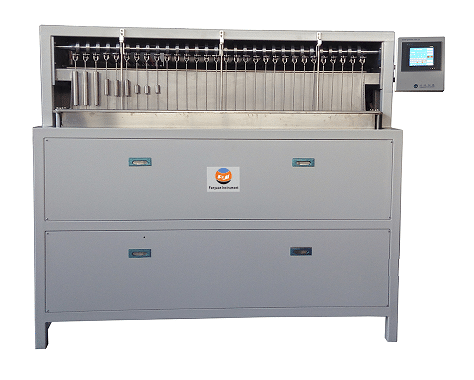
TM 144 Footwear Slip Resistance Tester DW9530
Footwear Slip Resistance Tester, also called Footwear Friction Tester or Shoe Dynamic Slip Resistance Tester , is internationally adopted slip resistance tester used to measure the dynamic coefficient of friction (CoF) of whole shoe sole, forepart or heel, for evaluation of shoe slip resistance.FYI is a leading manufacturer and supplier of high quality footwear slip resistance tester. We offer cost effective testing solutions and equipments for various industrial applications.