Drop Weight Impact Tester: Working Principle & Buying Guide
When you are responsible for testing material performance, accuracy is critical. In research institutions, universities, and textile or plastic manufacturing facilities, knowing how materials react to sudden impact is essential.
Impact behavior plays a key role in quality control and product development. Static tests alone cannot reflect real working conditions. In real life, materials usually fail because of sudden drops, collisions, or external hits, not slow loading.
This is why the drop weight impact tester is widely used across many industries. It allows you to recreate real impact situations in a controlled and repeatable way.
The testing process follows recognized standards. Whether you are testing plastic pipes, rigid sheets, or engineered polymers, this equipment helps you measure impact resistance with confidence and consistency.
In this guide, you will learn what a drop weight impact tester is and why it is important. You will explore the different types available and gain a detailed overview of how the machine works, how to evaluate its performance, and how to check compliance with industry standards.
Let’s dive into the article to know everything in detail:
What Is a Drop Weight Impact Tester?
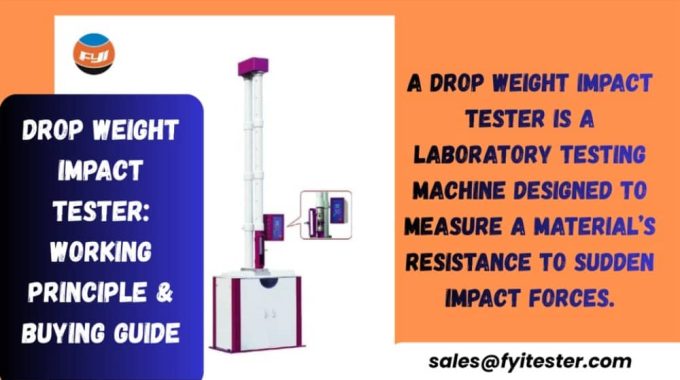
A drop weight impact tester is a laboratory testing machine designed to measure a material’s resistance to sudden impact forces. The test simulates a real-world scenario in which an object falls vertically and strikes a specimen with controlled energy.

The objective is to determine whether the material cracks, deforms, penetrates, or absorbs the impact energy without failure. This equipment is also commonly referred to as a:
- drop weight impact testing machine
- falling weight impact tester
- drop weight testing machine
- drop impact test machine
Although the names vary, the working concept remains the same: gravitational energy is converted into impact energy to test material toughness.
You typically use this equipment to evaluate:
- Plastic pipes and fittings
- Rigid plastic sheets
- Engineering plastics
- Composite materials
- Construction and building materials
For quality control personnel, this test ensures that products meet safety and durability requirements. For researchers and educators, it provides reliable, repeatable data for analysis and instruction.
Types of Drop Weight Impact Tester
Drop weight impact testers are available in different configurations depending on material type, specimen size, impact energy range, and testing standards. Selecting the right type depends on your application requirements.
Drop Weight Impact Tester DW5351
The Drop Weight Impact Tester DW5351 is a high-precision testing instrument specifically designed to determine the impact toughness of plastic pipes and rigid plastic materials. It is also known as a Falling Weight Impact Tester or Drop Weight Tester and is widely used in laboratories, manufacturing plants, and research facilities.
You can use this model to test:
- PVC-U feed pipes
- Drainage pipes
- Low-pressure feed pipes
- Low-pressure water pipes
- Core-layer foam pipes
- Double-wall corrugated pipes
- PE water pipes
- Rigid plastic sheets
Because of its versatility and accuracy, the DW5351 is considered an ideal solution for testing institutions, production units, building materials industries, and scientific research organizations.
FYI is recognized as one of the best drop weight impact tester suppliers in China, offering this model with a strong balance of quality, performance, and affordability.
Industry Recognition and Global Reach
All testing instruments manufactured by FYI are widely used throughout China and exported to more than 50 countries worldwide. The global adoption of FYI equipment reflects consistent performance, reliable engineering, and excellent value for professional users.
Key Features of Drop Weight Impact Tester DW5351
The DW5351 is engineered with advanced features to ensure precise results and safe operation:
- LED digital display for clear data visualization and long operating life
- Adjustable impact height from 50 mm to 2000 mm, covering a wide range of testing energies
- Imported servo motor control system for fast, smooth, and efficient lifting
- Automatic height calibration with calibration accuracy up to ±2 mm
- Combined striker system, allowing flexible assembly of different striker weights
- Pneumatic capture device to prevent secondary impact and ensure test accuracy
- Combined V-block support, suitable for specimens with different diameters
- Optimized falling pipe and vent hole design, minimizing air resistance and reducing friction damage to less than 2%
- Twin-screw specimen support, providing superior stability and rigidity during testing
These design elements ensure that you receive reliable, repeatable results while protecting both the specimen and the equipment.
Working Principle and Testing Method of the Equipment

The working principle of a drop weight impact testing machine is based on basic gravitational physics and controlled energy transfer. The purpose of the test is to evaluate how a material reacts when it is struck suddenly by a falling object under predefined conditions.
When you raise the striker to a selected height, it stores potential energy. This energy depends on the mass of the striker and the height from which it is lifted. Once the striker is released, the stored potential energy is converted into kinetic energy as it falls vertically along the guide column. At the moment of contact, this kinetic energy is transferred directly to the test specimen.
The amount of impact energy applied during the test is precisely controlled. It is mainly influenced by three key factors:
- The mass of the striker
- The drop height
- Gravitational acceleration
By adjusting the striker weight and drop height, you can accurately reproduce different impact energy levels. This allows you to simulate real-world impact conditions, such as accidental drops, tool strikes, or sudden collisions that materials may experience during actual use.
The Drop Weight Impact Tester DW5351 is designed to minimize energy loss during the falling process. Its optimized falling pipe structure and vent hole design reduce air resistance.
This ensures that the striker falls freely without friction against the guide wall. As a result, the energy delivered to the specimen remains stable and repeatable, improving test accuracy.
During the impact, the tester evaluates whether the specimen can withstand the applied force. The result is typically recorded as a pass or fail.
Failure may occur in the form of cracking, fracture, penetration, or excessive deformation. These outcomes help you assess the impact toughness and structural reliability of the material.
Testing Method
When you perform an impact test using the drop weight impact tester, the testing process follows a clear and standardized procedure. This ensures consistency, repeatability, and compliance with industry testing requirements.
1. Specimen Preparation
First, you prepare the test specimen according to the relevant testing standard. This includes cutting the pipe or sheet sample to the specified dimensions.
You also ensure that the specimen is properly conditioned under controlled temperature and humidity conditions. Proper preparation is essential to avoid test variation and inaccurate results.
2. Parameter Setup
Next, you set the testing parameters. You select the appropriate striker weight based on the material type and test standard.
Then, you adjust the drop height to achieve the required impact energy. The DW5351 allows precise height adjustment and automatic calibration, ensuring accurate and repeatable test conditions.
3. Specimen Mounting
Once the parameters are set, you mount the specimen on the testing fixture. Pipes are typically placed on V-block supports, while flat sheets are positioned on a rigid base.
The specimen must be securely fixed to prevent movement or misalignment during impact. Stable mounting ensures that the applied energy is delivered correctly to the intended impact point.
4. Impact Execution
After mounting the specimen, you release the striker. The striker falls vertically and impacts the specimen at the center or specified location. A pneumatic capture device prevents secondary impacts, ensuring that only one controlled impact is applied during each test.
5. Result Evaluation
After the impact, you carefully inspect the specimen. You look for visible cracks, fractures, surface damage, or complete penetration.
Based on the test criteria, you record the result as a pass or fail. In some applications, you may also document the failure mode and impact energy level for further analysis.
This controlled and repeatable testing method allows you to accurately simulate real impact conditions while maintaining high laboratory precision. It ensures that your test results are reliable, comparable, and suitable for research, quality control, and certification purposes.
Performance and Technical Parameters of the Equipment

When you evaluate a drop impact test machine, performance and technical parameters play a decisive role in the accuracy, reliability, and repeatability of your test results.
These parameters determine whether the equipment can meet daily laboratory demands, support standardized testing, and deliver consistent data over long-term use.
For research institutions, universities, and quality control laboratories, understanding these specifications is essential before selecting the right testing system.
1. Impact Height and Energy Range
Impact height is one of the most critical technical parameters of a drop weight impact tester.
The DW5351 provides a wide and adjustable impact height range, allowing you to generate both low-energy and high-energy impact forces. This capability is essential when you test materials with different thicknesses, diameters, and mechanical properties.
With adjustable impact height settings, you can accurately simulate real-world impact conditions. Low drop heights are suitable for thin plastic pipes or rigid sheets, while higher drop heights are required for thicker or more impact-resistant materials.
This flexibility allows you to test a wide variety of products using a single machine, making the DW5351 suitable for both research and industrial environments.
In addition, precise height control ensures that each test delivers consistent impact energy. This is especially important when you need to compare test results across different batches, materials, or production cycles.
2. Accuracy and Repeatability
Testing accuracy directly affects the credibility of your results. In a professional laboratory setting, even small variations in impact energy can lead to inconsistent outcomes. The DW5351 addresses this challenge through advanced control and calibration features.
The equipment uses a servo-controlled lifting system, which ensures smooth, stable, and precise movement of the striker. Unlike manual or mechanically driven systems, servo control minimizes positioning errors and reduces energy loss during lifting and release.
Automatic height calibration further improves accuracy. The system continuously monitors the striker position and adjusts it as needed, maintaining calibration accuracy within a narrow tolerance range.
This eliminates the need for frequent manual adjustments and reduces the risk of operator error.
Precision-machined components also contribute to repeatability. The guide columns, striker assembly, and support fixtures are manufactured to tight tolerances.
This ensures that the striker follows a consistent vertical path during each drop, producing repeatable impact conditions across multiple tests.
Together, these features allow you to obtain reliable and repeatable data, which is essential for quality control verification, academic research, and certification testing.
4. Structural Stability and Safety
Structural stability is another key performance factor when selecting a drop impact test machine. During impact testing, high forces are generated in a very short time. A rigid and well-balanced structure is necessary to absorb these forces without affecting test accuracy.
The DW5351 is built with a strong and rigid frame that minimizes vibration and movement during impact. This structural stability ensures that impact energy is transferred directly to the specimen rather than being lost through machine deformation.
Safety is equally important, especially in laboratories where multiple users operate the equipment. The pneumatic capture system prevents secondary impacts by securely stopping the striker after the initial impact. This protects both the specimen and the machine while ensuring accurate test results.
Additional safety features, such as protective enclosures and controlled striker release mechanisms, help safeguard operators during testing. These measures reduce the risk of accidental contact and make the equipment suitable for educational, research, and industrial environments.
By combining precise control, structural strength, and comprehensive safety features, the DW5351 delivers dependable performance for long-term use.
Product Quality and Brand Reputation

When you invest in a drop weight impact tester, product quality and brand reliability directly affect your testing accuracy, long-term costs, and operational confidence.
Poorly built equipment can lead to inconsistent results, frequent downtime, and higher maintenance expenses. For research institutions, universities, and industrial testing laboratories, these risks are simply unacceptable. This is where FYI clearly stands out.
1. Manufacturing Quality and Engineering Excellence
FYI places strong emphasis on precision manufacturing at every stage of production. Each drop weight impact tester is engineered using high-grade materials and carefully selected components to ensure durability, stability, and accuracy.
The machine frame is manufactured from high-strength structural materials that resist deformation even under repeated high-energy impact testing. This rigid construction helps maintain alignment and minimizes vibration during operation.
All critical components, including the guide column, striker assembly, lifting mechanism, and specimen supports, are precision-machined to tight tolerances.
This level of accuracy ensures smooth striker movement and consistent energy delivery during every test. As a result, you receive repeatable and reliable test data, even after extended periods of use.
FYI also applies strict internal quality control procedures throughout the manufacturing process. Each unit undergoes multiple inspections and functional tests before leaving the factory.
These checks verify impact height accuracy, striker release stability, safety system operation, and overall mechanical performance. By the time the equipment reaches your facility, it is fully tested and ready for professional use.
2. Durability for Long-Term Laboratory and Industrial Use
A drop weight impact testing machine is often subjected to frequent testing cycles, especially in production environments and research laboratories.
FYI designs its equipment to withstand long-term, high-frequency use without compromising performance. Wear-prone parts are reinforced, and mechanical stress points are carefully engineered to reduce fatigue over time.
The servo-controlled lifting system, pneumatic capture device, and optimized falling structure all work together to reduce mechanical shock and component wear.
This design approach extends the service life of the equipment and helps maintain consistent performance across thousands of test cycles. For you, this means lower maintenance frequency and reduced operational interruptions.
3. Commitment to Safety and Operational Reliability
Product quality is not limited to mechanical performance alone. Operator safety is equally important.
FYI integrates multiple safety features into its drop weight impact testers, including controlled striker release systems, impact capture mechanisms, and stable specimen fixtures. These features help protect both operators and samples during testing.
Clear displays, intuitive controls, and logical system layouts also improve daily usability.
Whether you are training students, conducting research, or performing routine quality inspections, the equipment remains easy to operate and reliable in demanding working conditions.
4. Brand Trust Built on Global Market Presence
FYI has built strong brand recognition by consistently delivering high-performance testing equipment to customers around the world.
Its products are widely used by research institutions, universities, quality inspection agencies, and manufacturing companies across more than 50 countries. This global presence reflects long-term customer trust and proven product reliability.
Brand trust is not built overnight. It is earned through consistent product quality, stable performance, and responsive customer support.
FYI maintains transparent technical documentation, clear specifications, and detailed product information so you can make informed purchasing decisions with confidence.
5. Dependable After-Sales Support and Service
After-sales service plays a crucial role in long-term customer satisfaction. FYI understands that professional users require reliable technical support, timely responses, and accessible spare parts.
The company provides technical guidance, troubleshooting assistance, and maintenance support to ensure your equipment continues to perform at its best.
This commitment to service reduces downtime and helps you maintain uninterrupted testing operations. Whether you are operating in an academic lab or a production facility, dependable support adds significant value to your investment.
Why Brand Reputation Matters for Your Testing Work?
When your testing results influence product certification, research outcomes, or regulatory compliance, brand reputation becomes more than a marketing factor.
It directly affects the credibility of your data. By choosing a well-established manufacturer like FYI, you align your testing work with equipment that is trusted by professionals worldwide.
In summary, FYI’s focus on precision manufacturing, durable construction, strict quality control, and strong global presence makes it a reliable choice for your drop weight impact tester needs.
You gain not only a high-quality machine but also long-term confidence in your testing results and operational stability.
Does the Equipment Comply with Industry Testing Standards?

Compliance with industry testing standards is a critical requirement when you are performing impact resistance testing. If your equipment does not follow recognized standards, your test results may not be accepted by manufacturers, certification bodies, or regulatory authorities.
For research institutions, universities, and quality control laboratories, standard compliance ensures that test data is reliable, comparable, and legally valid.
A drop weight impact tester that complies with industry standards allows you to perform tests that reflect real-world conditions while maintaining laboratory accuracy. It also ensures that your results can be compared with data generated by other laboratories worldwide.
1. Built for Standardized Testing
The Drop Weight Impact Tester is designed specifically to meet the requirements of commonly used testing standards for plastic pipes and rigid plastic materials.
Its flexible structure allows you to adjust testing parameters such as impact height, striker weight, and specimen support configuration. This adaptability makes it easier for you to align the equipment with both national and international testing requirements.
The machine supports standardized testing methods used in:
- Plastic pipe manufacturing
- Building materials testing
- Engineering plastic evaluation
- Research and academic laboratories
Because of this flexibility, you can use the same equipment for different test methods without compromising accuracy or repeatability. This is especially valuable when your laboratory handles multiple materials or serves different industries.
2. Calibration and Measurement Traceability
Accurate calibration is essential for maintaining standard compliance over time. The DW5351 is equipped with an automatic height calibration system that ensures precise striker positioning before every test.
The calibration accuracy of ±2 mm helps reduce measurement errors and ensures consistency across repeated tests.
Precision-controlled striker weights further improve test reliability. By using calibrated and standardized striker masses, you can ensure that the applied impact energy remains consistent from one test to the next.
This level of control is critical when you need to demonstrate traceable and repeatable test results.
3. Importance for Certification and Inspection
Standard-compliant testing is especially important in professional and regulated environments. The DW5351 supports testing activities required for:
- Certification testing, where results must meet strict acceptance criteria
- Third-party inspections, where impartial and verifiable data is required
- Academic research publications, where reproducibility and methodological transparency are essential
In these scenarios, even small deviations from standard procedures can lead to rejected results or repeated testing. By using a compliant drop impact test machine, you reduce the risk of nonconformance and improve the credibility of your work.
4. Long-Term Compliance and Laboratory Confidence
Over time, consistent compliance builds trust in your laboratory’s testing capabilities.
A standard-compliant drop weight impact testing machine helps you maintain audit readiness, meet customer expectations, and support long-term research and production goals.
It also ensures that your investment remains relevant as testing requirements continue to evolve.
Price, Cost-Effectiveness, and Maintenance Requirements

When you invest in a drop weight impact tester, the initial purchase price is only one part of the decision. You must also consider long-term performance, operating costs, and maintenance requirements.
The Drop Weight Impact Tester DW5351 is positioned as a high-value solution that balances advanced functionality with practical affordability.
Instead of paying for unnecessary branding or inflated pricing, you receive professional-grade features that directly support accurate and repeatable testing.
1. Competitive Initial Cost
FYI offers the DW5351 as a cost-effective alternative to premium-priced testing machines. Y
ou gain access to modern control systems, precise height adjustment, and reliable safety mechanisms without exceeding your budget.
This makes the equipment suitable for universities, research institutions, and manufacturers that require dependable testing performance while maintaining cost control.
The pricing structure allows you to allocate resources efficiently without compromising test accuracy or compliance.
2. Low Operating and Maintenance Costs
The DW5351 is designed for long-term operation with minimal maintenance effort. Its servo motor control system ensures smooth and stable lifting while reducing mechanical wear caused by frequent movement.
This extends component lifespan and lowers the risk of mechanical failure. The pneumatic capture device plays an important role by preventing secondary impacts, which reduces stress on the striker and structural components.
The machine also uses a modular design, allowing individual components to be replaced or serviced without dismantling the entire system.
Routine calibration and inspection procedures are simple and time-efficient. As a result, you experience less downtime, lower labor costs, and more consistent testing availability.
3. Long-Term Return on Investment
Over time, the DW5351 delivers strong return on investment across different user groups. In universities and research laboratories, you benefit from stable performance, accurate data, and repeatable experiments that support teaching and academic research.
In manufacturing environments, reliable impact testing helps reduce product failure rates and material waste, leading to improved quality control and lower production losses.
For testing institutions and inspection agencies, consistent performance ensures compliance with industry standards and builds long-term customer trust.
When you consider purchase price, operating efficiency, durability, and testing reliability together, the drop weight testing machine proves to be a cost-effective solution throughout its entire lifecycle.
Practical Applications Across Industries
The drop weight impact tester, particularly the DW5351, finds extensive use across multiple industries due to its ability to accurately measure material toughness under sudden impact.
In plastic pipe manufacturing, impact resistance testing is critical for ensuring product reliability and safety.
Pipes used in water supply, drainage systems, gas transportation, and construction must withstand accidental drops, external strikes, and other mechanical stresses during handling, installation, and operation.
By simulating these real-world conditions, the DW5351 allows manufacturers to identify weak points in pipe materials and optimize production processes, ensuring that only high-quality, durable products reach the market.
In research and academic institutions, falling weight impact testers are indispensable tools for studying material behavior. Universities and research centers use them to analyze how different polymers, composites, and engineered plastics respond to dynamic forces.
The equipment supports comparative studies between materials, facilitates student laboratory training, and helps researchers develop new materials with enhanced impact resistance.
The ability to generate precise, repeatable data makes it a vital resource for experimental validation and educational purposes.
Quality control and inspection agencies also rely on drop impact test machines to ensure compliance with industry standards.
Third-party laboratories use the DW5351 to validate manufacturing claims, perform certification testing, and provide impartial assessment reports, helping maintain product consistency, safety, and customer confidence.
Conclusion
A drop weight impact tester is an essential tool for accurately evaluating material resistance to sudden impacts.
Whether you work in research, education, manufacturing, or quality control, this equipment provides precise, repeatable results that reflect real-world conditions.
The DW5351 model stands out for its advanced features, adjustable impact height, reliable calibration, and wide application range, making it suitable for testing plastic pipes, rigid sheets, and engineered materials.
By understanding the working principle, performance parameters, compliance with standards, and maintenance requirements, you can make an informed decision that ensures long-term reliability and efficiency.
Investing in a high-quality impact tester helps maintain product safety, reduce failures, and support consistent quality assurance across industries.
Partner With FYI for Reliable Impact Testing
If you are searching for a professional, durable, and standards-compliant drop weight impact testing machine, FYI delivers proven solutions trusted globally.