
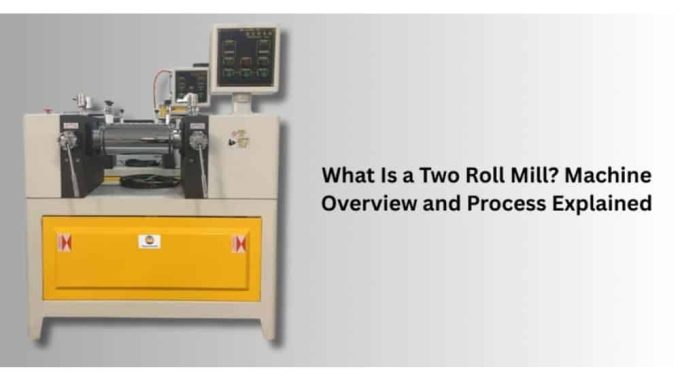
Two Roll Mill: Machine, Process and Lab Two Roll Mills Explained
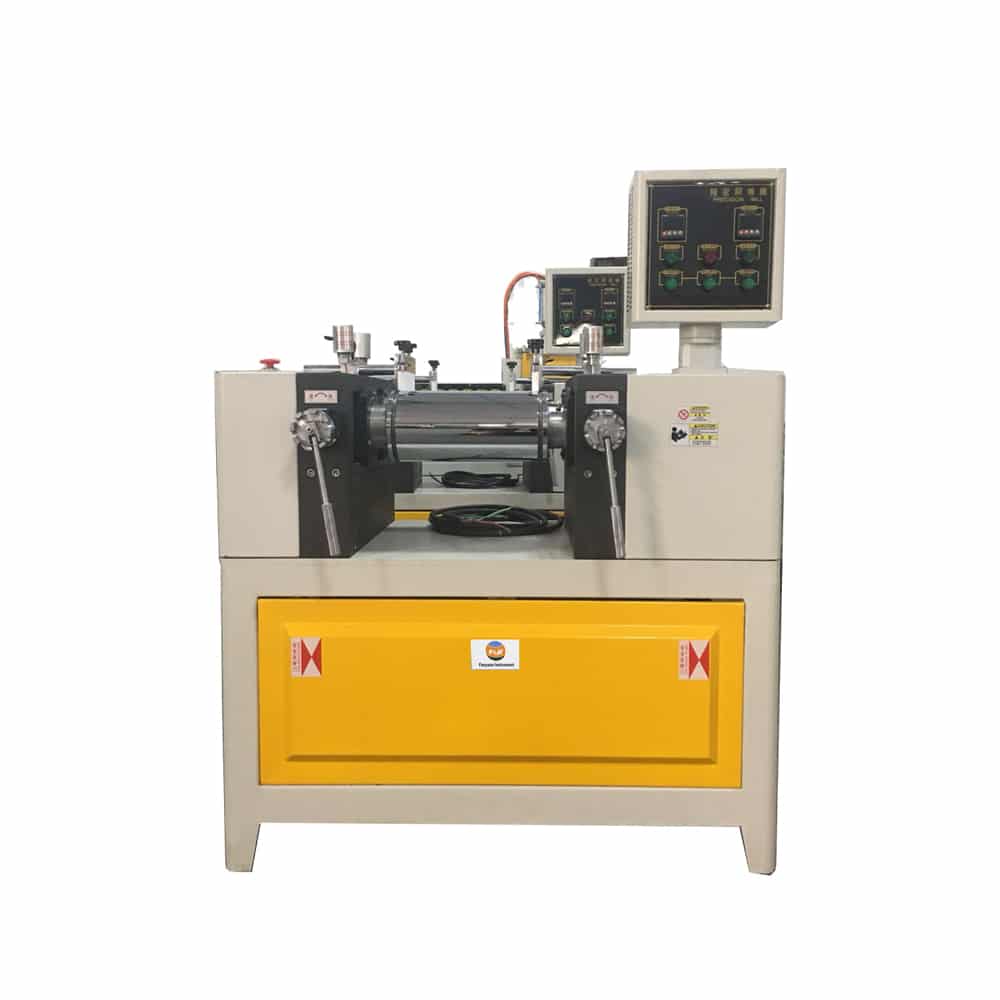
A two-roll mill is a machine that is primarily used to mix and match rubber, polymer, and plastic compounds into thin sheets. Think of something like two rolling pins with a plastic sheet passing in between. The two horizontal rolls are counter-rotating, which apply shear and compressive forces to process the material and produce very thin sheets.
What Is a Two Roll Mill?
A two-roll mill or a two-roll mill machine is a polymer processor that has two parallel, counter-rotating rolls that are made of hardened stainless steel or cast iron. The rolls rotate, with one at a higher speed and the second at a slower speed. This creates a friction ratio, creating a shear force at the nip (gap between two rolls).
The shear force is important because it disperses and rearranges the internal macromolecular chains in polymers, producing a homogenous material mix and a thin sheet.
What Materials Are Processed Using 2 Roll Mill?
A 2 roll mill processes many types of materials, mainly in the rubber polymer range. Think of materials with high molecular weight. Lab two roll mills can process the same materials but in smaller batches because of their roller size.
| Material | Example | Application |
| Natural Rubber | Raw; smr cv, smr 20, smr L | Tires, hoses, and shoes |
| Synthetic Rubber | Nitrile, EPDM, Butyl, CR, SBR, BR | Automotive parts, gaskets, belts, footwear |
| Silicone Rubber | Silicone | Devices, Seals, Gaskets |
| Thermoplastics | PVC, PE, EVA | Cables and films |
| Composites | Rubber with fillers, pigments, masterbatches | Polymer compounding |
Table of Two Roll Materials
Working Principle of Two Roll Mill

Step 1: Material Preparation and Feeding
The raw material, like rubber or polymer sheets and even pellets, is fed into the nip. The front roll rotating at a slower speed than the back roll pushes the compound through. In the nip, the material is subjected to compressive forces. At any point in the process, you can control the nip gap, which in turn controls the material thickness and the intensity of compression.
Step 2: Shearing and Mixing
Remember, the two rolls are rotating at different speeds. In technical terms, a velocity differential exists across the nip. This differential creates a shear that stretches and breaks the molecular chains of the material.
At this step, you can also add any curing agents, fillers, and other additives. The mixing requires a manual operator or an automated system that can cut, fold, and re-feed the material back into the nip for even dispersion.
Step 3: Temperature Control
Another important factor for even mixing and dispersion is maintaining the required temperature for the process. The internal heating and cooling system can maintain these temperatures to prevent scorching and loss of plasticity.
Step 4: Sheet Formation and Removal
Once the desired level of dispersion is achieved, the nip gap can be widened for extraction. The way this works is the compound is cut from the front roll to get a continuous sheet. On lab two-roll mills, the output sheet is typically weighed, tested, and compared against reference formulations.
Testing Methods of Two Roll Mill Machines
Rolling Mechanism
The most important factor in a two-roll machine is verifying that the rolling mechanism delivers a constant shear force. You can do that by measuring the friction ratio and comparing it with material specifications.
For example, friction ratios can range from 1:1 to 1:1.5. Roll gap consistency is verified using dial gauges mounted on bearing ho
using. If you ever need to check the temperature of the roll surface, you can do that using the embedded sensors in the machine.
Cooling Systems and Temperature Control During Operation
Another important control factor is the temperature. Controlling the temperature is important because not only can it affect the viscosity of the material, but many chemical reactions can also alter the temperature. For example, vulcanising agents begin reacting above specific temperature thresholds.
Both rolls in the two-roll mill are hollow and allow water circulation through the roll core. The water cooling system maintains roll surface temperature in a range, for example, 40 – 80
Some variants of the two-roll mill machine also have electric roll heating for processing materials that require high temperatures to achieve plasticity, like PVC.
Testing Methods and Research Applications
Lab two roll mills are a great research tool to evaluate new compound formulation before you commit to any large-scale batches.
Researchers prepare small batches ranging anywhere between 250g and a few kilos on a standard laboratory mill. The lab two-roll mill allows you to program the roll speed, nip gap, temperature, and processing time, creating a repeatable test for each formulation. This can help you compare samples and compounds by controlling as many limiting factors as possible for the process.
Hands-Free Operation
While manual two-roll mills are popular, hands-free automation allows you to minimize exposure to nip hazards because there are automatic scraper blades and roll-over devices that continuously reintroduce the compound to the nip without your intervention. Some advantages of automatic refeeding are better mixing consistency, reduced manual input, and better safety control.
Performance and Technical Parameters of Two Roll Mill Equipment
- Roll diameter and face length: Roll diameter is important because the nip pressure and material volume processed per pass are controlled using roll diameter. Laboratory mills typically have roll diameters from 60 mm up to 200 mm.
- Batch capacity: Lab two-roll mills have different batch capacities. Some are small with only 250 grams, but you can find categories like under 1000 grams, under 2000 grams, and under 5000 grams. Selecting the correct batch size is important because the wrong volumes can result in poor nip engagement.
- Friction ratio: The Friction ratio between front and rear rolls is a key process variable. Fixed and variable friction ratios are both available, and it is advisable to buy the variable one because variable friction ratio mills give you control over shear intensity, which comes in handy when processing materials with variable viscosities.
- Roll surface and material: The metal rolls are manufactured from cast iron, high carbon steel, or alloy steel. These rolls are polished and chrome-plated for corrosion resistance and consistent thermal conductivity.
- Drive system: Direct drive configurations reduce mechanical losses and simplify maintenance. Another drive system for two-roll mill machines is a belt drive system, but direct drive gear systems are better at maintaining correct speeds.
Two Roll Mill vs Four Roll Mill

The main difference between both roll machines is the number of rollers. A two roll mill uses two rolls for basic shearing and mixing, suitable for lab and small-scale applications. You can adjust the friction ratio, but there is limited control over thickness.
A four-roll mill has a larger footprint and is backed by larger support rolls for greater rigidity and precision. Four roll mill has many advantages over the two-roll mill, like it can handle thicker materials, produce better surface finish, and reduce deflection of the rollers. But the four-roll mill is expensive and complicated.
What Makes a High-Quality Two Roll Mill?
A high quality two roll mill has a solid, sturdy construction that does not deflect the rollers or shake the machine. As these machines can run for long hours, they have to be durable.
The components should resist wear, and you can see this in the material choice for the components. The best machines have vanadium-titanium alloy chilled iron with a chrome-plated surface that prevents adhesion.
Speed drives are another important feature, variable speed drives for friction ratios up to 1:1.35, and nip adjustments of 0.01 mm accuracy are some of the best spec’d machines.
At the same time, having safety protocols and safety integration into the machine is equally important. Some of these safety features include emergency stops and guards.
Industry Testing Standards and Safety Compliance
ANSI, OSHA, and CSA Certification Requirements
Two-roll mills must comply with key safety and industrial certifications.
- ANSI B11.12 requires guarding of nip points, emergency stops, fail-safe controls, and risk assessment for roll forming equipment. You can verify this compliance through a third party.
- OSHA 1910.216 requires that roll tops be at least 50” above the operator level with completely accessible front and back safety trip controls.
- CSA Z432 (for Canada) demands nip-point protection, interlocks, emergency stops, and operator training.
Conclusion
A two-roll mill is used for producing homogenous polymer sheets, and the machine’s performance is defined by roll quality, nip control, thermal management, and drive system. Whether you need a benchtop lab two-roll mill for formula development or a larger 2-roll mill for pilot production, always match the machine’s technical parameters to the material and batch requirements.