
Wet Spinning Machine: A Practical Guide to the Wet Spinning Process
A wet spinning machine is used to form fibers from a polymer solution (often called a spinning dope) by extruding it through a spinneret directly into a coagulation bath. In that bath, the polymer precipitates and solidifies into filaments, which are then washed, drawn, heat-treated, and wound into a usable fiber format. Wet spinning remains essential for polymers that cannot be melt-spun (because they degrade before melting) and for applications that demand precise microstructure control—from high-performance technical yarns to regenerated cellulosics and specialty biomedical materials.
Below is a practical, engineering-oriented overview of what wet spinning is, how the wet spinning process works on a wet spinning machine, which parameters most strongly influence performance, and how to think about sustainability and compliance when solvents and wastewater become part of the process reality.
What Is Wet Spinning (and Why It Still Matters)
Wet spinning is a solution spinning method. Compared to melt spinning, it starts with dissolving a polymer in a suitable solvent, then solidifying the extruded dope by non-solvent induced phase separation in a coagulation bath. In practice, wet spinning is often used for polymers and systems where melt spinning is not feasible or where the dope/bath interaction is a key lever to tune structure and properties.
Wet spinning vs. melt spinning vs. dry spinning
- Melt spinning: polymer is melted and extruded, then cooled to solidify. It’s high-throughput and widely used—but limited to thermoplastics stable at melting temperatures.
- Dry spinning: polymer solution is extruded into hot gas; solvent evaporates to solidify. Solidification can be limited by evaporation rate and solvent handling.
- Wet spinning: polymer solution is extruded into a non-solvent bath; solidification occurs by precipitation/phase separation, often enabling fibers that are otherwise hard to form.
Where wet spinning is the best choice
Wet spinning is common for regenerated cellulose fibers, specialty fibers, and various functional or high-performance systems. A wet spinning machine used for research or pilot production is often expected to handle multiple polymer/solvent combinations and to support controlled coagulation, washing, drawing, and sometimes heat setting.
How a Wet Spinning Machine Works (Step by Step)

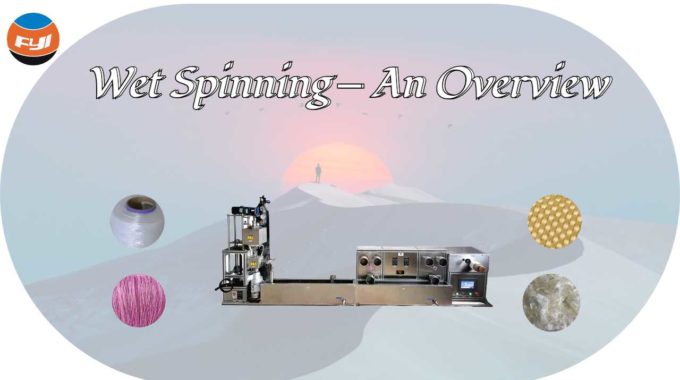
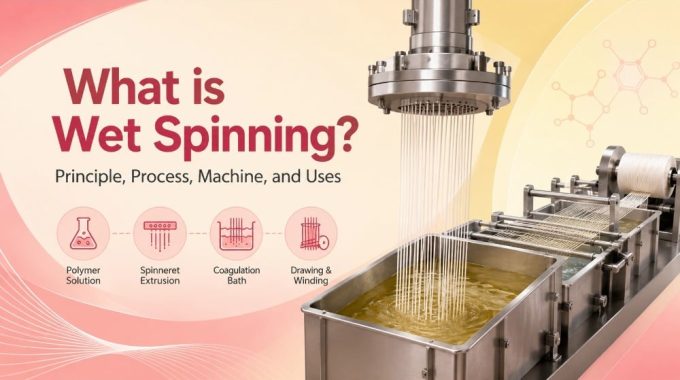
A typical wet spinning machine integrates upstream dope handling with downstream drawing and winding. One example wet-spinning process flow includes: solution tank → metering pump (with heating) → filter (with heating) → gooseneck → spinneret cap (with filter) → coagulation bath → drafting/drawing rolls → (draft bath / second drawing zone) → winding.
1) Dope preparation: mixing, filtration, deaeration
A stable dope is the foundation of stable spinning. In practical machine designs, the solution tank may support heating, stirring, pressure monitoring, and even inert gas protection. For example, a wet spinning setup may include a heated solution tank (e.g., up to ~80°C), pressure gauge monitoring, stirring, and nitrogen protection depending on the chemistry and sensitivity of the dope.
Filtration is equally important: it removes undissolved polymer and particulates that can clog spinneret holes, destabilize flow, and cause filament breakage. Many wet spinning machine configurations include a heated filter section to keep viscosity stable and prevent premature gelling.
2) Extrusion through the spinneret into a coagulation bath
The metering pump provides controlled throughput and helps maintain steady flow. One example configuration includes a metering pump specified around 0.6 cc/rev with heating up to ~80°C, plus real-time pressure/temperature sensing in the pumping zone for monitoring stability.
From the spinneret, the dope enters the coagulation bath where phase separation and precipitation occur. The bath chemistry (non-solvent type, concentration), temperature, and residence time are key to the resulting microstructure—skin/core formation, porosity, and final mechanical properties.
3) Washing, drawing, drying, heat setting, winding
After coagulation, filaments typically pass through washing baths to remove residual solvent/non-solvent, then through one or more drawing zones where orientation and crystallinity are developed. Many systems include drafting/drawing rollers and may include an oven or heating box for drying/setting, followed by winding. For example, a lab/pilot wet spinning machine may specify drafting roller speeds (e.g., up to ~20 m/min) and winding speeds (e.g., up to ~40 m/min), with an oven/heat-setting zone that can reach ~200°C depending on configuration.
Key Parameters That Control Fiber Quality

If you care about “core process and performance optimization,” these are the knobs that matter most in wet spinning.
Dope concentration, viscosity, and temperature
Dope rheology controls extrudability, stability, and the ability to draw without breakage. Temperature control across the dope tank, pump, filter, and lines helps stabilize viscosity and reduces pressure fluctuations. In many systems, temperature is monitored and controlled in real time across multiple zones.
Practical tip: if you see frequent breaks, check for (1) dope bubbles, (2) partial spinneret clogs, (3) unstable pressure. Cleaning and filtration discipline often solves “mystery instability” faster than changing chemistry.
Spinneret design and throughput stability
Spinneret hole geometry, L/D, and hole count influence shear history and initial filament shape. Throughput stability is the bigger story: a metering pump with controlled drive and visible flow/pressure feedback makes it easier to correlate “what changed” to “what the fiber did.”
Coagulation bath composition and temperature
The coagulation bath is where morphology is born. Changing bath temperature and composition can move you along a spectrum from dense structures to more porous ones. This matters for strength, dyeability, filtration/membrane performance, and downstream solvent removal. Wet spinning machines often include heated baths (and covers) to control these conditions and keep experiments repeatable.
Drawing ratio and heat setting
Drawing and thermal treatment determine how much orientation and crystallinity you lock in. In many fiber systems, controlled heating after drawing improves dimensional stability and mechanical performance by allowing stress relaxation and structural “settling” toward a more stable state (commonly described as heat setting). A machine that supports consistent multi-zone drawing and controlled heating makes scaling from “it works once” to “it works reliably” far easier.
Dry Jet Wet Spinning (Air-Gap Spinning): When the Variant Wins
A well-known variant of wet spinning is dry jet wet spinning, also called air-gap spinning. Instead of extruding directly into the coagulation bath, the dope passes through an air gap (or inert gas gap) before entering the bath. The air-gap allows a longer stretch zone and can improve drawability and speed in certain systems.
Some references describe the air gap on the order of 3–100 mm (often under 20–30 mm), and note that dry jet wet spinning can reach much higher spinning speeds (e.g., 600–1200 m/min) while also tolerating larger spinneret apertures (e.g., ~0.15–0.3 mm) under appropriate conditions.
Why it matters in practice:
- Certain fibers extruded directly into the bath can form micro-voids that hurt performance; an air gap can reduce that risk in some systems.
- For high-performance fibers (including some liquid-crystal-like systems), the air-gap approach may be preferred.
If you are evaluating an air-gap setup, see the dry jet wet spinning machine DW7091A configuration details.
Sustainability & Environmental Compliance Considerations

Sustainability and environmental regulation are increasingly important in wet spinning because the process often involves solvents, baths, washing water, and recovery systems.
Solvent selection and tightening restrictions
A practical reality: some widely used industrial solvents face increasing restrictions or stricter exposure limits.
- In the EU, DMF (N,N-dimethylformamide) has been subject to restriction requirements under REACH starting in December 2023, driven by health hazard concerns and tighter exposure controls.
- In the US, EPA activity under TSCA has targeted solvents like NMP (n-methylpyrrolidone); EPA announced a proposed rule in June 2024 aimed at reducing unreasonable risk from exposure.
What this means for wet spinning machine buyers: even for lab/pilot systems, you’ll want your process documentation to cover ventilation, closed handling, worker exposure controls, and recovery/waste treatment strategy—not just the spinning line itself.
Water, wastewater, and solvent recovery
Many wet spinning processes require washing stages; managing water and emissions becomes a design and operating requirement. For regenerated cellulose via solvent spinning (e.g., lyocell-type chemistry), a key sustainability lever is high solvent recovery. One well-known industrial example reports a closed-loop system recovering 99.8% of NMMO solvent, with minimal water directed to treatment.
Design takeaway: when you plan a wet spinning or dry-jet wet spinning setup, think early about:
- which loops must be temperature-controlled,
- where solvent ends up (bath, wash, exhaust), and
- how you will measure and reduce losses (recovery, reuse, treatment).
New Materials and High-Value Applications
Wet spinning and air-gap spinning remain “innovation tools” because they support materials and structures that are difficult to realize otherwise.
- High-performance fibers and precursors: dry jet wet spinning equipment is often discussed for polyacrylonitrile (PAN), aromatic polyamide fibers, and polybenzimidazole fibers, among others.
- Biomedical and composites: pilot-scale wet spinning platforms are often positioned for biomedical and composite applications where fiber properties need to be maximized and process conditions optimized before scale-up.
How to Choose a Wet Spinning Machine for Lab or Pilot Work
Here’s a practical checklist you can include in an informational blog post while still guiding the reader toward an inquiry.
A selection checklist (what to evaluate)
- Dope handling: tank volume, stirring, heating range, pressure monitoring, inert interface (if needed).
- Throughput control: metering pump precision, speed control, visible flow/pressure feedback.
- Filtration and clog prevention: heated filter sections, easy cleaning access.
- Coagulation + washing: bath size, temperature control, covers, guide rollers.
- Drawing and heat treatment: number of zones, roller speed range, heating box temperature range.
- Control & data: PLC/touchscreen, multi-zone temperature acquisition, alarms/interlocks.
- Your compliance constraints: solvent choice (restrictions), recovery approach, water handling plan.
Example: DW7091A wet spinning machine configuration (what it tells you)
A representative wet spinning machine configuration (DW7091A) is described with a process chain including solution tank → heated metering pump → heated filtration → spinneret cap → coagulation bath → drafting/drawing rolls → oven/setting → winding.
Example specifications and ranges include:
- Solution tank volume ~1 L (or customized), heated up to ~80°C, pressure gauge, nitrogen protection, stirring.
- Metering pump flow specified as 0.6 cc/rev (with heating up to ~80°C).
- Drafting roller speed range up to ~20 m/min (adjustable) and winding speed up to ~40 m/min (adjustable).
- Oven/heating box temperature range up to ~200°C (adjustable).
- Control mode: PLC + touch screen.
These are exactly the sorts of “hard constraints” that determine whether a wet spinning machine fits your material system and experimental goals.
If you’re selecting a wet spinning machine for a specific polymer/solvent system, email our engineering team via the Contact Page with your polymer, solvent, target fiber format (mono/multi/staple), and desired throughput so we can recommend the right configuration and options.
Quick Comparison Table
| Method | Solidification Mechanism | Typical Strengths | Typical Challenges |
| Wet spinning | Precipitation in coagulation bath | Works for hard-to-melt polymers; morphology control via bath | Solvent/water handling; bath + washing management |
| Dry jet wet spinning (air-gap) | Air gap stretch → bath coagulation | Higher drawability/speed in some systems; structure control | More parameters to tune; surface flow effects possible |
| Dry spinning | Solvent evaporation in hot gas | Simpler bath-free line | Evaporation-limited solidification; VOC controls |
FAQ
- What is a wet spinning machine used for?
A wet spinning machine produces fibers from a polymer solution by extruding through a spinneret into a coagulation bath, then washing/drawing/setting and winding. - What is the wet spinning process, step by step?
Dope preparation → metering pump → filtration → spinneret → coagulation bath → washing/drawing → drying/heat setting → winding. - What is dry jet wet spinning (air-gap spinning)?
A wet-spinning variant where the filament passes through an air gap before entering the coagulation bath, improving stretch-zone control in some systems. - How big is the air gap in dry jet wet spinning?
Some references describe ~3–100 mm (often less than ~20–30 mm), depending on material and goals. - Why does spinneret clogging happen, and how do you reduce it?
Usually from particulates/gel particles or unstable dope; better filtration, controlled temperature, and proper cleaning protocols reduce clogging. - Which parameters most affect fiber strength?
Dope rheology, bath composition/temperature, and drawing + heat setting conditions are major drivers of orientation/crystallinity and final strength. - How do sustainability and regulations affect wet spinning?
Solvent choices matter: DMF restrictions in the EU (from Dec 2023) and ongoing risk management actions on solvents like NMP in the US highlight the need for exposure control, recovery, and wastewater planning.