IR Dyeing Machine: A Technical Guide to Selection and Operation
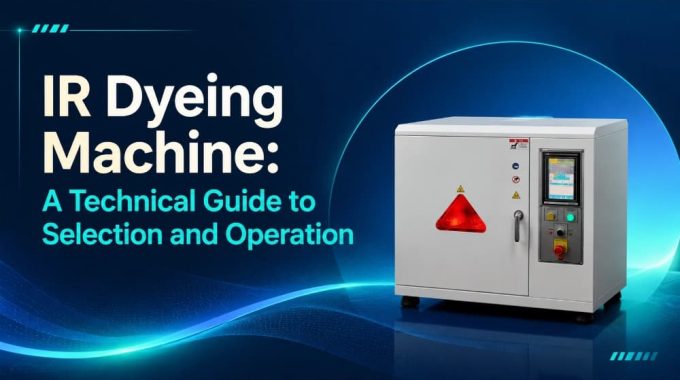
An infrared dyeing machine works similarly to a microwave. Still, for fabric, it heats up the dyeing solution directly using IR radiation instead of heating the solution using a glycerin or water bath. This helps it conserve energy while also allowing precise control over holding temperature and period.
The advanced heating principle will allow the manufacturer or you to start small from a beaker scale sample and then scale up the desired sample for production runs that have the same result. This article will guide you through how an ir dyeing machine should perform in practice.
IR Dyeing Machine for Small Scale vs Industrial Production
Ir dyeing machines are mainly used in textile labs as they are primarily laboratory and sampling instruments. A standard IR dyeing machine has a 12-48 beaker set configuration that has a 100 -500 ml capacity each. When compared to the industrial dyeing process that uses jet, jigger, or packeage machine’s that have a capacity of thousands of liters, an ir machine’s capacity is really small.
An ir machines reall job is to perfect the color recipe using small fabric samples and test for quality so that it can be replicated on large-scale productions without any errors.
Laboratory-Scale Specifications of the IR Beaker Dyeing Machine
An ir dyeing machine has a spinning wheel that holds a number of sealed stainless steel beakers that are exposed to infrared heating lamps. Each stainless steel beaker contains a small fabric with dyeing solution.
Key operating parameters of an IR dyeing machine are:
- Beaker volume: each stainless steel beaker has a 100–500 ml capacity, with some models that feature 1,000–5,000 ml pots for larger samples
- Sample size: the sample sixe og th fabric ranges from 5–25 g of fabric or yarn per beaker
- Liquor ratio: the dyeing solution is used in ratios starting from 1:8 and going up to 1:20, which must match the recipe used for production.
- Temperature range: the temperature can go up to 140 °C, past the boiling point of water, which is crucial for fabrics such as polyester, as its fibers expand at a higher temperature and under pressure.
- Heating rate: the temperature increase is programmable and usually increases around 1–4 °C/min and has air or water spray cooling.
The FYI RHS-24 IR dyeing machine is a great 24-beaker unit with PLC temperature control, a room-temperature-to-135 °C range, and air cooling.
Technical Limitations of IR Heating at Industrial Scale
Three main constraints have kept infrared dyeing machine technology at a sample scale:
- Penetration depth: the IR radiation heats the surface of the beaker while the rotation moves around the liquid inside to quickly distribute the heat. At a larger scale, this isn’t viable as you can’t achieve a uniform temperature in a large volume just by heating the surface.
- Material handling: Bulk dyeing requires you to force the dye through a tightly wound fabric using a hydraulic pump. Sealed beakers can’t accommodate pumps or the plumbing required for bulk dyeing.
- Energy geometry: IR emitters are really poor at heating large vessels, which makes steam and direct heat better and more cost-effective options at large volumes.
Integration of Lab-Scale IR Dyeing with Bulk Production
The ir dyeing machine is essential to any dye house since it is used to perfect the recipe, test, and process profile.
There needs to be precise alignment between the lab trials and bulk production; the IR machine recipes can be upscaled for production jet machines while matching crucial parameters such as liquor ratios, chemical dosing profiles, and heating gradients to minimize variance.
Effect of IR Radiation Intensity on Dyeing Quality

The intensity of IR radiation governs the heating rate, which controls the dye exhaustion rate, levelness, and shade reproducibility. If the intensity is off jus ty a little bit ti can cause various problem htat include uneven dyeing when there is excessive intensity and extended cycle time when the intensity is too low.
Additionally, temperature-sensitive dyes can be affected by not full setting, which can lead to bleeding during wash and premature fading.
Impact of Heating Rate on Dye Strike and Levelness
Most dye and fiber combinations have a critical temperature zone where the fibers open up, and the dye can properly react with those fibers. This usually ranged from 60 -80 C fro reactive dyes on cotton and 100- 130 C for disperse dyes on polyester.
The heating rate has to be consistent when it moves across this range for the best result. If the heating rate is too quick, it can lead to the following problems:
- It can cause the strike rate to out pace th migration rate, not allowing the dye to properly distribute throughout the fabric. This often causes ring dyeing and unlevelness.
- A dye recipe can contain different colors, each with a different strike rate, and sandblasting through the temperature range will cause these dyes to exhaust at different times, leading to multiple shades and the color to vary.
- The dye molecules rush to bond with the outer surface of the fiber instead of diffusing deeply into the fiber core; the physical bond is weak. This leads to poor wash fastness and causes the dye to fade.
A controlled gradient of 1–2 °C/min through the critical zone, achievable only with modulated emitter power, keeps strike rate below the migration rate and preserves levelness.
Radiation Uniformity Requirements Across the Beaker Carousel
The beakers in an IR beaker dyeing machine must receive identical radiant flux because even if there is a slight difference in the temperatures, the results are ruined. Design factors that determine uniformity:
- Carousel rotation (typically 5–45 rpm): the spinning wheel s has a speed range of 5-45 rpm and ensures that all th beaker are exposed to the heating lamps the same amount of time while mixing the liquid inside to ensure even temperatures.
- Emitter geometry: IR lamps have to be evenly spaced out. A weak lamp can often leave cold spots, so it should be replaced.
- Chamber reflectivity: the steel beaker was polished to have a mirror shine that reflects the radiation so ot reache all around the chamber. If the beaker are dirt, has condensation or chemical residue, don’t reflect the light adn lower the heating efficiency.
The process has a tolerance of ±1 °C, and any more is considered a failure since the shade can change just by a slight mismatch of temperatures. The final result is a visibly different shade.
PID-Based IR Intensity Control Systems
The RHS Series infrared sample dyeing machine illustrates this design approach, using a rotating rack that runs forward and reverse so every beaker receives equal radiant exposure from its patented IR heating system.
Modern machines use a closed-loop PID temperature control system with a temperature probe inside the sealed beaker, allowing you to adjust the temperature in real time rather than running the lamps at fixed wattage.
Safety Considerations in Operating IR Dyeing Machines

The high-pressure beakers, hot IR emitters, and chemical exposure combined with hand load are all hazards that require operators to stick to a strict procedure.
Thermal and Pressure Hazard Controls
- The sealed beakers above 100 °C operate under pressure and feature gaskets and seals to retain that press any damaged seal or gasket should be replaced, as it can cause a sudden release of pressure that can damage the machine and operator.
- Never open a hot beaker because Hot beakers have pressure built up inside them, which can cause steam burns. Machines are programmed to release the beaker only after they cool down to the threshold temperature.
- Do not overfill. Liquid expands when it is heaters so every beaker has a specific capacity, and going over this can risk an explosion.
- Emitter surfaces are extremely hot sop before handling the maps for maintenance or replacement, it is better to allow them to cool down completely.
Chemical Handling and Effluent Safety
- Dye powders can irritate the respiratory track so always have ventilation and wear a respirator when working with fine powders.
- Chemical-resistant gloves and goggles are essential when handling corrosive chemical sucha s caustic soda and acetic acid.
- Post testing this dye solution is typically hot and reactive, so disposing of it correctly using the designated drain line is essential.
Electrical and Mechanical Safety Requirements
- An IR emitter uses a lot of power, typically 3-13 kW per machine. IR machines require accurately rated circuits and wiring that can handle the current they require.
- An interlock safety feature that the spinning carousel should stop if the door opens must be verified before every run.
- The beakers should be loaded into the carousel symmetrically so that it balances when it spins. An unbalanced load will cause vibration and excessive stress on the machine.
Standard Operating Procedures and Pre-Run Checks
The majority of incidents that occur when working with these machines can be traced back to a lack of proper procedure rather than equipment. Opening the beakers earlien failed gasket and fill level can all be verified using a program and proper procedure, avoiding all the risks.
Cost Structure and ROI Analysis of IR Dyeing Machines

The cost of an infrared dyeing machine typically ranges from USD 5000 to 35000, depending on the beaker capacity, control, and temperature rating. Dye houses can usually recuperate this amount in a span of 12-24 months, as it pays for itself by reducing bulk dyeing and sampling costs.
Capital Cost Drivers of an IR Dyeing Machine
- Beaker capacity: An IR lab dyeing machine with a 12-beaker capacity is cheaper than a 48-beaker machine.
- Temperature rating: machines rated for higher temperature such a140C are required when dyeing fabrics such as polyester will cost more due to the required pressure-rated vessels.
- Control system: a machine that has a sophisticated control system that offers profiles, dosing simulations, and pc connectivity costs more but is crucial for dye houses.
- Brand and compliance: Units from established lab-equipment manufacturers with CE certification and calibration documentation carry higher prices than unbranded imports.
Before committing capital, comparing models against a current market overview, such as this top 10 IR dyeing machine guide, helps benchmark beaker count, temperature rating, and price across manufacturers.
Operating and Maintenance Costs
- Energy: IR dye in machines is efficient since the beakers heat up directly from a water bath. They require 30 -50% less energy compared to glycerin baths.
- Consumables: the IR machine requires gaskets, IR lamps, and calibration for best performance.
- Labor: The labor requirement is minimal, as one technician alone can load and supervise the runs.
ROI Sources and Payback Calculation
Roi is mainly achieved by the following :
- Fewer bulk re-dyes: a bulk production fail costs thousands of dollars in materials and utility. Improving the 2-3% chancegetting the correct chase on the first try can save you thousands of dollar recuperating the cost of the machine.
- Faster sampling turnaround: an IR machine can run up to 24 samples simultaneously, allowing you to set up more shade options and shortening lead time, which is a great commercial advantage in modern textiles.
- Reduced sample material waste: a 10 g sample trials istead of a larger pilot lots save the cost of fabric and utilities.
Troubleshooting Guide for IR Dyeing Machine Operation
There are mainly four types of faults that occur in an IR dyeing machine: temperature deviation, beaker-to-beaker inconsistency, mechanical/rotation issues, and shade non-reproducibility. All of these faults can be resolved by simple component replacement, such as a lamp or gasket.
Fault: Temperature Fails to Reach or Hold Setpoint
- Failed or aged IR lamps: inspect the IR lamp during a low-power test to check whether it is running at the same rate as the other lamp; if not, then replacing it is the best solution to preserve uniformity.
- Dirty reflectors: radiation can be absorbed by dye vapor and dust particles on the reflective surfaces, so the surface needs to be periodically cleaned.
- Faulty temperature probe: identify the beaker with the faulty probe and compare it wotha calibrate thermometer to confirm it and replace it because a faulty probe can cause the PID loop to over- or underdrive
- Ventilation faults: a blocked cooling fan can trigger over-temperature cutouts mid-program.
Fault: Beaker-to-Beaker Shade Variation
- Unequal liquor volumes or sample weights: this is the most common cause of shade variation, and to prevent this, a maximum tolerance of 0.01g and 1ml Liquopur should be enforced.
- Asymmetric loading: Loading the carousel symmetrically to distribute the weight evenly will help balance it thermally as well
- Mixed lamp ages: one weak emitter creates a cold spot, which will affect the overall temperature.
- Leaking gaskets: gasket inspection is crucial before every run, since a damaged gasket will cause the beaker to lose pressure
Fault: Mechanical and Electrical Malfunctions
- Carousel not rotating: check the interlocking mechanism first, as it is a safety check of the machine which prevents it form startin if the door is open. A misaligned door can often be mistaken for a motor issue,
- Excessive vibration or noise: an unbalanced load or a loose beaker and worn drive bearings will cause the machine to vibrate.
- Program aborts mid-run: Inspect the supply voltage stability, as IR emitter banks are sensitive to sags on undersized circuits.
Fault: Lab Results Not Reproducing in Bulk Production
If lab shades produced from the infra color dyeing machine aren’t being produced in bulk production, the fault is usually procedural:
- The incorrect liquor ratio or dosing sequence is used in the jet machine profile.
- Water quality can also be a defining factor, as hardness and pH differences between lab and production water can shift reactivity and disperse dye behavior.
- Wrong temperature readint dueto un calibrated temperature can also be a fault, so it is essential to recalibrate the probe every six months.
Preventive Maintenance Schedule
- Before each run: checking the gasket seals, fill level, and loading the beaker syumetericallt before each run.
- Monthly: cleaning the reflectors and performing the interlock test, as well as drive inspection, is crucial.
- Semi-annually: every six months, temperature calibration and lamp output check are essential for thermal balance.
Following this schedule will ensure that your IR machine will last more than a decade of precise and specification-level service, ensuring lab-to-bulk reproducibility that justifies its price.