Common Functional Characteristics and Applications of Chemical fiber
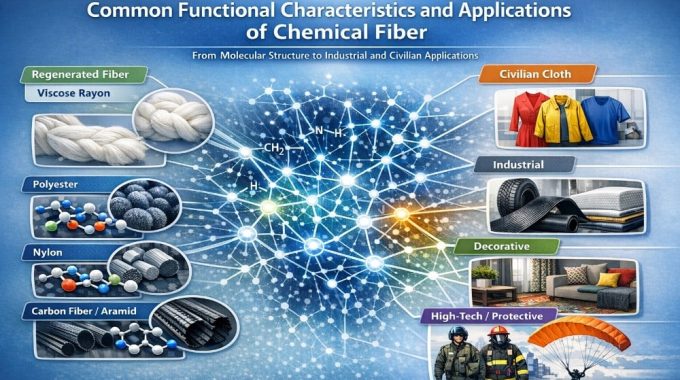
Chemical fibers share several common functional characteristics, including differences in strength, moisture absorption, elasticity, heat resistance, dyeability, and durability, which determine their practical applications. Regenerated fibers such as viscose and cuprammonium offer good comfort and moisture absorption, making them suitable for apparel. Synthetic fibers like polyester, nylon, acrylic, and polypropylene provide advantages such as high strength, wear resistance, wrinkle resistance, and lightweight performance, supporting wide use in clothing, industrial textiles, and technical products. Specialty fibers such as spandex, aramid, and polyethylene serve high-performance needs including elasticity, protection, flame resistance, and industrial filtration. Together, chemical fibers play a vital role across fashion, household, and industrial sectors.
Viscose fiber

Viscose fiber is one of the main varieties of artificial fibers. Due to its similar properties to cotton, it is also known as artificial cotton.
Main characteristics
(1) Its strength is less than that of cotton, and its elongation at break is greater than that of cotton. After absorbing moisture, its strength significantly decreases, and the wet strength is only about 50% of the dry strength.
(2) Its wear resistance is poor, and it becomes even worse after absorbing moisture.
(3) It is prone to deformation under small loads, and its dimensional stability is poor.
(4) It has better moisture absorption capacity than cotton, and under normal atmospheric conditions, its moisture regain can reach about 13%.
(5) Its heat resistance and thermal stability are good.
(6) Its dyeing performance is good, with a complete color spectrum and the ability to dye bright colors.
(7) It is more resistant to alkali but less resistant to acid.
Main applications and usage properties
Viscose fiber is used due to its good moisture absorption, comfortable wearing, good spinnability, and can be blended and interwoven with cotton, wool, and other synthetic fibers for various clothing and decorative products. Viscose filament is used to weave silk-like fabrics, and high-strength viscose can be used as tire cord, conveyor belts, and other industrial products.
Cuprammonuium fiber

Cuprammonuium fiber is also a type of regenerated cellulose fiber. It is made by dissolving natural cellulose polymers such as cotton short fibers in a copper hydroxide solution or a concentrated ammonia solution of alkaline copper salts to form a spinning solution. Then, it undergoes wet spinning and post-processing to be transformed into cuprammonuium fiber.
Basic characteristics of cuprammonuium fiber
(1) The fiber cross-section is circular, with a skin-core structure, and is straight and smooth in the longitudinal direction.
(2) The dry strength of cuprammonuium fiber is similar to that of viscose fiber, and the wet strength is about 50% of the dry strength.
(3) The moisture absorption capacity is similar to that of viscose fiber. Under normal atmospheric conditions, the moisture regain rate is approximately 12%-13%.
(4) The dyeing property is excellent, with a complete color spectrum.
(5) It is relatively resistant to alkali but not to acid.
(6) It has good heat resistance and thermal stability.
Main applications and usage properties
Cuprammonuium fiber is soft and fine, with a gentle luster. It is commonly used in high-end silk or knitted fabrics. Due to the limitation of raw materials and the complexity of the process, the output is relatively low.
Vinyl acetate fiber
Main features
(1) The strength of bisucral fiber is lower than that of viscose fiber, and its wet strength is approximately 60% of its dry strength; the wet strength of trisucral fiber is close to its dry strength.
(2) Its moisture absorption capacity is poorer than that of viscose fiber. Under normal atmospheric conditions, the moisture regain of bisucral fiber is about 6.5%, and that of trisucral fiber is about 4.5%.
(3) Its dyeing performance is worse than that of viscose fiber. Usually, disperse dyes and special dyes are used for dyeing.
(4) Ethylcellulose fiber has certain resistance to dilute alkali and dilute acid, but it will be saponified and decomposed by concentrated alkali.
(5) Ethylcellulose fiber has good heat resistance and thermal stability, and has persistent ironing finishing performance.
Main applications and usage properties
Ethylcellulose fiber has a lower moisture absorption capacity, is less prone to contamination, is easy to wash, and has a soft hand, good elasticity, and is not prone to wrinkling. Therefore, it is more suitable for making women’s clothing fabrics, lining materials, close-fitting women’s clothes and pants, etc. It can also be woven with other fibers to produce various satin products.
Polyester

Polyester is the most widely used and highest-yielding type of polyester fiber.
Basic characteristics of polyester fibers
(1) The tensile breaking strength and tensile breaking elongation of polyester are both relatively high. The strength of ordinary polyester is 35.2 – 52.8 CN/tex, and the elongation rate is 30% – 40%.
(2) Polyester is not prone to deformation under small loads, that is, it has a high initial modulus, and is second only to linen fibers among common fibers. Polyester has excellent elasticity. Therefore, the dimensional stability of the fabric is good, and it is stiff and wrinkle-resistant.
(3) The hygroscopicity is poor. Under normal atmospheric conditions, the moisture regain is only about 0.4%.
(4) The dyeability is poor. It is mostly dyed with disperse dyes under high temperature and high pressure.
(5) It has good heat resistance and thermal stability. However, polyester fabrics are prone to produce molten holes when exposed to fire.
Main applications and usage properties
Polyester fibers are widely used in clothing, decoration, and industry. Their short fibers can be blended with natural fibers and other chemical fibers to process various performance textile products, used for clothing, decoration, and various different fields. Polyester filaments, especially the modified filaments, can be used for knitting and weaving to make various different imitation-type inner and outer garments. The filaments can also be used for tire cord, industrial ropes, transmission belts and other industrial products.
Nylon

Nylon is the earliest synthetic fiber to be industrially produced. There are many varieties of nylon, and the main ones commonly used are nylon 6 and nylon 66.
The main characteristics of nylon
(1) It is a melt-spun fiber. Its cross-section and longitudinal shape are similar to those of polyester.
(2) Its moisture absorption capacity is better than that of common synthetic fibers. Under normal atmospheric conditions, the moisture regain can reach about 4.5%, and some varieties such as nylon 4 can reach 7%.
(3) Its wear resistance is the best among common textile fibers.
(4) It is prone to deformation under small loads, so the shape retention and stiffness of the fabric are not as good as those of polyester fabric.
(5) Its heat resistance and sun resistance are poor. It turns yellow and brittle after exposure to the sun. It will melt into small holes when exposed to fire.
(6) Its dyeing performance is good, and the color spectrum is relatively complete.
Main applications and usage properties
The output of nylon is second only to polyester. Its products are mainly in the form of filaments, and are mainly used for making civilian items such as socks, scarves, long fabric, and brush fibers, as well as for weaving carpets. For industrial use, it can be used to manufacture tire cord, ropes, fishing nets, etc.; in national defense, it is mainly used to weave parachutes, etc.
Acrylic
The main characteristics of acrylic fibers
(1) Its moisture absorption capacity is better than that of polyester and lower than that of nylon. Under normal atmospheric conditions, the moisture regain rate is about 2%.
(2) Its strength is lower than that of polyester and nylon. The elongation at break is similar to that of polyester and nylon, but the elasticity is slightly poorer.
(3) Its wear resistance is the worst among synthetic fibers.
(4) Its resistance to sunlight is particularly excellent, ranking first among common textile fibers.
(5) It has a special thermal shrinkage property. By reheating ordinary acrylic fibers and then rapidly cooling them, the resulting fibers will undergo significant shrinkage when exposed to high temperatures in a relaxed state.
Main applications and usage properties
Acrylic is fluffy and soft with an appearance similar to wool, thus being called synthetic wool. Therefore, it is often made into short fibers and blended with wool, cotton or other synthetic fibers to weave wool-like fabrics or spin into woolen yarn. Coarse-diameter acrylic fibers can be used to weave blankets or artificial fur. By taking advantage of the special thermal shrinkage property of acrylic, it can be spun into fluffy and highly wool-like elastic yarn.
Polyvinyl
Characteristics of polyvinyl fibers
(1) Its moisture absorption capacity is the best among common synthetic fibers. Under normal atmospheric conditions, the moisture regain can reach about 5%.
(2) Its strength is greater than that of cotton, and its elongation at break and elasticity are greater than those of cotton but worse than those of other common synthetic fibers.
(3) Its heat resistance to hot water is poor. Therefore, it must undergo acetalization treatment; otherwise, its heat resistance to hot water is very poor. It will shrink significantly in hot water and dissolve in hot water.
(4) Its dyeing performance is poor, and the dyeing color spectrum is incomplete.
Main applications and usage properties
The properties of polyvinyl are similar to those of cotton, and it is called synthetic cotton. The durability of polyvinyl fabric is better than that of cotton fabric, but it lacks the wool-like feel. Polyvinyl is mainly composed of short fibers and is often blended with cotton fibers. Due to the limitations of the fiber properties, it is generally used to produce low-end civilian fabrics. Due to its excellent adhesion performance with rubber, it is widely used in industrial products, such as ropes, water hoses, fishing nets, canvas tents, etc.
Polypropylene
The main characteristics of polypropylene
(1) It is a melt-spun fiber, with a cross-sectional and longitudinal shape similar to that of polyester.
(2) It has a low density and is the lightest among common textile fibers.
(3) It has relatively stable chemical properties, strong resistance to acids and alkalis, and good corrosion resistance.
(4) It hardly absorbs moisture, but has a capillary action.
(5) It has good tensile strength and can be superior to medium-strength medium-tensile polyester. It has good wear resistance and elasticity, second only to nylon.
(6) It has poor sun resistance, is prone to aging, and therefore anti-aging agents are often added during manufacturing.
(7) Its dyeing property is poor, and the color spectrum is incomplete.
Main applications and performance
Polypropylene short fibers can be used for pure spinning or blended with cotton fibers, viscose fibers, etc., to weave clothing fabrics, carpets, etc. In industry, it can be used as geotextiles, filter fabrics, artificial grass, etc. Crack film fibers are widely used in packaging materials, ropes, etc.
Chloro fiber
The main characteristics of chloro fiber
(1) It can be spun either by wet method or dry method. The cross-section is nearly circular, and the longitudinal surface is smooth or has 1-2 grooves.
(2) It has excellent resistance to acids and alkalis.
(3) It has very little moisture absorption and hardly absorbs moisture.
(4) Its strength is similar to that of cotton but greater than that of wool. The elongation at break is greater than that of cotton. The elasticity is better than that of cotton but worse than that of wool, making it the poorest among synthetic fibers.
(5) Its resistance to sunlight is good, but its heat resistance is poor.
(6) It is flame-retardant.
(7) It has strong electrical insulation. It is prone to accumulate static electricity, and the generated anions are helpful for the treatment of arthritis.
(8) Its dyeing performance is poor.
Main applications and usage properties
Chloro fiber is mainly used to make various knitted underwear, woolen yarns, blankets, and stuffing products; it can also be made into bristle fibers to be used for weaving window screens, screens, and ropes; in addition, it can also be used for industrial filter cloths, work clothes, insulating fabrics, etc.
Spandex
Spandex is an elastic fiber composed of a linear macromolecule made up of chain segment units containing at least 85% of amide groups when blended with other polymers. It comes in two types: polyester-type elastic fibers and polyether-type elastic fibers.
Main features
(1) The cross-section of polyester elastic fibers is like that of a broad bean, while the cross-section of polyether elastic fibers is triangular.
(2) The moisture absorption is relatively poor. Under normal atmospheric conditions, the moisture regain rate is about 0.8% to 1%.
(3) The strength is 2-3 times higher than that of rubber fibers, but compared with textile fibers, its strength is very low and it is the weakest among common textile fibers.
(4) It has high elongation and high elasticity. The fracture elongation rate can reach 480% to 700%, and the elastic recovery rate within the fracture elongation range is 95% to 98%.
(5) It has good properties such as acid resistance, alkali resistance, light resistance, and wear resistance.
Main applications and usage properties
Spandex is mainly used for spinning elastic fabrics, such as tight-fitting clothes and socks. Except for weaving knitted cuffs, it is rarely used directly in bare form. Generally, spandex fibers are combined with other fiber yarns to make core-spun yarns or twisted yarns for use.
Aramid
It is mainly used for aviation flight suits, space flight suits, protective clothing for the atomic energy industry, insulating suits, fire-fighting clothing, etc.; in addition, it is also used to make fire curtains, fire-resistant gloves, chemical filter cloth and gas filter bags under high temperatures, high-temperature transportation belts, high-temperature insulation materials for electrical machinery and electronics, and decorative fabrics in civil aircraft.
Polyethylene
The chemical name of polyethylene fiber is polyethylene. The wearing performance of polyethylene is poor, but its price is low, and it is suitable for making bristle fibers, flat fibers or membrane-split fibers, which are used to manufacture ropes, filters, packaging fabrics, etc.