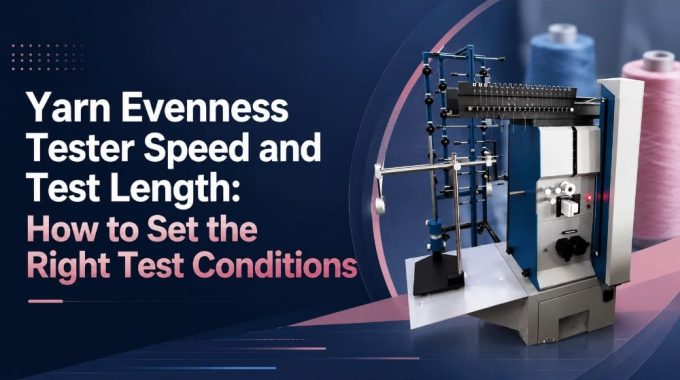
Yarn Evenness Tester Speed and Test Length: How to Set the Right Test Conditions
Testing speed and testing time will determine if the evenness measurements are repeatable. Generally, most staple yarns are tested at a speed of 400 m/min to provide a sample length of 400 meters. Roving is tested at 25–50 m/min, and sliver is slower still at 5–25 m/min.
This is intended for laboratory managers, quality control engineers, researchers, and buyers of the yarn evenness tester.
Test Conditions in Yarn Evenness Testing
Test parameters refer to the constants such as speed, test length, measurement hole, tension, and atmosphere in which these tests are conducted. A slight change in any of them causes variation in CV%, regardless of whether the yarn is identical or not.
This is the primary reason why most conflicts arise between spinners and their buyers. For instance, if two laboratories test the same batch of yarn using different speeds (200 m/min or 400 m/min) or conditioning time periods (two hours or twenty-four hours), then they get different readings of the unevenness.
The test method must be stipulated in the quality contract together with the tolerance.
What the Tester Measures
The capacitive evenness tester measures the change in capacitance created by the mass of fiber inside the parallel plates in the measuring slot and generates a signal showing mass variation per unit length and not diameter:
It produces the following results:
- U% – average linear irregularity
- CV% – coefficient of variation of mass, which is the main number to report
- Imperfections – thin spots (-30%, -40%, -50%), thick spots (+35%, +50%), and neps (+140%, +200%) per 1000 m.
- Spectrogram – mass variation amplitude over wavelength
- Length of variance curve – CV% over cut lengths
Since the capacitive measurement method depends on moisture content, conditioning is essential. The optical method is less affected by moisture and is used in some Filament Evenness Tester measurements for continuous filaments and fine synthetic yarns.
Recommended Testing Speed by Yarn Type

The standard testing speed of spun staple yarn is 400 m/min, which should be decreased to 200 m/min for coarse or delicate yarn, and further decreased to 25 – 50 m/min for roving and sliver. The speed depends on linear density, yarn strength, and the ability of the yarn strand to withstand the process without stretching or breakage.
Greater speed provides longer yarn samples in the same period of time; hence, it increases the statistical reliability of the results. The limitation is provided by the mechanics of the test, namely, the strand has to pass the slot under controlled tension without slipping.
Cotton Yarn
Carded and combed ring-spun cotton yarns with Ne 20-60 have a testing speed of 400 m/min for 1 minute. Rotor-spun cotton yarn is treated in the same way. For yarns less than ne 10, the speed is decreased to 200 m/min because of a heavier strand passing the slot and greater friction of the guides.
Yarn with high hairiness should be measured at a lower speed owing to increased friction at the guide faces.
Polyester and Blended Yarn
Testing of blends such as polyester/cotton and polyester/viscose blends should be done at 400 m/min using the same test conditions as for cotton. However, because blends are dielectrically mixed, the tester needs to be calibrated for 65/35 blend results, which result in systematic deviation from the absolute mass value.
Continuous filament polyester and nylon are tested using a Filament Evenness Tester working optically. The speed of the filament may vary from 100 to 400 m/min based on denier and texture.
Coarse and Fancy Yarn
Coarse yarns above roughly 200 tex, such as slub, core-spun, elastic, and chenille yarns, should be tested at 100 to 200 m/min. Testing of fancy yarns involves an engineered irregularity, and thus the purpose of testing is to record the consistency of the effect, not the problem itself.
Elastic core-spun yarns need to be tested under controlled tension. Stretching of the yarn in the measuring zone affects mass per unit length and increases unevenness.
Roving and Sliver
The testing speed for roving is 25-50 m/min, whereas for sliver it is 5-25 m/min; the measuring slot should be broad. The cohesion in these yarns is very weak; therefore, false drafting may occur at higher speeds owing to the transport tension.
The tests on slivers generally proceed by length and not by time (over 100 m m/can), since defects in slivers occur over large wavelengths and hence cannot be detected in small samples.
Speed Reference Chart
| Strand Type | Typical Count Range | Recommended Speed | Test Duration | Sample Length |
| Combed / carded cotton | Ne 20–60 | 400 m/min | 1 min | 400 m |
| Coarse cotton | Below Ne 10 | 200 m/min | 1–2 min | 200–400 m |
| Polyester / blended | Ne 20–60 | 400 m/min | 1 min | 400 m |
| Continuous filament | 50–300 den | 100–400 m/min | 1–2 min | 200–400 m |
| Fancy / core-spun / elastic | Variable | 100–200 m/min | 2 min | 200–400 m |
| Roving | 0.4–1.2 Ne | 25–50 m/min | 2–4 min | 50–200 m |
| Sliver | 3–6 ktex | 5–25 m/min | 4–10 min | 50–100 m |
Use them only as a point of departure. Verify from the operating manual and the relevant standard before incorporating them in your lab protocol.
Testing Speed Effect on Measurement Accuracy
Speed does not change the irregularity present in the yarn, but it changes what the instrument records through transport tension and vibration.
A constant sampling speed means that at high transport speeds, each sample will cover more of the yarn, resulting in a larger averaging distance of small wavelength irregularities. Practically speaking, this leads to a slightly reduced value of imperfections recorded, especially neps, which have the shortest wavelength.
An increase in speed brings an increase in tension. With weak or low-twisted yarns, this results in drafting on the way to the slot, with the measurable thinning of the strand before entering the slot, which will result in the recording of irregularity not present in the package.
Vibration is the third factor affecting the results. When the transport system reaches its mechanical stability threshold, the strand starts vibrating in the slot, adding extra noise to the spectrogram and increasing the baseline.
Slow speed is not automatically more accurate. Below about 100 m/min, the sample length decreases for a set amount of testing time, which leads to instability in the CV% calculation.
Effect of Testing Length on Results

The length of the test controls which wavelength of variations can be detected. The short sample reflects only the short-term variations; the longer wave variations due to drafting and blending require several hundred meters or more.
Short Length vs Long Length
While 100 m will give an acceptable indication of short-term CV%, it cannot resolve variations with a wavelength of several meters. A 400 m test will resolve both short and medium wavelengths. Tests of 1000 m and above are required for long-term count variation and blending problems.
QC testing typically requires 400 m per bobbin over 10 bobbins. Problem determination may require longer runs.
Length and CV% Reliability
CV% becomes reliable as sample length increases. Repeated tests on 100 m samples of a single bobbin may have several tenths of a percent difference between them; 400 m reduces the variability substantially.
The bobbin-to-bobbin variability is typically greater than within-bobbin variability, so 10 bobbins tested at 400 m is much better information than one bobbin at 4000 m. Running 10 packages at a fixed program is where an automatic evenness tester with a bobbin changer pays the investment.
Spectrogram Requirements
The range of wavelengths in the spectrogram depends on the sample length. The guideline here is that the longest analyzable wavelength is roughly one-fifth of the tested length.
A 400 m sample therefore, resolves wavelengths up to 80 m.
Short samples result in spectrograms with statistical peaks in long-wavelength regions that are not machine-related but rather are due to the statistics. Checking the draft-frame on a 50 m sample gives unreliable results.
Periodic Fault Detection
Periodic faults are presented on the spectrogram as individual chimneys. The wavelength of such a fault corresponds to the circumference of the defective roller and the total draft after the fault point. The wavelength of the defect caused by an eccentric front roller is relatively short, while the wavelength of the fault in the draw frame is rather long and can be detected only at large test lengths. This is the reason for using the evenness tester in the long-test mode for process diagnostics purposes.
How to Select Proper Test Conditions (numbered list descriptions)
Conditions to select in a fixed sequence: state the purpose of the testing, assign the slot to the count, determine speed and length simultaneously, then regulate atmosphere and tension. Doing things in reverse order will result in data that cannot be batch-compared.
- Define the Purpose: QC needs short, replicable tests. Process diagnosis needs long samples and full spectrogram analysis. Research and development may need several speeds.
- Match the Measuring Slot: pick the slot designated for your count range. Too large a slot will reduce sensitivity, too small a slot will lead to contacts and peaks.
- Set Speed and Length Together: pick the speed that your strand can stand, and set the time needed to obtain the length of the sample.
- Condition the Sample: standard atmosphere is 20 ± 2 °C and 65 ± 2 % and relative humidity. Give your samples at least twenty-four hours; more for tightly rolled bobbins.
- Fix tension and sample preparation: use the tension device indicated; remove the outermost layers from each bobbin and wind the same way.
- Standardize and Document: lock the parameters into a named test program; prevent operators from changing them. Document them with every report.
Common Testing Speed Mistakes

Some of the worst mistakes include using one speed for all counts, testing poor yarn at excessively high speeds, and reducing test length to improve efficiency. In all cases, the data is accurate but not comparable.
One Speed for All Counts
Testing Ne 6 and Ne 60 at the same speed is easy but incorrect. At 400 m/min, the coarse yarn runs too fast which means the heavier strand drags on the guides and false drats before it reaches the slot.
At 100m/min, the fine yarn runs too slow, a one-minute test yields only 100 m, which is not enough sample to stabalise the CV%.
Excess Speed on Weak Yarn
Yarns such as low twist, high hairiness, and regenerated fiber yarn break or false draft at higher speeds. The best indication of the need to lower speed is frequent breaks during testing.
Shortened Test Length
Cutting down from a minute to thirty seconds results in only half the sample size and makes CV% and counts of imperfections per 1000 meters unstable.
Skipped Conditioning
The capacitive method detects moisture. The use of unconditioned yarn taken directly from a hard spinning room gives consistently lower measurements of mass, along with inaccurate information about imperfections.
Wrong Slot or Calibration Drift
The wrong slot places the signal outside the optimum range. Drift in calibration happens quietly; check your results using a known reference regularly, following sensor cleaning.
Mid-Test Speed Changes
A speed change during the series makes comparisons within the series invalid. If a change in speed is required, baseline new control limits should be used instead of comparing the new data with the old.
Standards for Speed and Length
The standards used are the ASTM D1425 standard for evenness testing using the capacitance method and the ISO 16559 standard for unevenness of textile filaments with assistance of ASTM D1776 standard conditioning. These standards allow different speeds and lengths, which are noted in the report.
Standards and Reference Data
| Standard | Scope |
| ASTM D1425 | Unevenness of textile strands using capacitance testing equipment |
| ISO 16559 | Unevenness of textile strands — capacitance method |
| ASTM D1776 | Conditioning and testing atmospheres for textiles |
| Uster Statistics | Benchmark percentile data for CV%, imperfections, and hairiness |
User statistics are not a test methodology, but a benchmarking reference, and comparison can only be made when you test under the same conditions in which the statistics were compiled.
In-House Test Conditions
In-house test conditions are fine as long as there is no provision for testing the material – fancy yarns, technical filaments, unusual blends – in the standard, if the procedure is documented, repeatable, and mentioned in the report.
When assessing the yarn evenness tester for purchase, it must be checked whether the tester can measure all the required speeds and save locked test programs, and mention the test conditions on every report.
Conclusion
Speed and test length are not just throughput settings, but what makes the data meaningful. Set them per yarn type, keep them constant for batches of yarns, condition the samples, and mention the test parameters along with the test results. Comparison of evenness test results requires discipline more than an instrument.