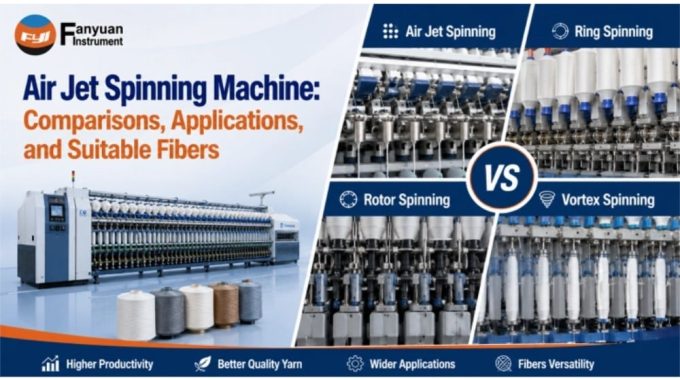
Air Jet Spinning Machine: Comparisons, Applications, and Suitable Fibers
Air jet spinning gives you a practical alternative when you need high productivity, consistent yarn quality, and reduced hairiness. But choosing the right spinning method depends on your fiber, yarn requirements, and production goals. This article will explain how an air jet spinning machine compares with ring, rotor, and vortex spinning machines, where each technology fits different production needs, and which fibers you can use for air jet spinning.
Air Jet Spinning Machine vs Ring Spinning Machine
In an air jet spinning machine, the fibers are twisted and wrapped around the yarn core by high-speed compressed air; in a ring spinning machine, the fibers are twisted mechanically by a spindle, ring, and traveler. This is a big difference between the two systems with regard to their yarn-making process.
Production Speed
Usually, air jet spinning runs at higher delivery speeds and so is best suited for situations where higher productivity is required. Ring spinning is slower but suitable for making finer yarns and is still widely used for the manufacture of high-quality yarns.
Yarn Characteristics
Low hairiness, uniformity, and high resistance to pilling yarn are produced by air jet spinning. Ring spinning is usually used for higher-quality yarns that will have greater strength, softness, and flexibility, which makes it a preferred spinning method for those applications where fabric feel is a premium criterion.
Best Application
Select air jet spinning for its high productivity, low hairiness, and uniformity of yarns. Ring spinning is recommended for making fine yarns with high strength, softness, and versatility in demanding textile applications.
Air Jet Spinning Machine vs Rotor Spinning Machine
Spinning Principle
An air jet spinning machine is a machine that produces yarn by the spinning process that utilizes the high-speed air vortex. The flow splits and regulates the fibers, and also wraps some fibers around a relatively parallel core, resulting in a relatively hairless yarn structure. On the other hand, a spinning machine with a rotor is used in which opened fibers are fed into a fast spinning rotor. The fibres are collected in the rotor gorge and are twisted continuously in the rotor to make fibres.
Production Speed
The two technologies are geared towards high productivity, with the air jet spinning technology having the ability to deliver very high yarn speeds. This will be helpful if you need to produce a lot of output without a lot of individual spinning positions. The rotor spinning method is also a high-productivity method, especially for automated, continuous production.
Yarn Structure and Appearance
The surface is smooth and clean, and hairiness is low in air-jet yarn, which can enhance the appearance of the fabric and minimize pilling. Fabrics made with rotor yarn are fuller and show a unique texture due to their open and bulky nature. Under similar conditions, however, rotor yarn typically is of lower strength than an air-jet yarn.

Fiber Compatibility
The use of air-jet spinning for spun cotton, polyester, viscose, and blends of fiber is especially suitable where the fibers are of an appropriate length and possess appropriate processability. Rotor spinning is more tolerant of shorter fibre, recycled fibre, and fibres which may be hard to spin in other spinning systems, and is useful for economical and recycled-yarn production.
Yarn Count and Applications
Air jet spinning is usually chosen for medium and comparatively fine yarns employed in clothes, household fabrics, and knitted fabrics. Since coarser and medium-count yarns are typically not required to be as soft or as strong, rotor spinning is a particularly good choice for denim, towels, workwear, home textiles, and other applications.
Yarn Count and Applications
The process of rotor spinning can reduce the number of intermediate processes and the number of preparatory and spinning functions in a single process. Therefore, it can reduce the production cost compared to conventional ring spinning. Also, air jet spinning can provide high productivity and minimised downstream issues relating to hairiness, but it has an important energy consideration in that there is a compressed air system.
Which One to Use?
Use air jet spinning if you require high productivity, low hairiness, clean yarn appearance, and good pilling resistance. Use rotor spinning when economy, bulkier yarn, recycled and/or shorter fibers, and economic production of medium to coarse yarns are the priorities.
Air Jet Spinning Machine vs. Vortex Spinning Machine
Spinning Principle
An air jet spinning machine is a fiber spinning machine that is controlled by compressed air to wrap fibers around a central fiber core. A vortex spinning machine is a machine that spins yarn by using a controlled air vortex, and the surface fibers wrap around the core of the yarn. Air-jet spinning is also known as vortex spinning, which is a more sophisticated air-jet spinning technology used specifically for stable yarn production.
Yarn Structure and Hairiness
Air-jet yarns in general have low hairiness and good uniformity, while vortex yarns are likely to have an even lower hairiness and a cleaner surface. The vortex yarn also has the characteristics of anti-pilling and anti-abrasion due to the high strength of the wrapping fibre.
Production Speed
Both systems are fast in production, in comparison with conventional ring spinning. For manufacturers looking for a high output, consistent yarn quality and minimal downtime in production, vortex spinning is an attractive option.
Yarn Strength and Quality
Air jet yarn gives good strength and uniformity, but vortex yarn can give better uniformity of strength, low hairiness, and uniformity of quality. Both systems, however, cannot automatically be called the best for all yarn counts and fibres; it depends on the properties of the fibre and setting of the machine.

Fiber Compatibility
Cotton, polyester, viscose fiber, and blends with appropriate fiber properties can be used for air jet spinning. Vortex spinning can also be applied to cotton and synthetic fibres, especially when it is necessary to get clean and consistent yarn for knitted and woven fabrics.
Best Application
Use air jet spinning when high productivity, low hairiness, and efficient yarn production are required. Select vortex spinning for extremely low hairiness, uniformity of yarn, resistance to pilling, and high-speed spinning.
What Fibers Can Be Used in Air Jet Spinning Machines?
Air jet spinning is applicable to a variety of natural, regenerated, and synthetic fibres, but spinning performance depends heavily on fibre characteristics such as length, fineness, strength, and friction. Cotton is commonly used, and other fibers such as polyester, viscose, modal, or blends can also be used to create uniform yarns if they are properly prepared.
Read More: Yarn Evenness Tester Speed and Test Length
Synthetic fibers can enhance strength and durability, while regenerated fibers can add softness and moisture management. To ensure good production, choose fibers that are long enough and uniform enough to ensure proper fiber control when spun at high speed in air.
Comparison of Air Jet, Ring, Rotor, and Vortex Spinning Machines
| Feature | Air Jet Spinning | Ring Spinning | Rotor Spinning | Vortex Spinning |
| Spinning principle | High-speed air wraps fibers around a core | Spindle, ring, and traveler insert twist | Rotating rotor collects and twists fibers | High-speed air vortex forms the yarn |
| Production speed | Very high | Moderate | High | Very high |
| Yarn hairiness | Low | Relatively high | Moderate | Very low |
| Yarn strength | Good | High | Moderate | Good |
| Yarn structure | Compact, smooth | Dense and highly twisted | Bulkier, fuller | Compact with wrapper fibers |
| Pilling resistance | Good | Moderate | Good | Very good |
| Fiber suitability | Cotton, polyester, viscose, modal, blends | Broad fiber range | Short/recycled fibers and coarser materials | Cotton, polyester, viscose, blends |
| Typical yarn counts | Medium to relatively fine | Fine to coarse | Mainly medium to coarse | Medium to relatively fine |
| Main advantage | High productivity and low hairiness | Excellent strength and versatility | Cost-effective, bulky yarn production | Very low hairiness and high productivity |
| Common applications | Apparel, knits, home textiles | Premium apparel and fine fabrics | Denim, towels, workwear, home textiles | Apparel, knitwear, home textiles |
Conclusion
The outlook for air jet spinning is good, because textile producers are looking for increased productivity, uniformity of yarns, decreased hairiness, and efficient production. It can be used for treating cotton, synthetic, regenerated, and blended fibres. Air jet is also significantly different in terms of speed and the appearance of the yarns produced compared to ring and rotor spinning, and vortex spinning is an even superior airflow technology. Its application will be enhanced in the current textile industry with future improvements in automation, energy efficiency, fiber compatibility, and yarn control.
Looking to improve your spinning process? Explore our air jet spinning solutions and choose the right machine for your fiber, yarn, and production requirements.