What is Wet Spinning? Principle, Process, Machine, and Uses
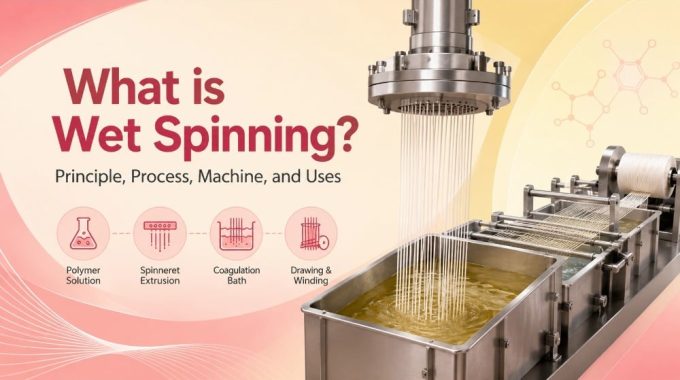
Wet spinning is used to produce textile fabric by dissolving a polymer in a solvent and extruding that viscose mixture through a spinneret to produce long strands of fibers, which are solidified in a liquid coagulation bath, hence the name wet spinning.
This article covers the principal process behind wet spinning, the types of textiles you can produce, and parts of a wet spinning machine.
What is Wet Spinning? Definition and Overview
Wet spinning is a fiber manufacturing process where a polymer is dissolved in a solvent and makes a viscous solution. The solution is extruded through a spinneret and quickly solidified in a liquid coagulation bath.
The bath contains a non-solvent for the polymer, which causes it to precipitate and form a continuous solid fiber.
So why is it called wet spinning? “Wet” refers to the liquid-cooling method and distinguishes it from dry spinning, in which the extruded part is passed through a heated air channel, or melt spinning (without any solvent).
Wet spinning started in the 19th century to produce artificial silk, and today it is still popular in the textile and plastics industry to produce viscose rayon, aramid, spandex, and synthetic fibers.
Principle of Wet Spinning
Polymer Dissolution And Spinning Solution Preparation
The wet spinning process starts from the homogenous polymer solution referred to as the spin dope. The polymer is dissolved in a solvent at concentrations ranging from 1% to 25%. The choice of concentration depends on the molecular size and weight of the polymer and the final fiber properties.
- For acrylic fibers, use dimethylacetamide or dimethylformamide
- Viscose rayon uses an alkaline carbon disulfide
- Lyocell uses N-methylmorpholine N-oxide
After the solvent passes, the solution is filtered to remove undissolved particles, which can block the small spinneret holes, and often passes through a degassing stage to eliminate air bubbles, which are the reason for non-uniform fiber properties.
Extrusion Through Spinnerets And Fiber Formation
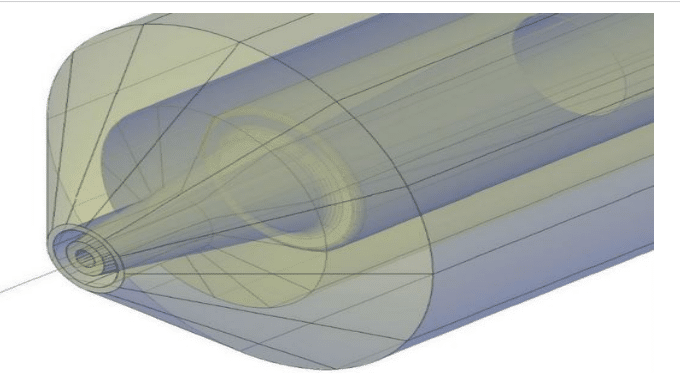
The spin dope is processed at a controlled rate through a filter to the spinneret. Spinneret, which is the most important part of a wet spinning machine, is a precision-machined disc with tiny capillaries that is submerged directly into the coagulation bath. The idea is to allow the exiting solution from the capillaries to directly make contact with the bath liquid.
The non-solvent diffuses into the filament, and the spinning solvent diffuses out. To put the spinneret into perspective, it is a tiny disc with at least 30,000 holes, and for some target fibers, it can exceed 100,000 holes.
Coagulation Bath: Solidifying The Fiber
The Coagulation bath is important for phase separation. Phase separation is the stage where the liquid jet converts into a solid fiber. Bath composition, temperature, and the submerging time directly impact fiber properties and quality. These parameters can change the internal structure of the fiber.
Some properties that are affected by the coagulation bath include: cross-sectional shape, porosity, tensile properties, rigidity, and gaps.
Faster coagulation rates produce denser skin and a porous core; a slow coagulation produces a more uniform cross-section. After exiting the bath, fibers pass through a series of washing baths to remove residual solvent and are stretched to remove molecular orientation before they are finally dried.
The Wet Spinning Process: Step by Step

- Spinning Solution Preparation: The polymer is dissolved in an appropriate solvent to form the spin dope. The solution is filtered and degassed before spinning begins.
- Extrusion: A metering pump delivers the spin dope at a precise constant flow rate to the spinneret. Each capillary produces a single filament as the solution enters the coagulation bath.
- Coagulation, drawing, and washing: Extruded filament solidifies in the coagulation bath and passes through multiple washing baths to remove the solvent. Draw rollers apply controlled tension to stretch the fiber, orienting the polymer chains along the fiber axis and improving tensile strength.
- Spin finish: Spin finish (lubricant) is applied to reduce inter-filament friction and static buildup. A long continuous filament can be wound into bobbins as filament yarn.
Types of Wet Spinning Processes
| Process | Key Feature | Common Use |
| Wet spinning | Direct immersion in the coagulation bath | Acrylic, viscose fibers |
| Dry jet wet spinning | Air gap between spinneret and bath | Lyocell, aramid fibers |
| Gel spinning | Semi-solid gel state before drawing | High-strength polyethylene |
| Solution blow spinning | Airflow-assisted fiber formation | Nanofibers, filtration media |
Dry Jet Wet Spinning
The other name for dry jet wet spinning is air-gap spinning. It is a modified process of wet spinning, and the key difference is the spinneret location. In dry jet wet spinning, the spinneret is positioned above the coagulation bath instead of submerged within it, like in wet spinning.
The extruded filament travels through the air gap before entering the coagulation bath, and this air allows for better molecular orientation and better mechanical properties in the final fiber.
Wet Spinning Machine: Components and Working Mechanism

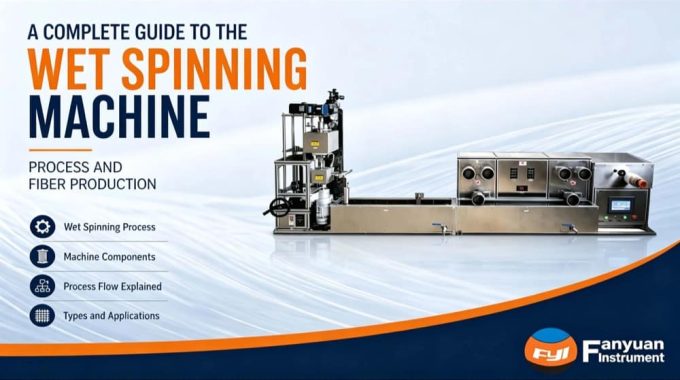
A wet spinning machine is made of many components, but the process relies on a few key systems: spinneret, coagulation bath, metering pump, environment control, and fiber stretching system.
Spinneret
Spinneret is important for the fiber geometry, size, and shape. It is a thin plate made from gold-platinum alloy, tantalum, or stainless steel with holes and extremely precise capillaries.
When designing the spinneret, the hole diameter, length-to-diameter ratio, and capillary count depend on the fiber you want to extrude. A smaller capillary diameter produces finer filaments but requires high extrusion pressure.
Coagulation bath system
The coagulation bath needs to be temperature-controlled because the non-solvent liquid controls the coagulation rate. Residence time, which is the time the filament stays submerged in the liquid, is determined by the take-up speed and the bath length parameter set by the operator. The dwell time or residence time only affects how fully the solvent is exchanged before the fiber exits.
Metering pump selection
The metering pump defines your extrusion rate, which defines the fiber linear density. The most common setup is the gear pump because it can eliminate pulsating flow. But you can operate different pumps depending on the viscosity, which affects the resistance the pump feels.
For multi-position wet spinning, each spinneret has its own metering pump for quality and uniform production across all filaments.
Heating and temperature control
While it is ideal to control the temperature throughout the process, there are many phases and interactions of the filaments with the equipment, which makes it extremely difficult. However, the temperature control works in three stages.
- Spin dope storage and delivery systems are maintained at a set temperature to keep viscosity stable during the extrusion process.
- Coagulation bath temperature is regulated in the tank, typically between 10 and 60 depending on the polymer. Controlling the bath temperature is important for the fiber morphology.
- Drying temperature is regulated through a hot air oven to remove residual moisture and solvent from the fiber before winding up.
Fiber stretching units
The ratio of the winding speed to the extrusion speed controls the orientation in the finished fiber. Higher draw ratios produce stronger fibers with higher Young’s modulus by aligning polymer chains along the fiber axis.
Stretching is applied initially in a wet stretch in the wash bath, followed by a dry stretch on heated godets after drying. Godet roller speed defines the stretch, and you can adjust the number of stretching rollers and stages for adding rotation.
Fibers Produced by Wet Spinning
| Fiber Type | Solvent/Process | Key Properties |
| Acrylic | Dimethylacetamide (DMAc) | Soft, wool-like, UV-resistant |
| Viscose (Rayon) | Alkaline CS₂ solution | Breathable, absorbent |
| Lyocell | NMMO solvent | Strong, biodegradable |
| Aramid | Sulfuric acid | High tenacity, heat-resistant |
| Protein-based | Ionic liquids | Biodegradable, specialty use |
Uses and Applications of Wet Spinning
Textile and apparel applications
The textile industry largely relies on wet spinning to produce different synthetic fibers. Acrylic fiber is exclusively produced using wet spinning and is an alternative to wool.
Viscose rayon, which is spun from alkaline cellulose solution, is used in lining and in lightweight fabrics. Spandex is another popular fabric commonly used in active wear, gym wear, and compression garments, commonly produced through wet spinning.
Technical and industrial fiber applications
Many industries other than textiles also use wet spinning. For example, aramid fibers, which are tactical fibers, are used in ballistic protection, heat-resistant protective clothing, and the aerospace industry in composite manufacturing.
Many fiber precursors are wet spun; the most common is PAN fiber, which is turned into carbon fiber after production through wet spinning.
Medical dressings and wound patches are made from medical-grade textiles like alginate, a product of wet spinning.
Advantages of Wet Spinning
- Ideal for polymers that cannot be melted without degradation, which allows you to produce more fabric options.
- Spinneret holes can be small, allowing you to produce and research fabrics with low linear density.
- Large tow counts can be processed simultaneously
- Compatible with natural polymer solutions such as cellulose
- Allows production of multiple fibers in one run with individual control over fiber morphology.
Disadvantages of Wet Spinning
- Production speed is significantly lower than that of melt spinning
- Solvent is a health risk and requires solvent handling safety training
- A coagulation bath is an added complexity, and the composition needs to be monitored and adjusted for consistent fiber quality.
- Higher costs than melt spinning.
Conclusion
Wet spinning is the only production route for many commercially important fibers, including acrylic, viscose rayon, spandex, and aramid. For polymers that degrade in high temperatures or are sensitive to thermal variations, wet spinning and its variants, like dry jet wet spinning, are the only options for reliable production.