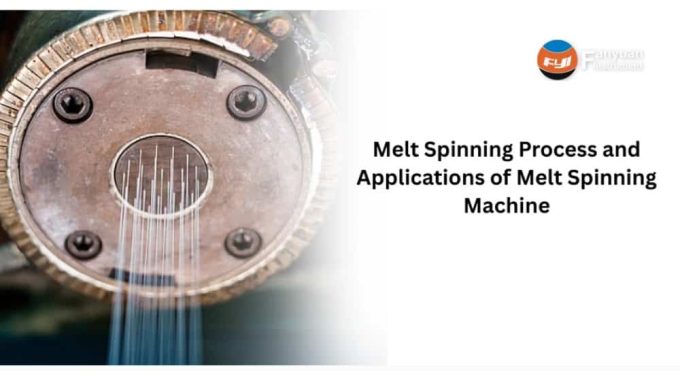
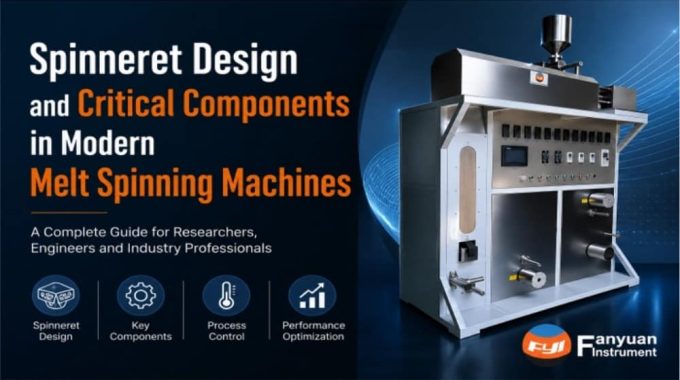
Spinneret Design and Critical Components in Modern Melt Spinning Machines
For anyone involved in fibre research, fibre engineering, fibre quality control, or fibre polymer processing, it is crucial to understand the key elements of a melt spinning machine to obtain uniform fibre quality and maximise production efficiency. Although synthetics are dominating the textile industry, recent developments in the melt spinning process have greatly enhanced the productivity, energy efficiency, and performance of the process.
In the laboratory, it influences the size and strength of the fiber, uniformity, and quality of the product in each experiment; in a new polymer product, it determines fiber diameter, tensile strength, uniformity, and product quality; and in the industry, it directly impacts fiber diameter, the strength of fiber, the uniformity of fiber, and product quality in a fiber production line.
This article will discuss important design considerations and operating systems associated with polymer melt spinning, such as spinnerets, extruders, temperature control systems, cooling systems, and take-up systems. You will also discover how the present automation and AI technologies are revolutionizing the future of the melt spinning process.
Understanding the Melt Spinning Process
What Is Melt Spinning?
Melt spinning is one of the most common methods to produce synthetic fibres. This is accomplished by using a thermoplastic polymer that is melted and extruded through a spinneret and then cooled into continuous filaments. This technique is so simple, quick, and inexpensive that it is most commonly used for commercial applications of fibers.
Why the Melt Spinning Process Is Important
The Melt Spinning Process is important for the following reasons. The melt spinning technology allows the production of large quantities of uniform fibers with a uniform mechanical property. It does not apply to other spinning technologies; it does not need a solvent recovery system, and it is more efficient than production. It is especially suitable for the production of polyester, nylon, and polypropylene fibres.
Key Stages of Polymer Melt Spinning

The polymer melt spinning workflow comprises polymer feeding, polymer melting, polymer extruding, cooling, drawing, and winding. The stages all affect the diameter of the filament, the orientation of the molecules within the filament, and the performance of the fiber. Being able to control these stages is crucial to ensure product consistency and minimize manufacturing defects.
Spinneret Design in Melt Spinning Machines
Why Spinneret Design Matters in a Melt Spinning Machine
What is a spinneret? The element that takes molten polymer and turns it into separate filaments is called the spinneret. The shape, fineness, and uniformity of the fiber are closely related to spinneret design since each fiber goes through its capillaries. Tolerances on the hole size can affect the product’s overall quality, regardless of its size.
Capillary Diameter and Fiber Formation
The diameter of the capillaries is the size of the initial filament that will come out of the spinneret. It is used for fine fibers and larger openings for high-denier products. With proper capillary design, the flow of polymer and dimensions of the fibers remain stable during the melt spinning process.
Cross-Sectional Shapes in Polymer Melt Spinning
Today, various types of fiber profiles, such as circular, trilobal, hollow, and multilobal, can be produced using modern spinners. They are also specially designed forms to enhance moisture management, insulation, softness, or filtration. Customized spinneret geometries are becoming more and more important as functional textiles are becoming more advanced.
Spinneret Materials and Durability
The spinnerets should be capable of withstanding the high temperature, pressure changes, and constant flow of polymers. As a result, often stainless steel or special alloys with high wear resistance are used to make them. The use of durable materials ensures dimensional accuracy and enhances the equipment’s service life.
Heating and Temperature Control Systems in Melt Spinning
Why Temperature Control Is Critical
Among all the variables of polymer melt spinning, one is very important, which is the temperature, as it directly influences the viscosity of the polymer. The flow may be affected either too hot or too cold, resulting in a loss of fiber quality. Stable thermal conditions provide reliable extrusion processes and good process stability.
Heating Zones in a Melt Spinning Machine
Most of the melt spinning machines consist of a number of heating zones to progressively melt and condition the polymer. In each zone, a special function is achieved, starting from initial melting until the final temperature stabilization prior to the extrusion process. The controlled heating method yields better melt uniformity and stability.
Thermal Management and Polymer Viscosity
By controlling the temperature effectively, the viscosity profile along the extrusion system can be kept uniform. It has a uniform viscosity in order to ensure that the polymer is evenly fed through all of the spinneret capillaries. This minimizes fibre variation and promotes better fibre quality.
Smart Temperature Control Technologies
The modern systems make use of the PID controller, temperature sensor, and automated monitoring software. They are technologies that dynamically regulate the heating conditions to achieve desired temperatures. Therefore, the operators can obtain higher process repeatability and eliminate quality problems.
Extruder Selection and Screw Design for Melt Spinning
The Role of the Extruder in the Melt Spinning Process
The extruder is the key component of the melt spinning machine, responsible for melting and conveying the melt. It melts solid polymer pellets into a homogeneous molten material suitable for forming fibers. To ensure throughput and fiber quality, it is essential to have stable extrusion.
Single-Screw Extruder and Twin-Screw Extruder
For the production of standard fiber, single screw extruders are used as they are simple and reliable. A twin-screw system offers improved mixing efficiency and is generally used for specialty materials and/or research applications. Depending on the processing needs, it is up to the material properties.
Screw Geometry and Melt Quality
The screw design affects the melting efficiency, mixing, and build-up pressure in the extruder. The correct design of the screw can guarantee the complete melting and uniform material distribution. This helps to maintain the stability of operation and to enhance the uniformity of the filament.
Feed, Compression, and Metering Zones
There are different kinds of screw elements that are employed in the melt spinning method. The polymer pellets are delivered to the feed zone, where they are melted and compacted in the compression zone, and finally, a uniform stream of melted polymer is supplied in the metering zone. These sections will form the basis for stable spinning performance.
Godet Roller and Take-Up Systems
Why Fiber Drawing Is Necessary

Initially, extruded filaments generally do not have sufficient mechanical properties to be used in end-use products. Drawing increases the strength of the fibers and makes the polymer chains line up. This is a crucial step to obtaining the desired performance characteristics.
Godet Rollers in Polymer Melt Spinning
The filament speed is regulated by the Godet rollers, and the tension during the drawing is applied. Fiber orientation is affected by their surface quality, temperature, and speed of rotation. Designing the appropriate roller helps to ensure consistency of the process and ensures that filament damage is minimized.
Tension Control and Fiber Uniformity
It is important to have a steady tension across the take-up system for even production of fibers. If the tension is too great, it can break the filament, and if it is too small, it can cause the filament to be wound unevenly. Precision control results in better package quality and processing efficiencies in product downstreams.
Modern Take-Up Technology
In advanced take-up systems, automation devices and servo motors are used to regulate the speed of the take-up to achieve a more precise winding. Manufacturers can achieve the consistent package formation they need at high production speeds, thanks to these technologies. Better winding performance also helps realize better overall winding efficiency.
Cooling and Solidification Systems in Melt Spinning
Why Cooling Is Important in Melt Spinning
Once the filament has been extruded from the spinneret, it is necessary to rapidly and evenly quench the molten stream to make stable fibers. The crystallization behavior, internal structure, and mechanical properties are affected by the cooling stage. Hence, good cooling is crucial to good fibre production.
Air Quenching Systems
The most common method of cooling in the melt spinning process is called air quenching. The conditioned air can take the heat away from the extruded filaments and help to solidify the filament uniformly. Correctly distributing the air flow will reduce diameter variation and structural defects.
Cross-Flow and Radial Cooling Methods
The air is blown across the bundle of filaments in a cross-flow cooling system and across the filament bundle from side to side in a radial system. The aims of both techniques are to enhance heat removal and produce even fibre development. The selection is dependent on the needs of production and fiber specifications.
Cooling Effects on Fiber Properties
The crystallinity, shrinkage, and tensile properties are highly influenced by the cooling rate. There is a risk that the molecular arrangement will change as the cooling is increased, or that it will increase as the cooling is slowed. By adjusting the cooling parameters, the desired strength and flexibility can be obtained.
Specialized Applications of Melt Spinning Technology
Polyester and Nylon Fiber Production
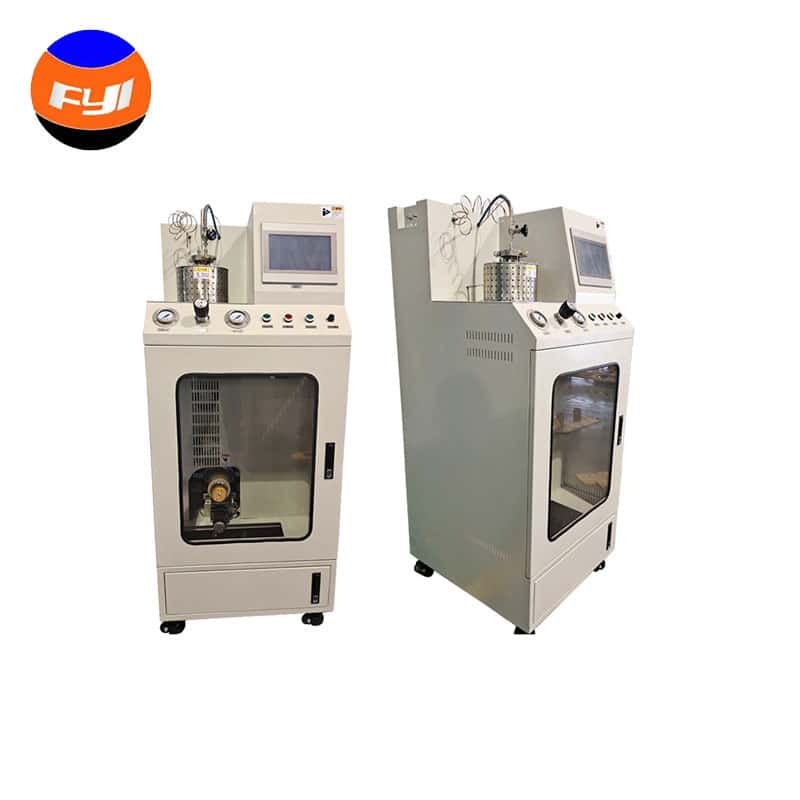
Polyester and nylon continue to be the most commonly spun fibers by the melt spinning process. They possess excellent processing properties and wide applications and are suitable for textile and industrial products.
Polypropylene and Technical Fibers
Use of nonwovens, filtration media, and geotextiles is common because of their lightweight and chemical resistance to polypropylene. These fibres can be efficiently and on a large scale produced by melt spinning.
Carbon Fiber Precursors and Pitch Melt Spinning
The production of precursor fibers for high-performance carbon materials by specialized melt spinning systems is gaining in importance. Pitch-based spinning technologies are available for the production of fibers with excellent thermal and mechanical properties.
Smart and Functional Fibers
New applications are conductive fibres, sensing material, and high-tech technical textiles. The innovations illustrate the development of modern melt spinning machines beyond the mere production of fibers to high-value material production.
Conclusion
For any melt spinning process, good performance of spinnerets, extruders, temperature control systems, cooling unit and take-up equipment is essential. All the components are directly related to fiber quality, productivity and process stability. With the ongoing advancements of automation, AI, and the development of new materials, the future of polymer melt spinning promises to be more precise, efficient, and innovative in both research and industrial settings. Need further assistance? Feel free to contact us. Our team will get back to you as quickly as possible regarding your queries.