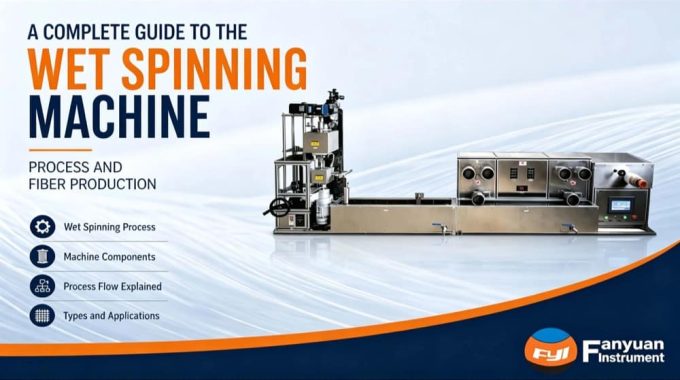
A Complete Guide to the Wet Spinning Machine Process and Fiber Production
Manufacturers are turning to specialized spinning technologies to use fibers with specific properties in various industries, including textiles, medical materials, aerospace, and advanced composites, as the demand for such fibers grows. One of the most significant technologies of these is wet spinning, which is used in the production of fibres that are not melt spun due to their chemical and thermal properties.
If you are employed by a research laboratory, university laboratory, textile manufacturing plant, or a quality control unit, knowledge about the working of a wet spinning machine could help you to develop the fibers, increase production efficiency, and enhance the quality of the product. In this article, you will learn about what wet spinning is, how the wet spinning machine works, the major components of the wet spinning machine, the complete wet spinning process, and various types of wet spinning machine systems used in modern fiber production.
What Is a Wet Spinning Machine?
Before we proceed to understand the wet spinning machine, the first thing we should understand is what wet spinning? Wet spinning is a widely used method for producing regenerated cellulose fibers as well as acrylic fibers, aramid fibers, and many special fibers that require controlled coagulation and solidification processes.
The wet spinning machine is a special type of fiber-forming machine that extrudes a polymer solution through a spinneret into a coagulation bath to form a continuous filament. The polymer present in a solvent changes from a liquid to solid fibers in the presence of the coagulating medium.
Wet spinning is used when the polymer cannot be melted and extruded into fibers (as in melt spinning) or the polymer decomposes at temperatures above which it can be melted and spun. This process allows the manufacturers to produce fibres that have excellent mechanical, chemical, and dimensional stability.
The common fibers that are being made by wet spinning are:
- Acrylic fibers
- Rayon fibers
- Viscose fibers
- Aramid fibers
- Carbon fiber precursors
- Specialty biomedical fibers
To learn more about the technology and its applications, you can view our in-depth wet spinning resource here.
How Does a Wet Spinning Machine Work?
Before knowing the importance of wet spinning, it is essential to know the principle of fiber formation.
The process starts with the making of a polymer solution, which is also known as spinning dope. The polymer is dissolved in an appropriate solvent to form a uniform liquid solution that has a precisely controlled viscosity.
The next step in the process is carried out in the wet spinning machine, which will carry out the following functions:

1. Polymer Solution Preparation
The polymer and solvent are blended in, and impurities are filtered out to ensure uniformity. To produce defect-free fibers, the quality of the solution is crucial. The raw polymer materials are dissolved in a suitable solvent. The most important quality parameters are:
- Concentration
- Temperature
- Viscosity
- Homogeneity
2. Extrusion Through Spinnerets
The dope is then pumped through a number of small holes (microscopic) in the precision spinnerets. Individual holes create individual filaments.
The fineness and the shape of the cross-section of the fibres are directly determined by the diameter and geometry of the spinneret. The dope is prepared, filtered, and degassed. This stage removes:
- Air bubbles
- Solid contaminants
- Gel particles
3. Coagulation Bath Solidification
The polymer solution is fed into a coagulation bath, which is a nonsolvent or chemical solution, as the polymer solution leaves the spinneret. The polymer solution is fed into a coagulation bath, a nonsolvent or chemical solution, as the polymer solution leaves the spinneret.
The key feature of the wet spinning process is this stage. Nonsolvent penetration, polymer precipitation, and solidification by the diffusion of the solvent take place at the same time.
4. Washing and Solvent Removal
The newly created fibers will have traces of the solvents and coagulants. The multiple washing stages remove these substances and result in a purer fiber. New fibers will have traces of solvent and chemical agents in them. Washing stages ensure:
- Improved purity
- Better environmental compliance
- Enhanced product consistency
5. Drawing and Orientation
The fibres are extended to make the molecular chains run parallel to the fibre axis. In this stage, polymer molecules are aligned, and improvement is done in terms of:
- Tensile strength
- Modulus
- Dimensional stability
- Fiber uniformity
6. Drying and Winding
Finally, the fibers are dried, finished, and then wound into packages for later use in the textile industry or other industrial applications. Proper drying prevents:
- Fiber deformation
- Surface irregularities
- Mechanical property variations
The success of each step will influence the fiber quality and how efficiently the fiber will be produced. After the working step procedure, the product is wound and packaged for transport.
Main Components of a Wet Spinning Machine
Modern wet spinning systems are composed of a number of integrated units that cooperate to obtain uniform fiber formation.

The polymer solution preparation unit is a device designed to prepare a polymer solution. In this section, the spinning dope is made from mixing the polymers and solvents under controlled conditions.
Typical equipment includes:
- Mixing tanks
- Agitators
- Heating systems
- Storage vessels
Stable viscosity and even polymer distribution are guaranteed with appropriate preparation.
Filtration System
Contaminants, gels, and undissolved particles are removed by filtration prior to the extrusion.
High precision filters prevent:
- Spinneret blockage
- Filament breakage
- Surface defects
- Metering Pump
Metering Pump
The metering pump provides a constant and controlled flow rate of the spinning solution.
Pumping accurately is very important since even a small change in pumping will change the diameter and uniformity of the fibers.
Spinneret Assembly
The spinneret is regarded as the “heart” of the wet spinning machine. Its functions include:
- Fiber shaping
- Filament formation
- Flow distribution
Today’s spinners are made with very high precision to produce a consistent filament.
Coagulation Bath
The coagulation bath is used to start the fiber solidification by solvent exchange.
Critical parameters include:
- Bath composition
- Temperature
- Flow rate
- Residence time
Optimisation of these variables directly affects the morphology and mechanical properties of fibers.
Washing and Drying Unit
A washing and drying unit is used to wash and dry the materials. Coagulate and draw fibers through washing and drying tanks.
These units are used to wash away remaining chemicals when winding fibers for their last processing.
Winding System
The winding system winds the fibres into bobbins or packages.
Advanced systems of winding ensure the quality and uniformity of packages throughout production.
For those considering the specification details or new fiber production line, they can find more technical information in this guide on wet spinning machines.
Types of Wet Spinning Machines for Fiber Production
Conventional Wet Spinning Machine
The most common fiber-making machine is the conventional wet spinning machine. These fibers are formed by extruding the polymer solution directly into the coagulation bath, with the fibers solidifying due to the exchange of solvents. This type is generally used to manufacture rayon, acrylic, and other regenerated fibers. It is widely used for research and industrial purposes due to its simplicity of design, reliability, and ability to run on various polymer systems.
Continuous Wet Spinning Machine
The continuous wet spinning machine is used for large-scale fiber production and is designed to produce fibers with consistent quality at a high rate. All the processes of spinning, from polymer extrusion to coagulation, washing, drawing, and drying to winding, are in a continuous production line. This machine type enhances manufacturing efficiency and lowers labor demand, which can be used in commercial fiber manufacturing plants to achieve stable operating conditions.
Laboratory Wet Spinning Machine
Laboratory wet spinning machines are specially designed for research institutions, universities, and product development centers. These systems enable the testing of new polymers, optimization of spinning parameters, and testing of fiber performance on a smaller production scale before going to full-scale production. They can be easily integrated with other components and are highly precise, which makes them useful for fiber innovations and academic research.
Multi Filament Wet Spinning Machine
Multi-filament wet spinning machines have a number of spinnerets with a large number of capillaries, which can manufacture several filaments at once. This design also helps in significantly enhancing production capacity along with fiber uniformity. Such machines are extensively used in industrial applications where a large amount of fiber production is desired, especially in the production of synthetic and specialty fibers.
Hot Jet Wet Spinning Machine
A dry jet wet spinning machine is a machine that has a gap between the spinneret and the coagulation bath filled with air. As the process is carried out, the polymer solution leaves the spinneret and passes through a short air gap before entering the coagulation medium. This extra step aligns and orients molecules to produce fibers that have improved mechanical properties. The dry jet wet spinning method is typically applied to the production of high-performance fibres, like aramids, carbon fibre precursor fibres, and advanced technical fibre products, which demand high strength and durability.
Pilot-Scale Wet Spinning Machine
The wet spinning pilot-scale machines are used to create a connection between lab research and commercial production. These allow manufacturers and researchers to test process parameters, to test the scalability, and to obtain larger sample quantities for testing and evaluation in the market. These machines can be especially helpful in the transition from laboratory to industry of new fiber technologies.
Automated Wet Spinning Machine
New generation automatic wet spinning machines combine high-end control technology, sensors, and digital monitoring technology to maximize production efficiency. Automated systems can adjust the spinning pressure, coagulation condition, drawing ratio, and winding tension with little operator effort. The machines can minimize human mistakes and increase consistency of the processes, ensuring high product quality and operational efficiency for manufacturers.

Key Advantages of Wet Spinning Technology
- Allows for the processing of polymers that are thermally unstable and cannot be melt-spun.
- Can be used in the production of high-quality and specialty fibers.
- Provides an excellent control of fiber morphology and internal structure.
- Capable of fine fiber diameter and shape adjustment.
- Makes strong and durable fibres.
- Aids the production of thin and super-thin filaments.
- Works well with a variety of natural, regenerated, and synthetic polymers.
- Helps to produce fibres that are more chemically resistant.
- Allows the fiber properties to be changed by altering the coagulation and drawing conditions.
- Suitable for producing high-tech textiles and industrial fibres.
- Allows to produce more uniform and consistent fibers.
- Encourages research and development of novel fibre materials.
- Selecting an appropriate wet spinning machine.
Choosing the Right Wet Spinning Machine
When making a decision on equipment investment, there are some factors that you should take into consideration.
Important considerations include:
- The application of fibre types and fibres.
- Production capacity requirements
- Scale up to the laboratory or industrial scale
- Automation level
- Solvent recovery systems
- Quality control capabilities
- Maintenance requirements
Choosing the right spinning machine equipment can help to enhance the efficiency of the operation and the uniformity of the product.
Conclusion
Although the market for polyacrylonitrile (PAN) fibers has shrunk, wet spinning continues to be an important fiber manufacturing technique for the production of high-performance and specialty fibers that cannot be manufactured by conventional melt spinning processes. Modern wet spinning machines are critical in research, product development and industrial production for their ability to control fiber formation, structure, and properties with great precision.
For those interested in upgrading their fiber production capacity or considering advanced wet spinning solutions, find out more about wet spinning technology and equipment at fyitester/wet-spinning. We can help you with your research or production needs with the right solution. Need further assistance? Contact us!