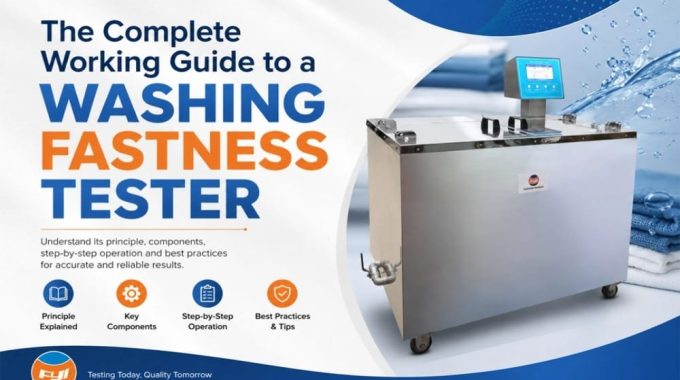
The Complete Working Guide to a Washing Fastness Tester
A washing fastness tester is a special textile testing machine designed for testing the color fastness to washing under simulated washing conditions such as washing temperature, washing solution, and washing mechanical power. It tests for washing fastness and colour fastness to washing, enabling manufacturers to guarantee that their fabrics will not stain and will not fade during use and washing. Modern testers meet international standards such as colour fastness to washing ISO 105 – C06, AATCC 61 and GB/T 3921, which ensures accurate and repeatable test results for quality control. This article provides an explanation of what a washing fastness tester is, its testing principle, the key components, and the step-by-step procedure of a reliable washing fastness test.
What Is a Washing Fastness Tester?
A washing fastness tester is an instrument in the laboratory that can be used to test washing fastness under simulated laundering conditions. It is used to measure the resistance of dyed or printed textiles to color fading and staining after washing to meet international standards like colour fastness to washing ISO 105 C06, AATCC 61 and GB/T 3921. Knowing the workings of the tester helps manufacturers to get accurate washing fastness results and ensure the uniformity of the quality of textiles.
Washing fastness testers are designed to simulate domestic/industrial laundering mechanical action, temperature, and detergent action. It is widely adopted as a method to assess the color fastness to washing of textile fabric, garments, yarns, and other textile products by textile manufacturers, quality control laboratories, and research institutes.
Read More: Top 10 Washing Fastness Tester Manufacturers
How Does a Washing Fastness Tester Work?
The washing fastness tester simulates washing conditions to assess the washing fastness of the color. The instrument is used to assess the ability of a fabric to retain color and/or resist staining during washing while measuring the detergent solution when the temperature is controlled.
1. Sample Preparation
The fabric specimen is cut to the size and sewn to a normal neighbouring fabric. This will enable the test to be used to assess the fading and transfer of color during the wash.
2. Washing Simulation
The specimen is then put in a stainless steel container filled with a normal detergent solution. The washing fastness tester is a machine capable of rotating the container at a specific temperature and speed, which is similar to the actual washing conditions. In some tests, stainless steel balls can also be added to provide a greater mechanical action depending on the test standard.
3. Rinsing and Drying
The specimen is taken out of the washing machine, rinsed with clean water, and dried following the specifications of the testing standard selected.
4. Color Fastness Evaluation
Color change and staining are measured on the tested specimen and compared with a set of gray scale standards in order to determine the washing fastness. The final rating would denote the color fastness to laundering of the fabric, which would help the manufacturers to ensure product quality and meet international textile standards.
Washing Fastness Tester Testing Principle Explained
The washing fastness tester works according to the principle that it mimics the effect of repeated washing under controlled laboratory conditions. In the test, the fabric specimen and another fabric are then placed in a stainless steel container that contains a standard detergent solution. The container is rotated at a predetermined temperature and velocity to simulate the action of water, detergent, temperature and mechanical action found during normal washing.
Learn More: Color Fastness to Washing SW-8A/12A
Following the test cycle, the specimen is rinsed, dried and the color fastness to washing is assessed both by the fading of color and staining of adjacent fabric by color fastness scales. It is a testing principle that can be used to accurately measure washing fastness and colour fastness to wash and meet international standards including colour fastness to washing ISO 105 C06, AATCC 61 and GB/T 3921.
Main Components of a Washing Fastness Tester
The washing fastness tester comprises a number of precision-engineered components that replicate standard laundering conditions and measure the color fastness with precision to the washing process. All are important pieces in getting consistent, repeatable, and reliable test results.
1. Stainless Steel Test Containers
The fabric specimen, neighboring fabric, detergent solution, and, if necessary, stainless steel balls are kept in the sealed containers. They have been engineered for high-temperature and continuous rotation during testing.
2. Rotating Drum or Rotor
The rotating drum is also used to create controlled mechanical agitation, mimicking the action of fabrics while they are being washed. It is constantly rotating and can be used to determine washing fastness under standardized conditions.
3. Temperature Control System
With water temperature standards like colour fastness to washing ISO 105, C06 and AATCC 61, the heating system allows for accurate and repeatable test results.
4. Digital Control Panel
The control panel enables the user to program and control the critical test parameters such as temperature, rotation rate, and duration of the test, providing simple and accurate operation.
5. Heating Chamber
Surrounding the test containers is the heating chamber, which evenly distributes heat throughout the testing cycle, so that each test container is washed under the same conditions.
6. Set up Timer and Safety Features
The timer is automatically controlled, and the duration of the test is automatically determined by the connected device; built-in safety functions, such as over-temperature protection and locking mechanisms, ensure that the connected device operates safely and reliably throughout the test.
How to Perform a Washing Fastness Test Step by Step
Step 1: Prepare the Test Specimen

Cut the fabric sample to size and join to another piece of fabric that it’s intended to be joined to. This will enable the test to evaluate color fading and color transfer in the wash.
Step 2: Load the Washing Fastness Tester
Submerge the specimen in the appropriate detergent solution in a stainless steel test container. Putting any stainless steel balls in the container is optional, but required by the testing standard if necessary.
Step 3: Set the Test Parameters
Set the washing fastness tester based on the selected national standard by setting the temperature, rotation speed, and washing time.
Step 4: Run the Washing Cycle
Turn on the tester and let it wash. The colors’ resistance to washing is checked through the use of mechanical agitation, water, detergent, and heat.
Step 5: Rinse and Dry the Specimen
Once the test is finished, remove the specimen, thoroughly rinse with clean water, and dry according to applicable testing standards.
Step 6: Review the Results
Compare the sample being tested against standard colour scales for colour change and staining. The final rating is the washing fastness of the fabric and confirms that it meets international textile quality standards.
Conclusion
Color fastness to washing is an essential property of textiles, and a washing fastness tester is an essential instrument for measuring color fastness to washing and to ensure that the textile will hold the colour after repeated laundering. It can simulate the real washing process, meet the washing fastness standard requirements like colour fastness to washing ISO 105 C06, AATCC 61, GB/T 3921 etc, and produce accurate and repeatable washing fastness results. Knowing about the working principle, various components, and the testing procedure of the tester will help manufacturers and laboratories to make a confident assessment of the colour fastness to wash of their product, enhance product quality, and satisfy international textile test requirements.
FAQs
What is the ISO 105 C03 test method?
The ISO 105 C03 is an international standard test method for the colour fastness of textiles to chlorinated water.
What is the process to test colorfastness?
Colorfastness is assessed through tests that simulate all manner of laundering, rubbing, and light exposure and also check for color change and staining on a set of predetermined gray scales.
What is the washing test?
The Color Fastness (CF) to Washing test is a test used to determine the resistance of a fabric to colour fading and staining during washing under standard washing conditions.