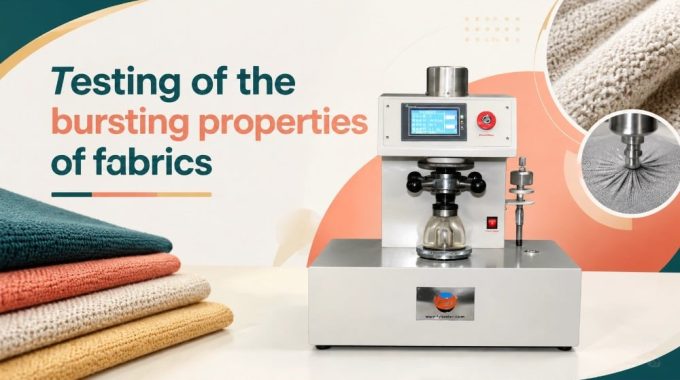
Testing of the bursting properties of fabrics
The elbows of our sweaters often lose their shape, the knees of our knitted trousers are the first to wear through and develop holes, and—needless to say—our socks occasionally sprout openings that let our toes peek out at the world. Consumers often wonder: are these issues a result of poor fabric quality, or are they simply inherent characteristics of the material? Ultimately, these questions boil down to one thing: the durability of the fabric. Strength testing—a key component of mechanical performance evaluation for textiles—plays a crucial role in assessing how durable a fabric is. Currently, “bursting strength” is the standard metric used to evaluate the strength of materials such as knitted fabrics and non-wovens. But how exactly is this property tested? Which types of products does it apply to? What are the testing procedures, and what are the requirements for the testing personnel? This article provides an overview of the testing methodology.
Principles, test methods, and corresponding standards

The principle of the ball-burst test involves clamping a specimen within a circular holder on a fixed base. A spherical plunger, moving at a constant speed, presses vertically against the specimen, causing it to deform until it ruptures; the force required to cause this rupture is recorded as the bursting strength. The principle of the diaphragm-burst test involves clamping a specimen over an extensible diaphragm. Fluid pressure is applied beneath the diaphragm, and the volume of the fluid is increased at a constant rate, causing both the diaphragm and the specimen to expand until the specimen ruptures. This process measures the bursting strength and the degree of expansion (distension) at the point of rupture.
There are three primary domestic and international standards for determining bursting strength: GB/T 19976—2005, “Textiles — Determination of bursting strength — Steel ball method”; ISO 3303-1:2012, “Rubber- or plastics-coated fabrics — Determination of bursting strength — Part 1: Steel ball method”; and Section 5.4.1 of GB/T 8878—2002, “Cotton knitted underwear.” Common domestic and international standards for bursting strength testing include: GB/T 7742.1—2005 “Textiles — Bursting properties of fabrics — Part 1: Determination of bursting strength and bursting distension — Hydraulic method”; GB/T 7742.2—2015 “Textiles — Bursting properties of fabrics — Part 2: Determination of bursting strength and bursting distension — Pneumatic method”; ASTM D3786/D3786M—2018 “Standard Test Method for Bursting Strength of Textile Fabrics—Diaphragm Bursting Strength Tester Method”; ISO 13938-1:2019 “Textiles — Bursting properties of fabrics — Part 1: Determination of bursting strength and bursting distension — Hydraulic method”; and ISO 13938-2:2019 “Textiles — Bursting properties of fabrics — Part 2: Determination of bursting strength and bursting distension — Pneumatic method.”
What are the similarities and differences between the two types of assessment indicators?
Both test methods share the same fundamental principle: a circular force is applied at a specific speed to a fabric laid flat, causing it to deform until it bursts. The primary difference lies in the mechanism: in the “bursting strength” (or penetration/puncture) test, a spherical probe acts directly and vertically upon the fabric to cause a rupture; in the “diaphragm bursting” test, pneumatic or hydraulic pressure expands a diaphragm, which then comes into contact with the fabric, causing it to deform and eventually burst. The unit of measurement for the former is the Newton (N), while for the latter, it is the kilopascal (kPa).
Regarding the standards for diaphragm bursting tests, there are two key differences between the Chinese national standards and the American ASTM standards. First, the Chinese standards distinguish between the two types of media—gas and liquid—by assigning them separate standards, whereas the ASTM standards cover both gas and liquid media within a single framework. Second, the Chinese standards require testing at 5 points, while the ASTM standards require testing at 10 points.
Effect
This performance metric helps businesses and consumers understand a product’s resistance to rupture—a measure particularly relevant for knitted fabrics and certain non-woven materials. While analyzing a product down to the level of individual yarns offers a more granular and detailed perspective, the process—which requires unraveling loops and isolating yarns—is cumbersome. Furthermore, because knitted fabrics typically exhibit greater stretch and elasticity than woven fabrics, and their looped structure significantly influences how they perform during actual use, evaluating product performance based solely on individual yarn properties is insufficient. Instead, using a burst test—which simulates the deformation caused by localized pressure (such as that from an elbow, knee, or toe)—to measure the force required to rupture the fabric provides a highly intuitive and effective method for assessment.
Testing steps
Steel ball method
Taking GB/T 19976—2005 as an example, follow these steps using a conditioned knitted fabric sample:
① Cut 5 test specimens, mark their front and back sides, and condition them in the atmospheric environment specified by GB 6529 (Figure 1).
② Place each specimen with the back side facing up and secure it in the specimen holder, ensuring it is flat, free of tension, and devoid of any creases (Figure 2).
③ Select the appropriate steel ball diameter, install the plunger and specimen holder onto the testing instrument, and drive the plunger downward at a speed of 300 mm/min to burst the specimen (Figure 3).
④ Once the test is complete, record the force value; repeat the procedure for the remaining 4 specimens and calculate the average value (Figure 4).

Hydraulic method
Taking GB/T 7742.1—2005 “Textiles — Bursting properties of fabrics — Part 1: Determination of bursting strength and bursting distension — Hydraulic method” as an example, a conditioned knitted fabric specimen is tested using a test area of 7.3 cm². The experimental procedure is as follows:
1. Power on the instrument, and select a test area of 7.3 cm² and a total of 5 test repetitions.
2. Open the instrument’s protective cover, place the specimen flat over the test aperture with its front side facing upward, then lower the protective cover and the test clamp to secure the specimen in place.
3. Initiate the test to measure the bursting strength at the first location. If the time to burst falls outside the range of (20 ± 5) seconds, the result must be discarded. For subsequent tests, the instrument will automatically adjust the flow rate to ensure the time to burst remains within the (20 ± 5) second range. Repeat the aforementioned steps at 5 different locations on the specimen until all 5 tests are completed. Remove the specimen and perform a test with the instrument empty (without a specimen) following the same procedure; the value obtained is the “diaphragm pressure.” The instrument will automatically subtract this “diaphragm pressure” to determine the final bursting strength of the specimen.
Testing Challenges and Points to Consider
First, the test specimen must be representative; the area selected for testing should be free of folds or creases and must not include the fabric selvage.
Second, ensure the specimen is oriented correctly according to the standard. Since the outer side of a garment faces outward during actual wear, the test setup—where the specimen’s reverse side faces the diaphragm and the outer side faces upward—is designed to simulate the conditions of real-world use. Additionally, the specimen must be conditioned in accordance with the relevant standard requirements.
Third, regarding the control of the bursting time, a preliminary test is typically conducted to determine the appropriate flow rate. The instrument then automatically adjusts the flow rate for subsequent tests to ensure the bursting time falls within the range of (20 ± 5) seconds. Any individual test result with a bursting time outside this range must be discarded, and the test should be repeated. If multiple tests fall outside this range, the instrument should be inspected for potential malfunctions, such as oil leaks or a loose test clamp.
Finally, personnel applying these standards must have a precise understanding of the parameters and technical details for both “puncture” (ball-burst) and “diaphragm-burst” test methods. Certain parameters—such as test speed, ball diameter, internal ring diameter (test area), and the number of specimens—may be explicitly defined by a standard, while others may require mutual agreement. For instance, the test area and ball diameter significantly influence the numerical results. The standard for socks (FZ/T 73037—2019) specifies a 20 mm diameter steel ball, whereas the standard for integrally knitted shoe uppers (FZ/T 73060—2017) specifies a 25 mm diameter steel ball; both differ from the 38 mm ball diameter commonly used for general knitted products. This is because both standards pertain to footwear-related items, where the use of a smaller-diameter steel ball more accurately reflects actual usage conditions.
Therefore, it is essential to pay close attention to key parameters when establishing test conditions. Furthermore, these selected parameters should be clearly documented in the test report to ensure the results are easily understood.
Reference: China Fiber Inspection (2020 No. 11)— “Expert Insight: Testing the Bursting Strength of Fabrics”. If any copyright infringement is detected, please contact us.