Research Progress and Applications of UV-Protective Fabrics
Changes in the atmospheric environment have drawn increasing attention to surface ultraviolet (UV) radiation, as excessive exposure can damage human skin. Textiles serve as a convenient means of UV protection, and UV-protective fabrics have become a key research focus within the field of functional textiles. Since conventional fabrics offer limited protection, their UV-shielding performance is typically enhanced through methods such as the selection of specific fibers or the application of functional finishes. Evaluation standards centered on the Ultraviolet Protection Factor (UPF) have been established, and the range of applications for these products continues to expand. This article reviews the protective mechanisms, performance metrics, manufacturing processes, and applications of UV-protective fabrics. By comparing the advantages and disadvantages of various production techniques, it provides a reference for the development of high-performance UV-protective textiles.
The Principle Behind UV Protection in Fabrics
Fabrics provide protection against ultraviolet (UV) radiation primarily through reflection and absorption. This protective capacity is influenced by the inherent properties of the raw fibers—specifically their individual abilities to absorb or reflect UV rays—as well as the fabric’s thickness, density, and color. Furthermore, the UV-protective performance of textiles can be enhanced by applying specialized UV-blocking agents to the fabric or its constituent fibers, thereby increasing their ability to reflect, refract, or absorb UV radiation.
Since UV protection in fabrics is achieved mainly through absorption and reflection, the selection of raw fibers is critical. In general, fabrics made from staple fibers offer better UV protection than those made from continuous filaments, and synthetic fibers typically exhibit higher UV absorption than natural fibers. Common synthetic fibers with UV-protective properties include polyester and acrylic. Among natural fibers, bast fibers (such as flax or hemp) possess a unique structure—characterized by pectin-rich, obliquely oriented pores—that provides strong UV-blocking capabilities. Additionally, protein-based fibers like wool contain aromatic amino acids, which are highly effective at absorbing UV radiation. When UV rays strike the surface of a fabric, some are reflected, while others are absorbed as they pass through the fibers. A portion may also pass through the gaps between fibers or penetrate the fibers themselves. Because even the most suitable fibers have limitations in their inherent UV-protective capacity, the application of UV-blocking finishing agents is the primary method for achieving higher levels of protection.

These agents are categorized into organic and inorganic types. Organic UV-blocking agents—commonly known as “UV absorbers”—are organic compounds capable of absorbing UV radiation. Synthetic UV absorbers typically feature conjugated systems and include chemical classes such as salicylates, benzophenones, benzotriazoles, and methane derivatives. Their mechanism of action involves absorbing UV energy to form an “active isomer,” which then reverts to its original structural state, releasing the absorbed energy as heat or other forms of energy that are harmless to the human body. There is a wide variety of UV absorbers in use, but because they may decompose under prolonged exposure to heat or light, further research and development are still required.
Inorganic UV-protective finishing agents—essentially UV reflectors—incorporate materials such as metal oxides or ceramic powders into yarns, fibers, or fabrics, thereby enhancing their ability to refract and reflect ultraviolet radiation. Common inorganic UV reflectors include titanium dioxide, zinc oxide, talc, clay, and calcium carbonate; these substances are highly effective at reflecting or refracting UV rays and are harmless to the human body. The finer the particle size of the reflector, the greater the UV-protective capability of the treated fabric. The development of nanotechnology and nanomaterials has opened up new avenues for the advancement of UV-protective finishing agents.

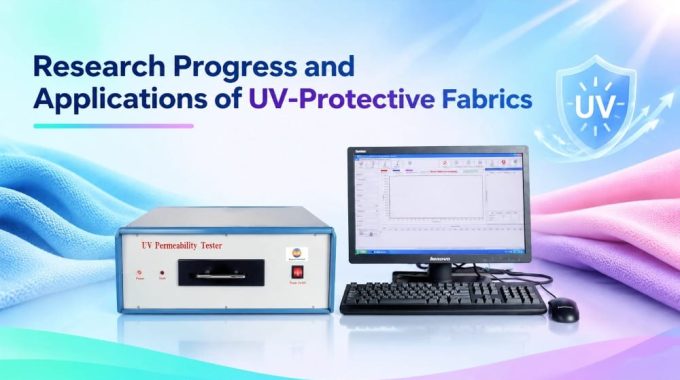
The standard GB/T 18830-2009 provides detailed specifications for the evaluation methods and criteria for the ultraviolet (UV) protection performance of textiles. The testing process involves exposing a specimen to UV radiation—generated by a suitable source such as a xenon arc lamp, a deuterium lamp, or a daylight simulator—and measuring the total spectral transmittance of the radiation that passes through the specimen. This data is then used to calculate the Ultraviolet Protection Factor (UPF) of the fabric. A higher UPF value indicates superior UV protection. According to this standard, products claiming UV protection must meet the following requirements: a UPF value greater than 40 and a mean UVA transmittance, $T(UVA)_{AV}$, of less than 5%. Furthermore, such products must display their UPF value on their labels; for instance, if $40 < UPF \le 50$, the product should be labeled as “UPF 40+” [11].
Preparation of UV-protective fabrics
There are three primary methods for producing UV-protective fabrics.
The first is the post-finishing method. This approach allows fabrics to achieve various aesthetic, structural, and functional properties—such as UV protection or stain resistance—by applying chemical or physical treatments to enhance the fabric’s appearance, tactile feel, and performance characteristics. UV-protective finishing agents are incorporated into the textiles using techniques such as high-temperature/high-pressure exhaustion, atmospheric-pressure exhaustion, padding, or cold-pad-batch processes. Post-finishing is the simplest and most widely used method.
The second approach is the coating method. In this process, a UV-protective agent is added to a coating formulation, which is then applied to the fabric surface—often in one or more precise layers—using specialized coating equipment. Subsequent drying and curing steps result in the formation of a dense, continuous film on the fabric surface. While the coating method is cost-effective and broadly applicable, it typically offers limited wash durability. The UV-protective agents used in this method are generally UV-reflecting substances; the resulting film effectively reflects or refracts ultraviolet radiation, providing a high level of UV protection.

The third method is magnetron sputtering. The fundamental principle involves using a plasma—generated from an Ar-O₂ gas mixture under the influence of electric and alternating magnetic fields—to accelerate particles that bombard the surface of a target material. Through energy exchange, atoms are dislodged from the target’s crystal lattice and deposited onto the substrate, forming a thin film. This technique is characterized by a high deposition rate, excellent film adhesion, and the ability to coat large surface areas. By selecting specific target materials—such as metals (e.g., Cu) or metal oxides (e.g., ZnO, TiO₂)—these substances can be sputtered onto the fabric surface to create a dense, protective film that imparts UV-blocking capabilities. Magnetron sputtering produces films with strong adhesion and is an environmentally friendly, innovative technology for applying thin-film coatings to textile surfaces.
Applications of UV-Protective Fabrics
UV-protective fabrics are primarily used in summer apparel for men and women—such as shirts, workwear, and skirts—designed to shield the skin from tanning or sunburn caused by excessive ultraviolet (UV) radiation; consequently, these items are highly popular among consumers. Beyond clothing, accessories like sun hats, knee-high socks, and arm sleeves also gain added appeal when crafted from UV-protective fabrics. Furthermore, apparel designed for outdoor exploration and sports often requires a certain level of protection, leading to the widespread use of UV-protective fabrics in this category. Sportswear and casual wear made from these materials represent another major market trend.

Beyond everyday apparel, professional workwear used in outdoor environments—where prolonged exposure to intense sunlight poses significant health risks—demands even higher standards of protection. Gear intended for outdoor labor, such as clothing for the fishing or agricultural sectors, as well as attire for work in high-altitude regions, must offer robust UV resistance; wearing such garments can substantially mitigate the harm caused by intense UV exposure. In addition to apparel, UV-protective fabrics are utilized in a variety of other applications, including parasols, sun umbrellas, curtains, shading fabrics, and outdoor tents.
Conclusion
This article provides a brief overview of the principles behind UV-protective fabrics and the methods used to produce them—namely, post-treatment, coating, and magnetron sputtering—each of which has its own distinct advantages and disadvantages. Post-treatment and coating are widely used and relatively simple to implement, though they can sometimes compromise the durability or comfort of the final product. Magnetron sputtering, by contrast, is a newer and less common technique; while the production process is more complex, it yields a higher-quality product. Regardless of the method employed, these techniques are effective in preventing excessive ultraviolet radiation from causing harm to the human body.
Reference: S Liaoning Silk (Issue No. 4 (Total No. 186))— “Research Progress and Applications of UV-Protective Fabrics”. If any copyright infringement is detected, please contact us.