About Warping Machines: Types, Working Principles, Testing Methods & More
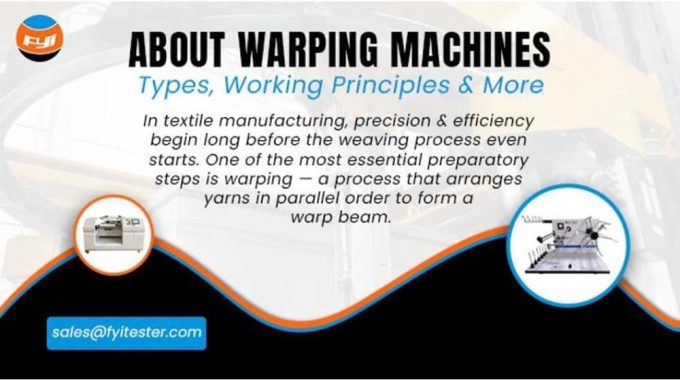
In textile manufacturing, precision and efficiency begin long before the weaving process even starts. One of the most essential preparatory steps is warping — a process that arranges yarns in parallel order to form a warp beam.
This process is made possible by an advanced piece of equipment known as a warping machine.
From research laboratories to industrial weaving units, warping machines serve as the bridge between spinning and weaving.
The machine’s ability to prepare warp yarns in an organized and tension-controlled manner determines the quality, uniformity, and productivity of the entire fabric manufacturing process.
In this detailed guide, we will explore everything you need to know about warping machines — from their history and types to their working principles, testing methods, performance parameters, and cost considerations.
Without any further ado, let’s get dive straight into the article:
What is a Warping Machine?
A warping machine is a key piece of equipment in the textile industry that prepares the warp yarns needed for weaving. It arranges a large number of yarns in parallel, winding them onto a warp beam under uniform tension. This warp beam is later mounted onto a loom for fabric weaving.
The main purpose of the warping machine is to ensure:
- Accurate alignment of yarns
- Consistent tension control
- Proper length and density across the warp sheet
The machine typically consists of several major components, such as:
- Creel: Holds yarn packages or cones.
- Tensioning devices: Maintain uniform tension.
- Guide rollers and reed: Align yarns and keep spacing even.
- Drum or beam: Collects yarns in parallel form.
- Electronic control system: Regulates speed, tension, and length precision.
Warping machines are indispensable for industries that demand high-quality fabrics, including apparel, upholstery, automotive textiles, and technical fabrics. Whether for small-scale sampling or full-scale production, warping ensures weaving begins on a foundation of accuracy and reliability.
History of Warping Machines
The origins of warping date back to the early days of weaving when yarns were manually arranged on a frame. As textile production evolved during the Industrial Revolution, the need for mechanized warping grew rapidly.
- Early 19th Century: Manual warping frames were replaced by basic mechanical drums powered by hand or foot.
- Mid-20th Century: The introduction of automatic tension controls and motorized beams revolutionized efficiency.
- Late 20th Century: Electronic and digital controls emerged, allowing precise tension, speed, and pattern settings.
- 21st Century: Modern warping machines now integrate PLC systems, servo motors, and real-time monitoring, enabling unmatched consistency and error-free operation.
Today, brands like FYI Tester have combined decades of engineering expertise with advanced automation to produce innovative warping machines that cater to both research institutions and industrial needs.
Types of Warping Machines
Warping machines are available in different configurations depending on the intended use — from small sample testing to industrial-scale production. Below are three widely used types that represent the best in modern textile technology.
1. Small Sample Warping Machine GA193-400

The Small Sample Warping Machine GA193-400 is designed for laboratories, textile research centers, and quality control departments. It’s ideal for creating small warp beams or short-length samples without compromising accuracy or performance.
Key Features
- Compact design suitable for limited space
- Automatic yarn tension control for consistent winding
- Adjustable speed and length parameters
- Digital display for real-time process monitoring
- Suitable for both single and multiple yarn types
Applications
- Sampling before bulk production
- Color matching tests
- Fabric design trials
- Yarn strength and performance evaluation
Benefits
This machine minimizes waste while allowing accurate sample preparation — a must-have for textile R&D and teaching environments. It also simulates industrial warping conditions, ensuring laboratory tests reflect real-world performance.
2. Sectional Warping Machine DW7140S

The Sectional Warping Machine DW7140S is a semi-industrial model ideal for both small and medium-scale weaving preparation. Its sectional drum design enables yarns to be wound in sections, which are later combined into one warp beam.
Key Features
- Precision sectional drum winding
- PLC-controlled tension and speed adjustment
- Intelligent fault detection and correction
- Smooth yarn alignment with automatic stop sensors
Applications
- Woven fabric production for apparel and upholstery
- Technical textile preparation
- Short-run industrial weaving
Benefits
The DW7140S ensures accurate yarn arrangement, prevents overlap, and minimizes thread breakage. Its automated systems make it suitable for high-efficiency production and consistent quality control in weaving mills.
3. Single Yarn Warping Machine GA193-1000

The Single Yarn Warping Machine GA193-1000 is a versatile high-capacity warping solution suitable for large-scale production and advanced yarn analysis. It winds each yarn individually under precisely controlled conditions.
Key Features
- High-speed operation with digital precision
- Uniform winding tension for all yarns
- Automatic yarn break detection and stop system
- Large beam capacity with robust build quality
Applications
- Industrial-scale weaving preparation
- Yarn tension and density studies
- Long-run fabric development
Benefits
Its superior automation and stability make it ideal for manufacturers who demand accuracy at scale. The GA193-1000 ensures continuous, efficient production with minimal downtime.
Working Principle and Testing Method of the Equipment

A warping machine works by arranging and winding many yarns side by side onto a large roll called a warp beam.
This process must be done very carefully so that all yarns stay straight, equally tight, and properly aligned. Any small error in tension or spacing can affect the final fabric quality.
The process begins when yarn packages or cones are placed on a creel, which holds hundreds of yarns. From there, the yarns move through a set of tension regulators that make sure every yarn has the same pulling force.
This step is important because if one yarn is tighter or looser than the others, it can break or cause uneven weaving later.
Next, the yarns pass through guiding rollers and reeds, which help arrange them in an exact order and keep the correct distance between each yarn.
After alignment, all yarns are wound together in parallel onto the warp beam or drum. The machine keeps rotating the beam at a controlled speed while maintaining steady tension throughout the process.
Modern warping machines are fitted with digital sensors and automatic control systems. These systems track the yarn length, tension, and winding speed in real time. If any yarn breaks or tension changes, the machine automatically stops to prevent damage.
When the desired yarn length is reached, the warping process finishes, and the beam is ready for the weaving stage.
To ensure the machine is working perfectly, several testing methods are used, such as:
- Tension uniformity tests to check equal pressure on each yarn
- Speed accuracy tests to confirm constant winding speed
- Beam density measurement to ensure even yarn layers
- Yarn break and defect detection tests
- Sample quality inspection using microscopes or tension analyzers
These tests guarantee consistent, high-quality warp beams suitable for any fabric production.
Performance and Technical Parameters of the Equipment

Modern warping machines are designed with advanced engineering and smart control systems to deliver consistent and accurate results.
The performance of these machines is usually judged through several technical parameters that directly influence fabric quality, production efficiency, and cost-effectiveness.
Below are the key aspects that define the performance of modern warping machines such as the GA193-400, DW7140S, and GA193-1000.
1. Speed Range
Speed is one of the most crucial parameters in a warping machine. Modern models typically offer a speed range of 0–1000 meters per minute, depending on the yarn type and production requirements.
Lower speeds are suitable for delicate or high-twist yarns like silk or fine cotton, while higher speeds can be used for durable yarns such as polyester or blends.
The ability to adjust speed ensures that the yarns are wound without damage and helps maintain consistent fabric quality. Higher speeds also mean faster preparation of warp beams, leading to better productivity in weaving operations.
2. Yarn Capacity
The yarn capacity of a warping machine usually ranges from 400 to 1000 ends. This represents the number of yarns that can be processed simultaneously.
Higher capacity allows operators to prepare large beams or multiple sample warps more efficiently.
Machines like the GA193-1000 are known for handling large numbers of yarns at once while maintaining perfect alignment and even distribution, which is essential for smooth weaving later on.
3. Tension Control Range
Maintaining proper yarn tension is essential to avoid defects such as slack or tight yarns. Most modern warping machines provide a tension range of 0–50 centinewtons (cN).
This controlled tension ensures uniform yarn stretch and prevents breakage during high-speed warping.
In models like DW7140S, automatic tension monitoring systems continuously adjust the tension to maintain stability, ensuring that each yarn layer is evenly wound on the beam.
4. Beam Width
The beam width defines the maximum working width that a machine can handle, usually between 400 mm and 1000 mm.
This flexibility allows textile manufacturers and laboratories to produce warp beams of various sizes depending on their weaving requirements.
For example, the GA193-400 is suitable for smaller sample beams, while the GA193-1000 can produce larger beams for bulk fabric production.
5. Power Consumption and Energy Efficiency
Energy consumption plays a key role in the overall operational cost of textile manufacturing. Modern warping machines are designed to be energy-efficient, with typical power consumption ranging from 1 to 3 kW.
Their smart motor systems adjust the power output based on the running load, reducing unnecessary energy usage. Over time, this helps save electricity costs and minimizes the machine’s environmental impact.
6. Digital Control Accuracy
One of the standout features of modern warping machines is their digital control accuracy, which usually falls within ±0.5%.
This means that even at maximum speed, the system maintains nearly perfect precision in controlling yarn length, speed, and tension.
The PLC (Programmable Logic Controller) technology used in machines like the GA193-1000 ensures that every operation— from yarn feeding to beam winding— is automated and precisely synchronized.
7. Combined Performance Benefits
Machines such as the GA193-400, DW7140S, and GA193-1000 combine all these parameters to deliver exceptional results.
Their advanced electronic drives and automatic monitoring systems maintain constant yarn tension and alignment even at high speed.
This consistency leads to fewer yarn breakages, better fabric uniformity, and less material wastage during weaving.
In addition, the smooth and precise control of these machines allows textile professionals to produce high-quality warp beams suitable for both research and industrial applications.
Product Quality and Brand Reputation

When it comes to warping machines, the quality of the product and the reputation of its manufacturer are two of the most important aspects that influence purchasing decisions.
A high-quality machine ensures long-term reliability, consistent performance, and reduced maintenance costs. At the same time, a trusted brand gives users the confidence that they are investing in a product tested and approved by other professionals in the textile industry.
1. Importance of Product Quality
The overall quality of a warping machine is determined by its construction materials, design precision, and control technology.
Machines such as the GA193-400, DW7140S, and GA193-1000 are built with high-strength steel frames that reduce vibration and ensure stability even at maximum speed.
The use of premium components, including precision bearings, tension control systems, and reliable motor drives, guarantees durability and consistent output.
Every part of these machines—from the yarn creel to the winding beam—is engineered to handle delicate yarns without causing damage.
The smooth motion control system ensures that yarns are wound evenly, with minimal tension variation, resulting in warp beams that are perfectly aligned and ready for efficient weaving.
High-quality warping machines also undergo rigorous testing during production to ensure each component meets performance standards.
These tests often include speed calibration, tension control accuracy, noise level analysis, and safety system verification. This level of attention ensures that every unit leaving the factory performs exactly as specified.
2. Advanced Features That Enhance Quality
Modern warping machines feature digital monitoring systems and PLC-based controls that allow precise adjustment of speed, tension, and yarn distribution.
For example, the GA193-1000 uses automatic error detection to identify yarn breaks instantly and stop the machine, preventing waste. Similarly, the DW7140S is equipped with an infrared breakage sensor, ensuring continuous production without compromising yarn integrity.
These automated systems not only improve productivity but also guarantee the consistency of each warp beam, which directly affects the final fabric’s appearance and quality.
3. Brand Reputation and Global Recognition
Machines produced by FYI Tester have earned strong recognition both in China and over 50 countries worldwide for their outstanding performance and long service life.
The company’s commitment to research, innovation, and strict quality control has established it as a reliable brand in the textile equipment industry.
FYI’s warping machines are especially popular among textile laboratories, research institutes, and weaving factories because they combine modern automation with practical usability.
The brand’s strong after-sales service, readily available spare parts, and customer-focused design further enhance its reputation.
Each machine model—like the GA193-400 Small Sample Warping Machine, DW7140S Sectional Warping Machine, and GA193-1000 Automatic Single Yarn Warping Machine—reflects FYI’s dedication to engineering excellence.
These models are designed to meet the real-world needs of textile professionals, ensuring dependable performance, safety, and superior results across various fabric types.
Compliance with Industry Testing Standards

Compliance with international testing standards is essential for ensuring the reliability and credibility of every result.
Whether used in research institutions, textile laboratories, or industrial production facilities, warping machines must operate under conditions that meet recognized global benchmarks.
FYI Tester’s warping machines are specifically engineered to comply with key ISO, ASTM, and GB/T standards, guaranteeing accurate, consistent, and internationally accepted results.
1. Meeting Global Textile Standards
FYI Tester designs its warping machines to align with international quality and testing regulations, including:
ISO 139: This standard specifies the environmental conditions—such as temperature and humidity—under which textile materials should be tested. FYI Tester ensures that all its warping machines, including the GA193-400, DW7140S, and GA193-1000, perform optimally within these parameters. This ensures that yarn behavior such as elongation, tension, and friction remains stable and repeatable, no matter where the machine is used.
ASTM D2256: This standard measures the tensile strength and elongation of yarns during processing. FYI’s machines maintain precise yarn tension and winding speed control, allowing yarns to be prepared without altering their mechanical properties. This means that the warp beams created using FYI machines can be used confidently for tensile or performance testing in laboratories and production environments.
GB/T 14344: This Chinese national standard defines the procedures and parameters for preparing yarns during warping. Compliance with GB/T 14344 ensures that FYI Tester’s machines deliver uniform yarn distribution, consistent beam density, and stable warp tension—key factors in achieving reliable weaving and testing results.
2. Importance of Compliance
Compliance with these standards does more than just meet regulatory expectations—it directly impacts product reliability and credibility.
By adhering to ISO, ASTM, and GB/T standards, FYI Tester ensures that the measurements, samples, and beams produced are accurate, repeatable, and comparable worldwide. This is especially valuable for research institutions and universities, where data consistency and repeatability are crucial.
In commercial applications, compliance also supports international trade, as many textile buyers and certification bodies require materials and testing to follow these globally accepted standards.
3. How FYI Tester Maintains Standardization
FYI Tester integrates quality assurance procedures throughout its production line. Every machine undergoes factory calibration and performance validation under controlled conditions. The digital control systems in their warping machines continuously monitor parameters like tension, speed, and alignment to ensure consistency with the defined standards.
Additionally, the company’s R&D team regularly updates machine software to stay aligned with new versions of testing standards. FYI also provides operators with clear technical documentation, enabling them to perform tests in full compliance with international guidelines.
Price, Cost-Effectiveness, and Maintenance Requirements

When investing in a modern warping machine, textile manufacturers and research facilities often consider three key aspects: price, operational efficiency, and maintenance requirements.
Each of these factors plays a crucial role in determining long-term productivity and overall cost-effectiveness.
1. Price and Investment Value
The price of a warping machine can vary widely depending on several parameters such as yarn capacity, beam width, automation level, and digital control precision.
Machines designed for laboratory or R&D use tend to have smaller capacities and simpler interfaces, making them more affordable and ideal for experimental or sampling work.
On the other hand, machines built for industrial-scale applications typically come with advanced automation systems, such as electronic tension controls, digital monitoring, and programmable logic controllers (PLC).
These features enhance performance and speed but also increase the initial investment.
However, this higher cost is often justified by significant productivity gains, reduced manual labor, and consistent product quality. In the long run, such machines deliver an excellent return on investment (ROI) by minimizing production errors, downtime, and material wastage.
2. Cost-Effectiveness in the Long Run
Even though the initial purchase price can vary, modern warping machines are designed to be highly energy-efficient and durable. They require minimal supervision, operate smoothly for extended hours, and maintain consistent performance over years of use.
Digital control systems ensure uniform yarn tension, reducing the risk of broken ends or uneven warps. This precision lowers material loss, saving both time and cost during weaving.
Additionally, many models come with software-driven control interfaces that make operation simple and training easy, further enhancing cost-efficiency for textile plants and testing laboratories.
3. Maintenance Requirements
Modern warping machines are low-maintenance systems built for long-term reliability. Regular care involves a few routine practices, such as:
- Cleaning of yarn guides, reeds, and creels to prevent lint buildup and maintain smooth yarn passage.
- Lubrication of moving components to minimize friction and extend the lifespan of bearings and shafts.
- Calibration of tension sensors and digital drives to ensure consistent yarn tension during each run.
- Software and firmware updates for the PLC and control systems to improve performance and maintain compatibility with modern testing environments.
Because these machines are designed with precision engineering and robust materials, they require very little unscheduled maintenance. Most service procedures can be performed by trained in-house technicians, saving on external maintenance costs.
4. Long-Term Reliability and ROI
A well-maintained warping machine can operate efficiently for many years with minimal downtime. Its ability to maintain consistent tension, accurate yarn alignment, and uniform beam formation ensures long-lasting performance.
These features not only improve the overall quality of fabric production but also reduce operational costs by lowering energy consumption and waste.
For textile enterprises, laboratories, and educational institutions, investing in a modern warping machine represents a smart long-term decision—one that combines high reliability, easy maintenance, and outstanding value for money.
Conclusion
Warping machines play a vital role in preparing high-quality warp beams that determine the efficiency and precision of weaving.
From their historical development to modern advancements, today’s warping machines combine automation, accuracy, and durability to meet the evolving needs of the textile industry.
Their performance depends on key factors such as speed control, yarn tension, digital accuracy, and adherence to global testing standards.
When evaluating any model, it’s essential to consider its technical features, cost-effectiveness, ease of maintenance, and brand reliability. FYI Tester’s advanced warping machines deliver all these qualities — offering exceptional performance, compliance, and long-term value.
Explore FYI Tester’s range of high-precision warping machines today to upgrade your textile production with accuracy, efficiency, and global-standard quality.
FAQs
1. What is the main function of a warping machine?
A warping machine arranges yarns in parallel order and winds them onto a warp beam, preparing them for weaving.
2. How does a warping machine maintain yarn tension?
It uses advanced tension controllers and sensors to ensure every yarn maintains uniform tension throughout the process.
3. Which warping machine is best for laboratory use?
The GA193-400 Small Sample Warping Machine is perfect for labs and research institutions due to its compact size and precision.
4. Do these machines comply with international testing standards?
Yes, FYI Tester’s warping machines comply with ISO, ASTM, and GB/T textile testing standards.
5. What factors affect the cost of a warping machine?
Price depends on the machine type, yarn capacity, automation level, and advanced control systems included.
Contact Us
Phone: +86-551-68 105003
Phone: +86-551-68 105008
Fax : +86-551-6523 2507
Email: [email protected]
Email: [email protected]