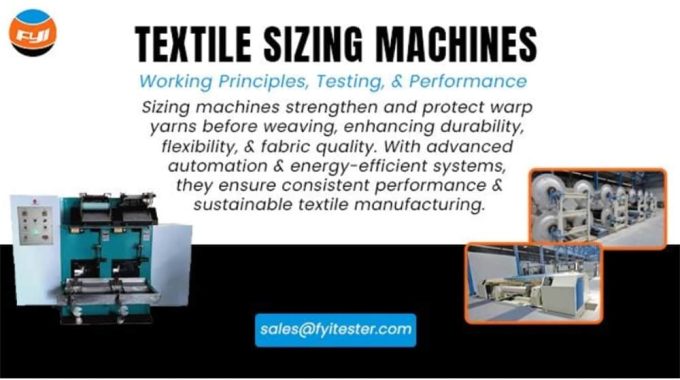
Textile Sizing Machines: Working Principles, Testing, and Performance
In textile manufacturing, every process—from spinning to finishing—shapes the final fabric quality. One vital yet often overlooked step is warp preparation, especially the sizing process.
Before weaving, yarns must be strong, smooth, and flexible to handle the tension of the loom. Without proper sizing, they may break or lose shape.
A textile sizing machine strengthens yarns by coating them with materials like starch, PVA, or CMC. This improves strength, reduces hairiness, and boosts weaving efficiency.
Modern yarn sizing machines now include automatic controls, precise temperature regulation, and eco-friendly drying systems.
At FYI Tester, we specialize in advanced sizing machines that ensure consistency, durability, and performance. This article explores their principles, performance, standards, and cost—helping you choose the best solution for your textile operations.
What Is a Sizing Machine?
A sizing machine is specialized textile equipment designed to apply an adhesive coating (known as “size”) to warp yarns. This process strengthens yarns and prepares them for weaving by improving their elasticity, abrasion resistance, and uniformity.
- Enhance Yarn Strength – Increases tensile strength, allowing yarns to withstand tension and friction.
- Reduce Hairiness – Smooths out the yarn surface to prevent entanglement and breakage.
- Improve Weaving Efficiency – Minimizes loom stoppage and enhances productivity.
- Ensure Fabric Uniformity – Produces consistent warp tension and smooth yarn surface for better fabric texture.
The size materials are chosen based on fiber type: starch and CMC for cotton, PVA for synthetic fibers, and acrylic agents for blends. These coatings form a thin, flexible film around each fiber, protecting it during high-speed weaving.
Yarn Sizing Machine GA392

The Yarn Sizing Machine GA392—also known as a single yarn sizing machine or slasher sizing machine—is a compact, high-performance unit designed for precise yarn treatment.
It performs sizing, drying, and winding in a single process, ensuring yarns are strong, smooth, and ready for weaving.
Perfect for laboratories, research centers, and textile institutes, this model is ideal for small-batch or sample preparation. It enhances yarn strength, minimizes hairiness, and ensures consistent coating, making it an essential tool for textile testing and teaching applications.
Manufactured by FYI Tester, a trusted name in textile testing equipment, the GA392 combines efficiency, precision, and cost-effectiveness. It is suitable for cotton, silk, wool, flax, and synthetic yarns, helping users achieve professional-level results with minimal waste.
Key Features
- Compact, lab-friendly design
- Frequency or stepless speed control system
- Servo-controlled yarn guidance
- Precise temperature drying
- Low energy use and easy operation
Working Principle and Testing Methods

Understanding how a textile sizing machine functions is essential for monitoring quality and improving production stability.
The sizing process prepares warp yarns for weaving by applying a thin, uniform film of adhesive material that enhances strength and reduces breakage.
A modern yarn sizing machine performs several coordinated actions—each contributing to the yarn’s final performance and consistency.
1. Working Principle
The working principle of a sizing machine revolves around three core stages: size application, drying, and winding. The process begins with warp beam mounting, where yarns from the creel or beam are arranged on the sizing frame.
Next, the yarns pass through a size bath, where they absorb a controlled amount of adhesive solution such as starch, polyvinyl alcohol (PVA), or carboxymethyl cellulose (CMC). This coating reinforces the yarn surface, improving strength and resistance to friction.
After immersion, the yarns move through squeeze rollers to remove excess size and ensure a uniform coating. Maintaining consistent pressure at this stage is critical to achieving even size pickup.
The yarns then proceed to the drying section, where heated cylinders or hot-air chambers evaporate moisture and solidify the size layer. Controlled temperature and airflow ensure that the yarns retain flexibility while gaining adequate strength.
Finally, the dried yarns are wound onto the weaving beam or cone, ready for use in the loom.
The objective is to reach an ideal size pickup level—typically 8–12% for cotton yarns and 4–8% for synthetics. This balance guarantees smooth weaving performance, minimizes breakage, and enhances the final fabric’s appearance and quality.
2. Testing Methods
To maintain process efficiency and consistent results, a series of testing methods are applied to assess the quality of the sizing operation. The size pickup test measures the percentage of size added to the yarn, ensuring that coating levels meet process specifications.
The tensile strength test evaluates how much the yarn’s strength improves after sizing, while the abrasion resistance test checks the yarn’s durability under frictional stress during weaving.
Additionally, a moisture content test helps verify proper drying, as excessive moisture can cause sticking or poor weaving efficiency. The viscosity test, conducted using a digital viscometer, measures the consistency of the size solution, ensuring uniform application across all yarns.
Together, these testing methods provide vital data for fine-tuning machine parameters and verifying that the textile sizing machine consistently produces high-quality, reliable yarns for industrial applications.
For a complete overview of testing standards, visit: https://fyitester.com/introduction-of-sizing/.
Performance and Technical Parameters

The performance of a textile sizing machine plays a decisive role in determining the overall yarn quality and weaving efficiency.
In the textile industry, even slight deviations in sizing parameters can affect the strength, elasticity, and uniformity of the yarn, leading to variations in the final fabric.
Therefore, understanding and optimizing each technical aspect of a yarn sizing machine is essential for achieving consistent, high-quality results.
Modern sizing systems have evolved to include advanced automation, energy-saving mechanisms, and precision control technologies.
These improvements allow textile manufacturers and research institutions to monitor performance metrics in real-time, minimize waste, and ensure reliable, repeatable outcomes in both large-scale and laboratory environments.
1. Sizing Speed and Production Efficiency
One of the key performance indicators in any textile sizing machine is the sizing speed. The typical operating range lies between 20 and 150 meters per minute, depending on the model and application.
A higher speed enhances production output, but only if the yarn coating remains uniform. Excessive speed without proper control may lead to uneven drying or incomplete adhesion of the size material.
In models like the FYI Tester GA392 yarn sizing machine, speed adjustment is handled through frequency converters or stepless speed controllers, which provide smooth acceleration and deceleration.
This enables precise control, especially when processing delicate yarns such as silk, wool, or synthetic blends. Maintaining an optimal balance between speed and coating quality ensures consistent results without compromising yarn integrity.
2. Drying Temperature and Film Strength
Another critical parameter is the drying temperature, typically maintained between 90°C and 130°C. The drying stage solidifies the size film applied to the yarn surface.
If the temperature is too low, residual moisture may remain, causing yarn stickiness or poor weaving performance. Conversely, overheating can make the film brittle, leading to breakage during weaving.
High-performance machines use temperature-controlled drying cylinders or hot-air chambers with automatic sensors. These systems ensure uniform heat distribution and prevent energy wastage.
In the GA392 model from FYI Tester, precise temperature control contributes to a consistent and durable coating, ensuring superior film strength and flexibility for various yarn types.
3. Beam Width and Yarn Capacity
The beam width of a sizing machine defines its maximum warp capacity.
Most machines offer widths between 800 and 3000 millimeters, suitable for different production scales—from laboratory testing to industrial manufacturing.
A wider beam accommodates more warp yarns, increasing output and reducing downtime caused by frequent re-beaming.
In research or educational setups, compact units like FYI Tester’s slasher sizing machine or single yarn sizing machine are preferred for sample preparation and testing.
These smaller models deliver the same precision as industrial versions but on a scale ideal for experimentation, teaching, and quality evaluation.
4. Power Consumption and Energy Efficiency
Energy efficiency is increasingly becoming a core performance factor for textile machinery.
A typical yarn sizing machine consumes between 8 to 12 kWh, depending on its configuration and operating conditions.
FYI Tester’s equipment focuses on minimizing energy loss by integrating optimized heating systems, smart motor drives, and insulated drying zones.
Reduced power consumption not only lowers operational costs but also supports sustainability goals—an important consideration for modern textile facilities aiming to reduce their carbon footprint.
5. Size Pickup and Coating Uniformity
Size pickup refers to the percentage of adhesive coating applied to the yarn, usually within 8–12% for cotton and 4–8% for synthetic fibers.
Maintaining this balance ensures adequate strength without making the yarn excessively stiff. Too much coating increases cost and affects weaving efficiency, while too little can result in frequent yarn breakage.
FYI Tester’s sizing systems feature digital control panels that display real-time data on tension, size viscosity, and pickup rates, allowing operators to make immediate adjustments and maintain uniform coating quality across the batch.
6. Tension Control and Process Stability
Uniform tension control is vital during sizing to avoid yarn stretching, slackness, or entanglement.
Advanced machines use automatic servo-driven tension systems that continuously monitor and adjust tension levels throughout the process. This ensures even sizing and prevents yarn deformation.
In FYI Tester’s GA392 yarn sizing machine, the servo control mechanism maintains perfect synchronization between the feeding, coating, and winding stages. This precision results in consistent yarn tension, improved handling, and enhanced weaving efficiency.
7. Smart Features and Safety Systems
Today’s high-performance textile sizing machines incorporate a range of intelligent features designed to improve productivity, safety, and longevity.
Among these are automatic slurry feeding systems, which deliver a constant and controlled supply of size material, and humidity control mechanisms, which maintain optimal atmospheric conditions inside the drying zone.
Additionally, integrated safety sensors provide temperature and overload protection, preventing operational hazards and extending machine life.
FYI Tester’s sizing machines are equipped with such modern safeguards, ensuring that both operators and equipment remain secure during long production cycles.
8. Overall Performance Outlook
Combining these parameters—speed, temperature, beam width, energy use, and tension control—defines the total performance profile of a sizing machine.
Machines like FYI Tester’s GA392 deliver exceptional stability, reproducibility, and cost-effectiveness, making them ideal for textile laboratories, research centers, and small-scale manufacturing units.
By optimizing each technical aspect, these machines help users achieve consistent yarn quality, reduced waste, and higher operational efficiency.
With ongoing advancements in automation and digital monitoring, textile sizing continues to move toward smarter, more sustainable production systems—ensuring the highest standards of performance for years to come.
Product Quality and Brand Reputation

When choosing a textile sizing machine, two factors matter most—product quality and brand reputation. These elements determine not only how efficiently a machine performs but also how reliably it supports long-term textile production goals.
A well-built sizing machine ensures process stability, accurate results, and reduced downtime, while a trusted brand provides the assurance of technical support, proven performance, and industry compliance.
The quality of a yarn sizing machine can be evaluated through several key performance and structural indicators. These aspects directly impact the durability, safety, and efficiency of the equipment.
1. Build Quality
A reliable sizing machine should be constructed with high-grade stainless steel and corrosion-resistant components. These materials prevent rust and deterioration, especially in environments exposed to humidity, chemicals, and heat.
A robust frame minimizes vibration, ensuring smooth operation and extended machine life. In high-production settings, this durability directly translates to reduced maintenance costs and consistent output quality.
2. Operational Stability
Operational stability reflects the machine’s ability to maintain uniform performance under varying loads and conditions. Inconsistent tension or speed can result in uneven yarn coating and weak spots, affecting fabric performance.
Machines with advanced tension control systems and precision-engineered rollers—like those used in modern textile sizing machines—maintain smooth yarn flow and consistent coating thickness across the entire warp.
3. Energy Efficiency
Energy efficiency has become a major consideration for textile manufacturers striving to balance productivity with sustainability.
A high-quality sizing machine integrates smart heating systems and controlled drying chambers that reduce energy waste while maintaining optimal size pick-up rates.
The use of variable frequency drives (VFDs) or stepless speed controllers also allows operators to optimize power consumption based on production demands, lowering operational costs and environmental impact.
4. Ease of Use
Another hallmark of product quality is operational convenience. Modern yarn sizing machines feature intuitive control panels and digital displays that simplify setup, monitoring, and adjustment.
User-friendly interfaces help operators quickly identify process variables like temperature, tension, and viscosity—making production more efficient and less prone to human error.
5. Safety Measures
Safety remains a top priority in any textile operation. Machines that incorporate emergency stop functions, overheat protection, and fully enclosed moving parts minimize workplace risks.
Proper safety interlocks and temperature sensors ensure stable operation even during extended use. Such design features not only protect operators but also contribute to long-term equipment reliability.
Together, these indicators define the true quality of a sizing machine. A unit that combines strong construction, operational precision, and intelligent safety features provides better value and reliability, making it a wise investment for any textile facility.
6. FYI Tester’s Brand Reputation
When it comes to trusted brands in textile testing and preparation equipment, FYI Tester stands out as a leader in quality and innovation. The company has built its reputation through a strong focus on engineering excellence, advanced technology, and customer satisfaction.
FYI Tester specializes in a wide range of textile machinery, including the GA392 Yarn Sizing Machine—a compact, efficient model designed for research institutions, universities, and small-scale textile production.
Its ability to perform sizing, drying, and winding in one operation showcases FYI Tester’s commitment to simplicity and precision.
Brand Strengths
Global Recognition: FYI Tester is widely recognized for its continuous contributions to textile testing innovation and equipment development.
Reliable Support Network: The brand offers comprehensive after-sales assistance, including spare parts availability and responsive technical support, ensuring uninterrupted operations.
Academic & Industrial Collaboration: FYI Tester works closely with research institutions and universities, promoting advancements in textile education and testing methodologies.
ISO-Certified Quality: The company adheres to strict ISO-certified quality management systems, guaranteeing consistency, safety, and reliability in every product.
FYI Tester’s unwavering dedication to research, precision, and customer trust has made it a preferred partner for textile professionals worldwide.
Whether you are a manufacturer seeking stable production results or a research institution conducting textile trials, FYI Tester’s yarn sizing machines deliver consistent performance and long-term value.
By combining modern engineering principles with dependable customer support, FYI Tester continues to shape the future of textile testing and manufacturing—offering solutions that ensure both product quality and brand excellence.
Compliance with Industry Testing Standards

In textile manufacturing, it is very important that every sizing machine follows international testing standards.
These standards help make sure the machine works safely, gives accurate results, and performs the same way each time. When a sizing machine meets these standards, users can trust the data, improve product quality, and reduce production problems.
One of the main global certifications is ISO 9001, which focuses on the quality management system of a company. This certification means that a manufacturer follows strict rules in design, production, and testing.
A sizing machine made under ISO 9001 is checked at every stage to make sure it meets quality, performance, and safety requirements. For users, it means dependable machines that deliver consistent and accurate results.
Another key standard is ISO 5079, which describes how to test the breaking force and elongation of yarns. This test helps users understand whether the sizing process has improved the yarn’s strength and flexibility.
Similarly, ASTM D2256 defines the test method for measuring the tensile properties of yarns, making it easier to compare results with international benchmarks. Both standards make sure that the machine’s sizing process actually improves yarn performance in a measurable way.
The AATCC 76 standard focuses on how well the size material penetrates the yarn. It checks whether the yarns are evenly coated and if the sizing layer provides the right balance between strength and softness.
If the coating is uneven or too thick, the yarn may break or cause weaving issues. Following this test ensures better control of size pickup and fabric quality.
Another important guideline is EN 14111, which covers machinery safety and energy performance. This ensures that the sizing machine is not only efficient and durable but also safe for operators and environmentally friendly.
At FYI Tester, all yarn sizing machines, including the GA392 model, are built and tested according to these global standards. These machines meet the needs of both industrial plants and academic institutions, offering precise, reliable, and repeatable test results.
By complying with international standards, FYI Tester ensures long-lasting performance, improved quality control, and peace of mind for textile professionals around the world. This commitment helps you achieve dependable results every time you use your sizing equipment.
Price, Cost-Effectiveness, and Maintenance

When selecting a textile sizing machine, price, functionality, and long-term maintenance are the main considerations that define value. The cost of equipment typically varies according to production scale, automation features, and technological advancement.
Laboratory and sampling units are compact and designed for testing or research purposes, while large industrial systems are equipped with advanced automation, multi-cylinder drying, and real-time monitoring for continuous production.
1. Sizing Machine Price Overview
The price range of sizing machines depends largely on the model and capacity. Smaller laboratory models, such as single yarn sizing machines, are developed for experimental and educational purposes, offering efficient performance for smaller batches.
Mid-scale machines are suitable for textile workshops or pilot production lines, delivering a balance between speed, accuracy, and energy efficiency.
Industrial-grade slasher sizing machines—commonly used in large weaving units—offer high automation, temperature control, and superior output consistency.
The Yarn Sizing Machine GA392 from FYI Tester provides an ideal middle ground between performance and affordability.
It is designed to offer advanced functionality for research institutions, universities, and small-scale textile manufacturers who require dependable, repeatable results without committing to a heavy capital investment.
The GA392 model demonstrates that high quality and innovation can be achieved at a reasonable cost, ensuring smooth integration into both academic and professional environments.
2. Cost-Effectiveness
A reliable yarn sizing machine quickly proves its value through operational savings and improved production stability. By ensuring precise coating, consistent drying, and controlled tension, it minimizes yarn breakage and loom stoppages—two of the most common causes of inefficiency in weaving preparation.
Modern machines are engineered to optimize energy use and reduce slurry material waste, lowering overall running costs.
Long-term cost-effectiveness also comes from enhanced product uniformity and reduced downtime.
A machine that operates efficiently and consistently produces higher-quality yarns, enabling smoother weaving performance and less fabric rejection. These advantages directly translate into lower production expenses and a faster return on investment.
3. Maintenance Requirements
Proper maintenance is crucial to ensuring stable operation and extending equipment lifespan. Regular cleaning of size baths, rollers, and drying components prevents residue buildup and uneven coating.
Periodic inspections help detect minor wear or misalignment early, avoiding costly breakdowns. Following the manufacturer’s lubrication and calibration schedules helps preserve machine precision and process accuracy.
Modern textile sizing machines are designed with intelligent diagnostic systems that alert operators to potential issues before they impact performance.
Using genuine spare parts and adhering to preventive maintenance practices guarantees consistent operation and long-term durability.
With disciplined care and quality support, a sizing machine continues to deliver efficient, reliable, and high-quality results for years—making it a truly cost-effective investment for any textile operation.
Challenges and Future Trends

Although textile sizing technology has advanced over the years, manufacturers still face several challenges. One of the biggest issues is waste management, as the disposal of used size solutions can harm the environment.
Energy consumption is another concern, especially during the drying stage, which requires a large amount of power. In addition, many traditional chemical sizing agents are not biodegradable, making sustainability a growing priority in modern production.
To address these challenges, the industry is moving toward eco-friendly innovations. Manufacturers are now using biodegradable materials such as modified starch and carboxymethyl cellulose (CMC) to reduce pollution.
Water recycling systems are also being introduced to minimize waste and save resources. Moreover, digital technologies like AI and IoT are helping operators monitor sizing processes in real time.
Finally, the development of modular machine designs allows easier upgrades and better maintenance, paving the way for smarter, cleaner, and more sustainable textile production.
Practical Recommendations
When choosing or operating a textile sizing machine, it is important to plan carefully. First, define your purpose—whether it is for research, teaching, or full-scale production. Match the size material with the yarn type to get the best coating results.
Always check that the equipment meets ISO and ASTM standards for quality assurance. Consider automation features, as digital control improves accuracy and reduces errors.
Lastly, evaluate long-term savings from better yarn strength and reduced waste. The FYI Tester GA392 Yarn Sizing Machine offers excellent reliability, precision, and value for laboratories and institutions.
Conclusion
Sizing machines are an essential part of the weaving process. They strengthen yarns, reduce hairiness, and ensure smooth performance on the loom.
From traditional industrial models to modern laboratory systems, their role in improving fabric quality and production efficiency remains unmatched.
A good sizing machine offers the right balance between durability, cost, and precision. By understanding its functions, testing methods, and maintenance needs, users can achieve consistent and high-quality results.
As the textile industry continues to evolve, modern sizing machines now focus on automation, energy efficiency, and sustainability. To stay ahead in both research and production, it is important to invest in reliable equipment.
The FYI Tester GA392 Yarn Sizing Machine is a trusted choice—offering accuracy, innovation, and long-term performance for today’s textile professionals.