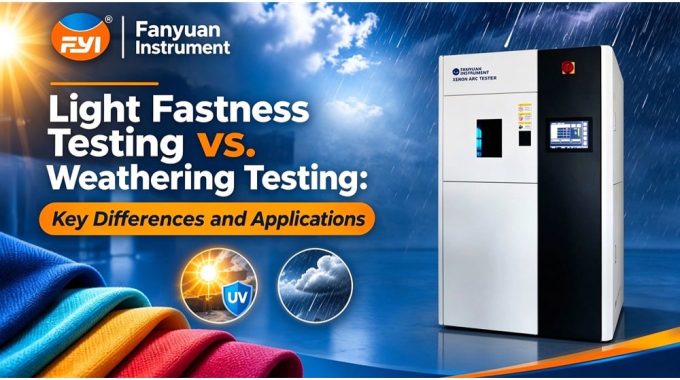
Light Fastness Testing vs. Weathering Testing: Key Differences and Applications
When assessing a product’s ability to resist sunlight, don’t confuse colour change with general deterioration of the material. Light fastness tests assess a material’s ability to resist colour change when exposed to light, while weathering tests assess changes in appearance and physical properties under environmental stresses. Both can employ xenon arc radiation, but have different testing goals. The knowledge of these differences will aid you in choosing appropriate equipment, exposure parameters and assessment parameters for your material.
1. What Is the Difference Between Light Fastness Testing and Weathering Testing?
Light fastness testing and weathering testing are two different tests that measure the resistance of a material to environmental exposure, but they measure different aspects of resistance. The difference is that if you have to measure color retention, or if you want to gauge overall material degradation.
1.1 Light Fastness Testing
Light fastness is a measure of the resistance of a material to color change on exposure to light, especially to the damaging effect of ultraviolet and visible light. This is the technique used to see if dyes, pigments, and other colourants change in colour from their original state.

When testing dyed cotton fabric, one part of the fabric is exposed, and the other part is not exposed, and the difference between these parts is determined to see if there is any fading or change in color. The results can be assessed according to the standard applied: standard gray scales, blue wool references, and instrumental color measurements.
The details of your assessment emphasize the extent of fading, the changes in color and tone, and the reactions of the material to the designated light exposure. The testing applies to the textile, leather, print, dye, and colored products in particular.
1.2 Weathering Testing
A weathering test is used to test changes in a material that occur over time due to exposure to the environment. Depending on the test method, simulated sunlight and controlled humidity and temperature exposure can be combined with water spray to simulate selected outdoor exposure conditions.
These circumstances can cause photodegradation, oxidation, hydrolysis and thermal degradation. For instance, if you test an outdoor plastic product under conditions of simulated sunlight and moisture, you might notice that the product has become discolored, cracked, brittle, or has lost its mechanical strength.
Weathering testing is used routinely to test plastics, paints and coatings, automotive and other construction materials, subjected to environmental exposure.
1.3 Key Differences
| Comparison factor | Light fastness testing | Weathering testing |
| Primary objective | Evaluate color retention | Assess environmental degradation |
| Main focus | Fading and color change | Appearance and physical property changes |
| Exposure conditions | Controlled light exposure under a specified method | Light combined with temperature and moisture conditions |
| Common equipment | Light fastness tester | Xenon arc or other weathering tester |
| Evaluation methods | Gray scale, reference materials, and color measurement | Visual, dimensional, mechanical, and chemical assessments |
| Typical materials | Textiles, dyes, leather, and printed products | Plastics, coatings, paints, and outdoor materials |
2. Light Fastness Tester vs. Xenon Arc Weathering Tester
2.1 Light Fastness Tester
The light fastness tester is designed to evaluate mainly the light fastness of colours under controlled illumination. It can be based on a xenon arc lamp, optical filters, specimen holders, reference materials, as applicable to the design and applicable standard.
This type of equipment can be used to compare specimens exposed to light with reference material to assess resistance to fading. To measure the level of colour change using the exposure condition, you can use a standardized blue wool reference to evaluate the degree of colour change.
The most important factors to take into account are the spectral distribution, the irradiance, the exposure time, the specimen temperature and relative humidity. This required setting is related to the test method and not necessarily to a single operating condition.
2.2 Xenon Arc Weathering Tester
The xenon arc weathering tester is a sun simulator based on filtered xenon radiation to simulate relevant parts of natural sun. It can also control temperature, humidity and water spray to simulate defined environmental exposure cycles depending on its configuration.

This equipment can be used to explore changes other than fading, such as surface cracking, loss of gloss, changes in brittleness and changes in mechanical properties. The operating parameters can be spectral irradiance, filter configuration, black panel or black standard temperature, chamber air temperature, relative humidity and wetting cycles.
2.3 Equipment Comparison
| Factor | Light fastness tester | Xenon arc weathering tester |
| Main purpose | Color stability evaluation | Environmental durability evaluation |
| Light source | Depends on instrument design | Xenon arc lamp |
| Specimen assessment | Primarily color change | Color and broader material changes |
| Moisture exposure | Depends on test method | May include humidity and water spray |
| Temperature control | Depends on instrument | Often includes specimen and chamber temperature control |
| Typical applications | Textiles, dyes, and colored materials | Plastics, coatings, automotive, and construction materials |
3. Differences Between Color Fading and Material Degradation
3.1 Color Fading

When dyes and pigments are exposed to light, the chemical structure or their optical properties are altered; this is called color fading. Colorants can absorb radiation, which can start a photochemical reaction that decreases the intensity of color or changes the original colour.
3.2 Material Degradation
Material degradation will include any changes in the chemical composition, surface characteristics or physical properties of a material. Cracking, brittleness, chalking or loss of mechanical strength may be observed depending on its composition and exposure conditions.
3.4 How to Model a Logarithmic Function
The ability of a product to hold its color doesn’t necessarily mean it is durable. A plastic part can have the same color, but lose mechanical strength due to cracks on the surface. Likewise, a dyed fabric can fade without significant damage to the fabric.
4. When Should You Use a Light Fastness Tester?
4.1 Textile and Dyed Fabric Evaluation
Determine the light fastness of dyed or printed fabric. The UV and visible radiation may have a different effect on various dyes, fibers and finishing processes. For instance, the dye formulation A is compared with dye formulation B on the same fabric to see how well A holds colour when conditions of exposure are the same as those for B.
4.2 Leather and Upholstery Products
Colors might change when leather, synthetic leather or upholstery are used indoors or outdoors. You can test their lightfastness prior to using them for furniture, car interiors, shoes, or other purposes.
4.3 Printed and Colored Products
Materials such as printed packaging and consumer products in colored inks can degrade in quality when exposed to light. You can use testing to compare printing inks, pigments and surface treatments under controlled exposure conditions.
4.4 Quality Control and Material Selection
Light fastness testing can also be performed during the supplier qualification testing, formulation development, and routine production quality control testing. It can be used to examine the colorant formulations, to check the color retention against the purchasing specifications, to detect colour differences that could be caused by the inconsistent dyeing or printing performance, and to evaluate alternative materials prior to production.
Before selecting an instrument, review FYI Tester’s light fastness testing information and identify the exposure conditions required for your material.
5. Can a Weathering Tester Replace a Light Fastness Tester?
5.1 When a Weathering Tester Can Be Used

When the spectral output of the weathering testing machine, the level of irradiance, the arrangement of specimens and the environmental conditions meet the requirements of the light fastness method, the xenon arc weathering testing machine can be used for light fastness evaluation.
5.2 When a Dedicated Light Fastness Tester Is More Appropriate
When you’re working especially with testing for standardized colorfastness, a dedicated light fastness tester is typically the best option, especially for fabrics and dyed items. A general-purpose weathering chamber cannot provide you with all the specimen holders, blue wool references, exposure cycles or evaluation procedures you might need.
5.3 How to Choose the Right Equipment
| Selection criteria | What you should verify |
| Testing objective | Color retention or overall material durability |
| Applicable standard | Required test method and exposure procedure |
| Light source | Required spectral distribution and filter type |
| Irradiance control | Specified wavelength band and intensity |
| Temperature and humidity | Required environmental conditions |
| Specimen arrangement | Holder design, exposure area, and mounting |
| Evaluation method | Color measurement, visual grading, or physical testing |
Conclusion
Light fastness testing focuses on color retention, while weathering testing evaluates broader material deterioration under environmental exposure. Select equipment according to your test standard, specimen, and evaluation objectives. For xenon arc exposure applications, explore the Air-Cooled Xenon Arc Tester YG611M and compare its specifications with your testing requirements.