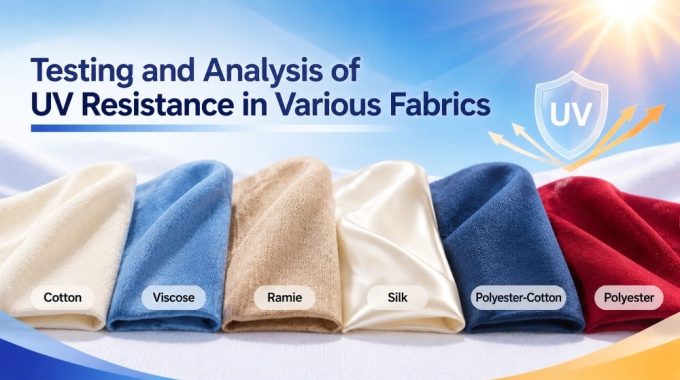
Testing and Analysis of UV Resistance in Various Fabrics
Ultraviolet (UV) radiation consists of invisible light rays located in the high-energy spectrum of sunlight. Based on their wavelength, UV rays are categorized as follows: long-wave ultraviolet (UVA), with a wavelength of 320–400 nm; medium-wave ultraviolet (UVB), with a wavelength of 280–320 nm; and short-wave ultraviolet (UVC), with a wavelength of 200–280 nm.
UV radiation is closely linked to human health. Moderate exposure can be beneficial; for instance, UVB radiation triggers the conversion of 7-dehydrocholesterol in the skin into vitamin D, which helps prevent rickets. Furthermore, UV radiation possesses germicidal and disinfecting properties.
However, excessive exposure to UV radiation is harmful. Due to the ongoing depletion of the ozone layer, the threat posed by UV radiation to humans has been steadily increasing. Excessive UV exposure triggers photochemical reactions that can disrupt various bodily functions. The most significant damage occurs to the skin and eyes; UV exposure can lead to melanin pigmentation and redness, while prolonged exposure may cause erythema, inflammation, and premature skin aging—in severe cases, it can even lead to skin cancer. To mitigate these risks, there is growing interest in the UV-protective properties of fabrics and garments, particularly those designed for summer wear.
This article presents an analysis and testing of common, everyday fabrics that have not undergone any specific UV-protective treatment. It compares the varying degrees of UV protection and sun-shielding effectiveness offered by different types of textile materials.
Fabric Category Selection
Many factors influence the ultraviolet (UV) protection performance of textiles, including fiber raw materials, yarn linear density, yarn structure, fabric thickness, fabric tightness, weave structure, color, and finishing processes. This article focuses on how different fiber raw materials affect the UV protection capabilities of fabrics. Textile fibers inherently possess varying degrees of capacity to absorb or reflect UV radiation; consequently, different fiber types exhibit different levels of absorption and reflection. Lower absorption and reflection capacities result in higher UV transmittance, which in turn leads to poorer UV protection performance. To ensure data comparability, this study selected two sets of plain-weave fabrics—composed of cotton, linen, viscose, silk, polyester, and polyester-cotton blends—with each set consisting of fabrics that share similar thickness and air permeability characteristics, and then tested them for their UV protection performance.
1.1 Basic Composition and Structure of Various Fabrics
Cotton is primarily composed of cellulose, alongside associated substances such as pectin, waxes, and proteins. In cross-section, cotton fibers appear as irregular, kidney-like ovals with a central lumen (hollow core), while longitudinally, they exhibit a natural, twisted (convoluted) appearance.
Bast fibers (such as flax, ramie, etc.) are also primarily composed of cellulose, containing varying amounts of hemicellulose, lignin, and pectin. There are many types of bast fibers, and the specific content and morphological structure of these components vary by variety. Ramie fibers, for instance, have cross-sections that may be oval, crescent-shaped, polygonal, rhombic, or flattened—all featuring a central lumen—while their longitudinal view shows nodes (joints) but lacks distinct twists.
Viscose fiber is a type of regenerated cellulose fiber. It is produced by processing natural cellulose into a spinning solution, which is then converted into man-made fibers via a wet-spinning process. Often referred to as “artificial cotton,” viscose fibers have a serrated cross-sectional structure and appear straight with longitudinal grooves.
Silk is a protein fiber. Each silk filament consists of two main substances: fibroin and sericin. Fibroin forms the core of the fiber, while sericin coats the fibroin, providing a protective layer. The cross-section of a silk fiber is approximately oval.
Polyester (PET) is primarily composed of polyethylene terephthalate; it is termed a “polyester fiber” due to the presence of numerous ester groups within its molecular chains. Produced via melt-spinning, polyester fibers typically have a circular cross-section and a smooth, cylindrical longitudinal appearance.
“Polyester-cotton” refers to a blended fabric made from polyester and cotton. It is woven from yarns composed of a blend of 65%–67% polyester fibers and 33%–35% cotton fibers.
1.2 Fabric Parameter Testing
This study utilizes two sets of fabrics, each comprising six different raw materials, all featuring a plain weave and similar thickness and air permeability. The thickness and air permeability of these fabrics are presented in Tables 1 and 2.
Table 1 Fabric categories and parameters for the first group
| Fabric Type | Thickness (mm) | Air Permeability (mm/s) |
| Silk 1 | 0.35 | 478 |
| Cotton 1 | 0.38 | 488 |
| Ramie 1 | 0.40 | 503 |
| Viscose 1 | 0.37 | 467 |
| Polyester 1 | 0.30 | 484 |
| Polyester-Cotton 1 | 0.30 | 466 |
Table 2 Fabric Categories and Parameters for the Second Group
| Fabric Type | Thickness (mm) | Air Permeability (mm/s) |
| Silk 2 | 0.18 | 1143 |
| Cotton 2 | 0.22 | 1151 |
| Ramie 2 | 0.25 | 1094 |
| Viscose 2 | 0.21 | 1115 |
| Polyester 2 | 0.20 | 1149 |
| Polyester-Cotton 2 | 0.18 | 1203 |
UV Performance Testing and Analysis
2.1 Test Instruments
In this study, a YG902 Textile Ultraviolet Prevention was used. This instrument is specifically designed to measure the UV transmittance (UVA and UVB) of textiles and evaluate their UV-protective performance. Controlled by a computer, the testing process involves zero-point calibration, a blank test, and the testing of the specimen. The computer then processes the data to directly provide the Ultraviolet Protection Factor (UPF) value.

2.2 Test Results
Tables 3 and 4 below present the test results for the UV-protective performance of two sets of fabrics, respectively.
Table 3 UV Resistance of the First Group of Fabrics
| Fabric Category | T(UVA)/% | T(UVB)/% | UPF Value |
| Cotton 1 | 8.57 | 9.24 | 13.33 |
| Viscose 1 | 8.15 | 7.26 | 14.39 |
| Ramie 1 | 7.14 | 5.83 | 16.85 |
| Silk 1 | 7.15 | 4.15 | 21.73 |
| Polyester-Cotton 1 | 5.50 | 2.85 | 36.61 |
| Polyester 1 | 4.05 | 2.35 | 39.27 |
Table 4 UV Resistance of the Second Group of Fabrics
| Fabric Category | T(UVA)/% | T(UVB)/% | UPF Value |
| Cotton 2 | 13.36 | 12.16 | 7.28 |
| Viscose 2 | 11.70 | 13.11 | 7.90 |
| Ramie 2 | 12.71 | 12.67 | 8.24 |
| Silk 2 | 10.32 | 8.85 | 10.26 |
| Polyester-Cotton 2 | 7.75 | 4.55 | 23.41 |
| Polyester 2 | 7.52 | 3.61 | 25.82 |
As shown in Tables 3 and 4, the ultraviolet (UV) transmittance for both groups of fabrics follows the same order: polyester < polyester-cotton < silk < ramie < cotton < viscose. The ultraviolet protection factor (UPF) values follow the reverse order, with polyester being the highest: polyester > polyester-cotton > silk > ramie > cotton > viscose. Based on these two metrics, polyester exhibits the best UV protection performance.
2.3 Analysis of UV Resistance of Fabrics
There are two primary indicators for evaluating the UV protection performance of fabrics: UV transmittance and the Ultraviolet Protection Factor (UPF). A lower UV transmittance and a higher UPF value indicate stronger UV protection. Generally, a fabric must have a UV transmittance of less than 10% and a UPF value greater than 20 to provide effective sun protection.
To facilitate a more intuitive analysis of the measured results, line graphs illustrating the UV transmittance and UPF values for the two sets of fabrics have been plotted, as shown in Figures 1 and 2.。

Fig.1 Anti-ultraviolet performance of the first group of fabrics

Fig.2 Anti-ultraviolet performance of the second group of fabrics
As shown in the figure above, the UV-protection performance of these six types of fabrics—categorized into two groups—ranks as follows: polyester-cotton > polyester > mulberry silk > ramie > cotton > rayon. The variations in UV-protection performance among fabrics made from different fibers are closely related to the composition and structure of the fibers themselves.
As noted in section 1.2, polyester molecules contain aliphatic hydrocarbon chains, which facilitate crystallization; consequently, polyester exhibits a high degree of crystallinity and molecular orientation, contributing to good light resistance.
“Polyester-cotton” is a general term for blends of polyester and cotton, combining the properties of both. Such fabrics offer better resistance to sunlight than those made from natural fibers, ranking just behind pure polyester.
Silk is a protein fiber composed of 18 different amino acids. Among these, tryptophan and tyrosine are capable of absorbing ultraviolet (UV) radiation, which gives silk its effective UV-protection properties. However, the absorption of UV radiation triggers chemical changes within the silk, causing the fabric to yellow when exposed to sunlight.
Cotton and linen (ramie) fibers are primarily composed of cellulose, while rayon (viscose) is a regenerated cellulose fiber. These materials possess only moderate resistance to light and heat. Exposure to sunlight and the atmosphere leads to gradual oxidation, which reduces the fabric’s strength. Furthermore, prolonged exposure to high temperatures can damage the cellulose structure. Among these three types of fabrics, UV-protection performance is relatively weak; however, due to differences in their structural characteristics, there are slight variations: ramie offers the best UV protection, followed by rayon, while cotton provides the least.
Conclusion
The analysis of the tests above indicates that, in the absence of any UV-protective treatment, the raw material of a fabric plays a significant role in its UV-blocking capability. Polyester and polyester-cotton blend fabrics offer superior UV protection, providing effective sun defense. Silk fabrics follow, while cellulose-based fabrics exhibit the weakest UV-blocking performance. A comparison of the two sets of fabrics further reveals that a fabric’s sun-protection efficacy is closely linked to its thickness and breathability: thinner, more breathable fabrics tend to offer poorer UV protection, whereas thicker, less breathable fabrics provide better protection. In short, many factors influence a fabric’s UV-blocking performance. When selecting clothing materials for the summer, one should balance wearing comfort with UV protection—ideally choosing fabrics that are lightweight and breathable while still offering effective defense against ultraviolet radiation.
Reference: LIGHT INDUSTRY SCIENCE AND TECHNOLOGY (2016 No. 10)— “Testing and Analysis of UV Resistance in Various Fabrics”. If any copyright infringement is detected, please contact us.