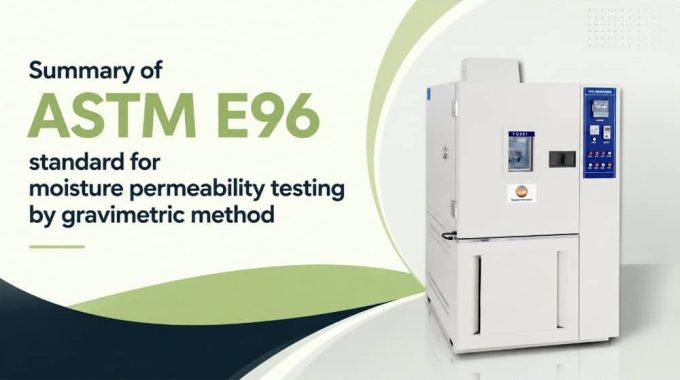
Summary of ASTM E96 standard for moisture permeability testing by gravimetric method
Moisture permeability is one of the key performance indicators of textiles. With increasing emphasis on moisture and water resistance, textiles with superior moisture-blocking properties (i.e., lower moisture permeability) have become a focus in textile development and use, receiving growing attention in recent years. Material suppliers, product manufacturers, and testing institutions are increasingly introducing moisture permeability testing equipment to strengthen the testing of textile moisture permeability. Currently, the main types of moisture permeability testers on the market are the cup method moisture permeability meter and the sensor method moisture permeability meter.
ASTM E96 is one of the gravimetric testing standards. It not only details the desiccant method, which is common in other standards, but also introduces the water method, which has the same status as the desiccant method in the field of moisture permeability testing.
Overview of the weighing method
The gravimetric method is an independent method for testing water vapor permeability. Its principle is simple and clear: under specified temperature and relative humidity, a certain water vapor pressure difference is maintained across the sample, and the amount of water vapor permeating through the sample is measured to calculate relevant permeability parameters. The gravimetric method can be divided into two methods: the weight gain method (where water vapor permeates into the permeation cup) and the weight loss method (where water vapor permeates out of the permeation cup). Their testing principles are the same.
These tests are conducted to obtain reliable water vapor permeability values for permeable and semi-permeable materials using simple equipment. These test values will be used in design, production, and trade.
Testing principles of weight gain and weight loss methods

ASTM E96 considers both the weight gain method and the weight loss method as fundamental test methods. Both methods can be used to test specimens with a thickness not exceeding 32 mm. Both methods can be used to determine the water vapor transmission rate of a specimen.
In the weight gain method, the specimen is sealed at the mouth of a permeation cup containing desiccant, and the entire permeation cup assembly is placed in a controlled environment. The permeation cup is periodically weighed to determine the water vapor transmission rate through the specimen absorbed by the desiccant.
In the weight loss method, the permeation cup contains distilled water, and the water vapor transmission rate permeating through the specimen from the distilled water side into the controlled environment is determined by weighing the cup.
Both test methods use the same water vapor pressure difference—one side of the specimen is extremely wet while the other is extremely dry—only the direction of the water vapor pressure difference relative to the specimen changes. Here, it’s necessary to clarify the scope of application of the gravimetric method: ASTM E96 is applicable not only to testing the water vapor transmission rate of textiles, paper, and fiberboard, but also to testing the moisture permeability of gypsum, plaster products, and wood products. Therefore, the standard has very lenient requirements regarding sample thickness.
For very thick samples, preventing edge leakage is paramount. However, in the field of textile testing, very thick samples are rare. Therefore, the subsequent introduction to the standard will not cover the testing of excessively thick building materials and the corresponding facilities, although these are also part of ASTM E96.
Experimental Implementation
Moisture Permeation Cup
The test dish shall be of any noncorroding material, impermeable to water or water vapor. It may be of any shape. Light weight is desirable. A large, shallow dish is preferred, but its size and weight are limited when an analytical balance is chosen to detect small weight changes.
Different depths may be used for the Desiccant Method and Water Method, but a in.(19mm)depth(below the mouth)is satisfactory for either method.
If the sample is prone to wrinkling or warping, an outer rim or support needs to be added to the mouth of the permeation cup to support the sample. Generally, very thin samples often require the use of an outer rim or support to assist in the test.
Test environment
The test environment is achieved using a test chamber in ASTM E96, which requires the temperature to be maintained within ±1°C and the humidity to be maintained within ±2%RH.
Air shall be continuously circulated throughout the chamber, with a velocity sufficient to maintain uniform conditions at all test locations.
Generally speaking, since the test temperature for moisture permeability testing is often higher than the laboratory ambient temperature, a single heating method is often used to control the temperature.
Weighing system
ASTM E96 specifies the use of an analytical balance to weigh the permeation cup, although other weighing methods can also be used. The standard specifies certain sensitivity requirements for the analytical balance.
The balance shall be sensitive to a change smaller than 1% of the weight change during the period when a steady state is considered to exist.
Therefore, if you use an analytical balance with high sensitivity, the corresponding weighing interval can be shorter; if you use an analytical balance with low sensitivity, the corresponding weighing interval will need to be much longer.
Using a high-precision analytical balance or other high-precision weighing system is beneficial for improving the accuracy of sample moisture permeability testing and shortening the test time.
Sampling

The material shall be sampled in accordance with standard methods of sampling applicable to the material under test. The sample shall be of uniform thickness. If the material is of nonsymmetrical construction, the two faces shall be designated by distinguishing marks.
Test specimen shall be representative of the material tested.
ASTM E96 specifies in detail the number of specimens to be prepared and the test methods under different conditions.
Attach the specimen to the dish by sealing(and clamping if desired)in such a manner that the dish mouth defines the area of the specimen exposed to the vapor pressure in the dish. Thoroughly seal the edges of the specimen to prevent the passage of vapor into, or out of, or around the specimen edges or any portion thereof.
The quality of sample clamping directly affects the accuracy of test results, with the sealing of the sample edges being the most crucial aspect. Wax sealing and sealing rings are two commonly used sealing methods.
Wax sealing is a more complex process. First, sealing wax must be prepared according to a specific ratio and heated to a molten state. Then, the wax is poured onto the edge of the permeation cup to seal the sample. After the wax cools and sets, the edge of the permeation cup is cleaned. It is particularly important to note that different wax compositions will result in varying wax evaporation weights during the test, directly affecting the accuracy of the results.
Sealing rings offer significantly better adaptability and operability than wax sealing.Gasketed types of seals are also in use on appropriately designed dishes. These simplify the mounting of the specimen, but must be used with caution, since the possibility of edge leakage is greater with gasketed seals than with wax seals.
Experimental process
The entire test process can be divided into sample equilibration, periodic weighing to determine whether the sample has reached osmotic equilibrium, and the test can be stopped once the sample has reached osmotic equilibrium.
Experimental process of the weight gain method
Fill the test dish with desiccant. Leave enough space so that shaking of the dish, which must be done at each weighing, will mix the desiccant. Attach the specimen to the dish and place it in the controlled chamber. Weigh the dish assembly periodically, often enough to provide eight or ten data points during the test. At first the weight may change rapidly; later a steady state will be reached where the rate of change is substantially constant.
Experimental process of weight loss method
Fill the test dish with distilled water.The air space thus allowed has a small vapor resistance, but it is necessary in order to reduce the risk of water touching the specimen when the dish is handled. Such contact invalidates a test on some materials such as paper, wood, or other hygroscopic materials. Attach the specimen to the dish. Weigh the dish assembly and place it in the controlled chamber on a true horizontal surface.
Calculation results
ASTM E96 describes the test procedure in two parts: the weight gain method and the weight loss method, but the data processing method is the same.
Calculate the water vapor transmission, and permeance as follow.
G=weight change(from the straight line), g
t=time, h
G/t=slope of the straight line, g/h
A=test area(cup mouth area), m²
WVT=rate of water vapor transmission, g/h·m²
△p=vapor pressure difference, mmHg
S=saturation vapor pressure at test temperature, mmHg
R1=relative humidity at the source expressed as a fraction(the test chamber for desiccant method;in the dish for water method)
R2=relative humidity at the vapor sink expressed as a fraction
There are generally two ways to process data: graphical analysis and numerical analysis.
Precautions
Selection of testing environment
A permeance value obtained under one set of test conditions may not indicate the value under a different set of conditions. For this reason, the test conditions should be selected that most closely approach the conditions of use. Several sets of standard test conditions are provided in the appendix of ASTM E96 for users to choose from.
Sample clamping may cause errors.
When the specimen area is larger than the mouth area, this overlay upon the ledge is a source of error, particularly for thick specimens. The overlay material results in a positive error, indicating excessive water vapor transmission. The magnitude of the error is a complex function of the thickness, ledge width, mouth area, and possibly the permeability.
Test time
Early gravimetric analyzers generally used analytical balances with low accuracy, and the manual weighing process could affect the osmotic equilibrium of the sample (this effect would be less pronounced if the weighing process were performed in a controlled environment). Therefore, tests using early gravimetric analyzers were typically lengthy, often taking several days to test a single medium-barrier sample.
Modern fully automated gravimetric permeameters, through improvements to the weighing process, allow for automated weighing in a controlled environment and employ high-precision weighing elements, reducing the time required to test the same medium-barrier sample to just a few hours.
Dummy sample
When results of water vapor transmission are expected to be less than 0.05 perm, a dummy specimen is strongly recommended. Such a dummy specimen should be attached to an empty cup in the normal manner. The environmental effects of temperature variation and buoyancy variability due to barometric pressure fluctuation can be arithmetically tared out of the weighing values. This precaution permits earlier and more reliable achievement of equilibrium conditions. As a further precaution when gasketed seals are used instead of preferred sealants, a blank test run is suggested using glass or metal as a dummy specimen.
Summary
ASTM E96 is one of the most comprehensive gravimetric testing standards currently available. Here is a brief summary: Gravimetric methods are divided into two types: the weight-addition method and the weight-reduction method, both based on the same testing principle; the permeation cup, the testing environment, and the weighing system are the three main components for completing the gravimetric method, and none can be omitted; the specimen clamping process is complex, but the clamping effect directly affects the test results; the test results of dummy specimens have a significant impact on the analysis and calculation of the test results.
Reference: China Packaging News (2005.04.25)— “Summary of the Gravimetric Method for Moisture Permeability Testing Standard AST ME96” .If any copyright infringement is detected, please contact us.