
Lab Roving Machine: A Complete Guide to the Roving Frame Process
In textile production, moving from bulk fiber to a high-quality yarn has an intermediary stage. A roving frame, speed frame, or simplex machine is used to turn the fiber into yarn. As you’d expect, this is a large-scale industrial process, so how do you turn it into a small-scale frame for sampling and material testing? A lab roving machine is engineered for R&D and provides the critical controlled environment for testing roving processes and refining them through laboratory research.
What Is A Lab Roving Machine?

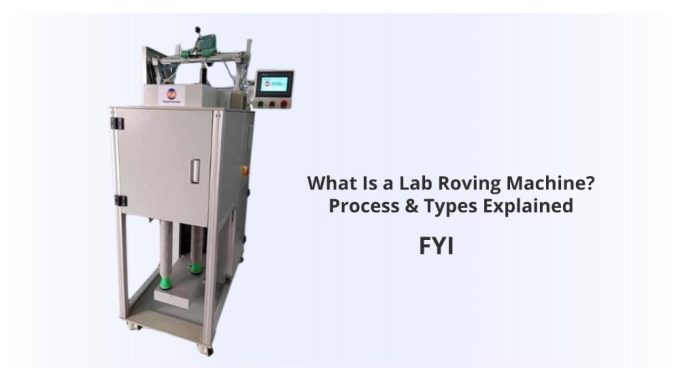
A lab roving machine is small, compact, and has a low throughput, but it is the same as an industrial roving frame. A lab roving machine is primarily designed for research, fiber testing, and yarn development, and you can use it for educational demonstrations in textiles.
A lab roving machine takes the drawn sliver, which is a loose rope of aligned fibers produced by the draw frame, and converts it into roving through drafting and twisting.
- Drafting: Process of reducing the thickness of fiber strands by sliding fibers
- Twisting: Turning the fiber or twisting using turns per inch into the drafted fiber strand for strength.
The roving is then wound onto bobbins for feeding into the ring spinning frame.
Key Features of a Modern Lab Roving Machine
Modern laboratory spinning machinery cannot replicate industrial conditions, but it can simulate industrial conditions.
- Advanced control systems: PLC systems and servo motors in these roving machines ensure precision. Models like DW7030H provide a touch screen interface for any operator to change and set technical parameters. You can control the machine’s running state in real time.
- Modular Independent Drivers: How do you ensure accuracy in a compact system? One way lab roving machines do this is by independent drivers for the drafting system, spindle blade, and flyer.
- High-Precision Drafting: When roving, the drafting quality depends on the roller mechanism. If you find fibers are loose or wavy, it’s because of the nip width that comes from the rollers. A 3-roller drafting system and spring-weighted pressure modes can achieve a draft multiple of 4-12.
- Optimized Mechanical Design: The use of suspended flyers and a good supporting plate minimizes friction. This also lowers energy consumption and enables vertical movement of the bobbin rail.
- Capabilities: Capable of Z-twist turning with a wide twist range (15 – 80 twist/m), a FYI lab roving machine can produce a yarn density between 200 and 1000 tex, meeting the specialized needs of textile production labs.
Roving Machine Process (Step-by-Step)

The roving frame or roving machine is based on the principle of lab roving machines, and the sequence is identical. Each stage is interdependent and can affect the quality of the ring-spun yarn.
Step 1: Fiber Feeding
You feed the drawn sliver into the roving frame creel. The sliver itself is in cans, and the creel positions the cans and guides the sliver into the back rollers of the drafting zone. It is important as a researcher or demonstrator that you keep the feed rate and sliver weight consistent.
Types of materials for the feeding system:
- Cotton
- Wool
- Polyester
- Blended slivers
Step 2: Pre-Cleaning & Carding
If you are not using drawn slivers, a cleaning stage comes before the drafting. Carding elements further open and parallelize the fiber bundle, removing residual short fibers and any kind of impurities. For lab roving machines, this stage is minimal, and these compact frames mostly work with drawn slivers.
Step 3: Drafting (Stretching)
Drafting is the actual stage where the sliver passes through a series of roller pairs. The goal is to stretch the fiber bundle and reduce its linear density, and increase fiber parallelism. Draft ratios on lab machines typically range from 4x to 16x.
An important thing to note here is the apron cradle in the middle drafting zone, which controls the movement of short fibers between the middle and front rollers and also determines roving evenness.
Step 4: Twisting
As the drafting strands exit the rollers, they cannot be wound because they are a weak fiber. A twist by the rotation of the flyer around the spindle provides cohesion for the roving to not fall apart. The initial controlling twist is called ‘twist multiplier’.
Step 5: Winding
The twisted roving is wound onto a bobbin by the winding mechanism of the machine. The bobbin rotates faster than the flyer and automatically takes the roving. The bobbin oscillates on the bobbin rail to form a conical wind.
Applications of Lab Roving Machines

You can use a lab roving frame in many settings, and they serve a range of functions.
● Fiber Checks and Research
Testing how new or different raw materials, including organic cotton or synthetic fibers, behave through the roving process before any large-scale industrial tests.
● Educational Use
Lab roving machines are used to teach textile engineering students the mechanics of the simplex process in a more practical and hands-on experience.
● Quality Control
It is ideal to create reference roving samples under controlled conditions for comparative testing against production output.
● Sample & Prototyping
Small amount of roving for sample yarn development, fabric trials, or apparel manufacturing can be done on lab roving machines without occupying industrial roving frames.
Types of Roving Frame Machines
Single Roving Frame
Single roving frame processes drawn sliver directly into finished roving in a single pass. It is the most common configuration for lab and industrial settings, where the fiber has been adequately prepared through a draw frame.
Double/Second Roving Frame
For wool and coarse fibers, a two-stage roving process can be used. The first stage involves producing a thick roving, and the second roving frame, refines the original pass into a finer roving suitable for ring spinning. Think of the second roving frame adding more drafting and a finer twist multiplier.
Wing Roving Frame vs. Twisting Roving Frame
The wing roving frame uses a rotating flyer that continuously applies real twist to the yarn strip as it passes through the hollow flyer arm onto the bobbin. Wing-suited frames are suitable for production requirements like higher twist levels and finer roving counts.
| Feature | Wing Roving Frame | Twisting Roving Frame |
| Twist Type | Real twist (Z or S direction) | False twist (alternating, net zero) |
| Roving Output | Twisted roving | Untwisted roving |
| Typical Application | Cotton, wool, ring spinning | Specialized downstream processes |
| Spindle Speed Range | 800 – 1,500 RPM | Lower; varies by design |
| Fiber Suitability | Most staple fibers | Specific fiber/process requirements |
What is a Wool Roving Machine?
A wool roving machine is not comparable to a standard cotton simplex machine because the length of the fiber is different. Wool fibers are longer and have scales that produce a lot of friction. The drafting zone in a lab wool roving machine is much wider (larger gauge mm), and some manufacturers also provide textured rollers to prevent fiber damage.
Wool roving machines use PLC controls and touch screen interfaces similar to any standard roving machine with operable speed, twist, and draft parameters.
Factors to Consider When Buying a Lab Roving Machine
Fiber Choices and Compatibility
If you’re looking for a roving machine, confirm that the drafting zone geometry supports standard fiber types and your target fiber type.
Spindle Controls
All roving machines provide spindle controls, but you need to check the fine print to look for the spindle speed accuracy. Anything less than or equal to ±1% drives consistent results.
Draft Range
The machine’s draft capacity should match your target roving counts. Most draft machines cover a total draft of 4x to 16x.
Throughput
Lab machines produce 0.25 to 1 Kg/h. This is enough for most sample runs, but if you expect a different production rate, you can specify your production capacity; however, it’s not recommended to get higher production runs beyond your requirements, as costs increase.
Controller and PLC
PLC-based touch-screen control with parameter storage reduces setup time, and you can program profiles for different materials, reducing setup time further. It also ensures reproducibility for running tests and benchmarking.
Certifications
When buying lab roving frames you should check for any available certifications like CE, and the availability of parts and technical manuals. Most machines are manufactured in different regions, so having a technical operational manual simplifies running.
Lab Roving Machine vs. Industrial Roving Frame Key Differences
| Feature | Lab Roving Machine | Industrial Roving Frame |
| Spindle Count | 1–4 spindles | 48–120+ spindles |
| Production Rate | ~0.25–1 kg/h | 50–200+ kg/h |
| Primary Purpose | Research, testing, education, small-batch prototyping | Continuous yarn production for apparel manufacturing and industrial textiles |
| Automation | Semi-automatic; selective, fully automatic doffing | Fully automatic with automated doffing, automatic tube cleaning, and bobbin transport systems |
| Drive System | PLC + servo/inverter motor; 1–2 motors | Four-motor linkage (spindle, flyer, bobbin rail, drafting) with synchronized control |
| Footprint | Compact; typically on casters, movable | Fixed installation; 10–30+ metres in length |
Table comparing the industrial roving machine and the lab roving machine
Conclusion
Lab roving machines are important for researchers, universities, and factories to test and sample yarns. These machines are moveable, have PLC-controlled parameters, and cost a fraction of the industrial roving machines. They ensure ring-spun yarns meet rigorous consumer demand for quality textiles.
Get In Touch
Phone: +86-551-68 105003
Phone: +86-551-68 105008
Fax : +86-551-6523 2507
Email: [email protected]
Email: [email protected]
MAIL US
If you have any need please contact with us, or if you have any problem, please send email to us anytime.


