Light Fastness Tester: How It Works and What It Tests
Light fastness tester tests the rate at which the material’s colour fades when exposed to artificial daylight. This article goes over the working of the instrument, how it is built, and what its applications are, along with the materials you can test.
What Is Light Fastness Testing for Textiles?
When it comes to textiles, light fastness testing shows the extent to which a dyed piece of textile can retain its color when it is exposed to daylight and then matched against calibrated reference material.
The most common method used is ISO 105 B02, which uses xenon arc lamps to reproduce daylight and cover all the major kinds of textiles.
In North America, the equivalent reference method is AATCC TM16.3, Colorfastness to Light: Xenon-Arc. It includes three options:
- Option 1: Xenon arc, alternate light and dark
- Option 2: Xenon arc, continuous light, black standard
- Option 3: Xenon arc, continuous light, black panel
What Is a Light Fastness Tester?

Xenon light fastness tester is a laboratory instrument that shines a filtered xenon arc light on a specific sample and recreates the wear and fade of months in a much shorter time span.
An additional benefit of a tester is that it eliminates the variance of UV rays that comes in outdoor exposure.
Working Principle of a Light Fastness Tester
The working principle of la ight fastness tester is to expose a fabric sample along with blue wool to a controlled light produced using xenon and compare it to a blue wool reference chart which shows similar color fade.
The testing goes through the following steps:
- Mounting: You set fabric samples and Blue Wool references on cards covered so that they stay unexposed.
- Exposure: The instrument exposes all samples to filtered xenon light at a set irradiance, temperature, and humidity.
- Comparison: Observe the difference between the exposed and covered areas and compare them to rated Blue Wool references that faded in the same way.
- Grading: You use the Grey Scale for change in colour to judge the degree of contrast between exposed and unexposed areas.
The comparison method gives a more accurate assessment because both the sample and bluewool undergo the same conditions and are affected equally if any variance occurs in the lamp.
How Does a Light Fastness Tester Simulate Natural Sunlight
The light fastness tester imitates natural sunlight by passing xenon arc lamp light through optical filters, which alter its spectrum to imitate sunlight. This sets the irradiance, temperature, and moisture levels so that you can repeat the process.
Xenon Arc Lamp as the Light Source
Xenon arc lamps are the most ideal because they can imitate the natural daylight spectrum most accurately.
Older methods used carbon lamps but were later replaced when xenon could produce UV rays below 270nm which can actually break down the dyes.
Optical Filters for Daylight Simulation
Raw xenon light has short-wave UV that can’t reach indoor textiles, so filters are used to remove it. The filter type depends on what you want to simulate:
- Window glass filters: They are designed to simulate the natural sunlight passing through a window. When testing plastic, ISO 4892-2 uses filters that cut out wavelengths shorter than 310 nm.
- Window-IR filters: The standard requirement across all ISO 105-B02 textile testing cycles. Alongside filtering out short-wave UV, these reduce infrared energy to prevent test specimens from overheating.
- Daylight filters: These imitate the direct sunlight that you have outdoors for standard weathering tests such as ISO 105-B04.
Irradiance Control
Irradiance control refers to the intensity of light that is affecting the specimen. A sensor measures it continuously and gives feedback to a controller, which keeps on adjusting the lamp power to hold the setpoint as the lamp ages.
ISO 105-B02 allows two setpoints:
- 42 W/m² across 300–400 nm (broadband UV)
- 1.10 W/m²/nm at 420 nm (narrowband)
Temperature and Humidity Control
Heat and moisture both change the rate of fading, so the tester controls them alongside light. ISO 105-B02 was written before precise climate control was common, so it uses reference materials to define humidity.
The standard’s cycles show how much these settings vary:
| ISO 105-B02 Cycle | Black Standard Temperature | Humidity |
| A1 (Standard) | 47 °C | Effective humidity ~40% |
| A2 (Extreme low humidity) | 62 °C | Effective humidity <15% |
| A3 (Extremely high humidity) | 42 °C | Effective humidity ~85% |
| B | 65 °C | Relative humidity 30% |
Black Standard Temperature
Black standard temperature measures the highest amount of heat a dark or black sample will experience under a light source through an insulated black-coated thermometer that is set alongside the specimen.
Testers can use two types of thermometers: an insulated black standard thermometer and an uninsulated black panel thermometer both of them give different readings.
Main Components of a Light Fastness Testing Machine
Xenon Lamp
This is the main component that provides the full-spectrum light; it is typically air-cooled or water-cooled, depending on the design. The output of the lamp drops down as time goes on, so you will need to replace the lamps as directed by the manufacturer.
Filter System
There are many different filters available which sit below the lamp and are chosen based on the test you are performing. Filters have a specified life expectancy and age as they are used,d so you need to replace them on schedule to keep the spectrum within standard limits.
Test Chamber
The test chamber is the enclosure where the samples are exposed to the filtered light. The main job is to keep the samples isolated from external light and maintain controlled temperature and humidity.
Specimen Holders and Rotating Rack
Holders, as the name suggests, hold the test samples and blue wool cards. Holder configuration can be rotating so that each specimen is exposed to the same amount of light intensity.
Cooling System
Xenon lamps generate a lot of heat, which requires blowers as air coolants or a water cooling system that can extract heat.
Sensors and Control Panel
Sensors are used to measure 4 main aspects of the test: the irradiance, black standard or black panel temperature, chamber air temperature, and relative humidity.
The control panel constantly takes feedback from these sensors and adjusts these variables in real time to maintain the asset’s standard state.
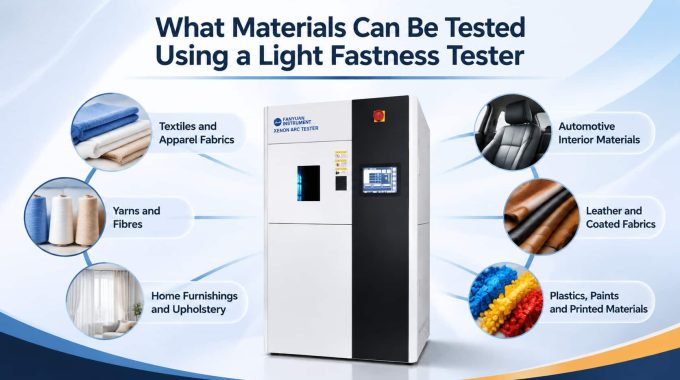
What Materials Can Be Tested Using a Light Fastness Tester

Textiles and Apparel Fabrics
Regular clothing is tested for light fastness using ISO 105-B02 or AATCC TM16.3. High visibility workwear requires much stricter testing according to ANSI/ISEA 107. They are exposed to 40 AATCC Fading Units, which is equivalent to a year of harsh exposure.
Yarns and Fibres
Instead of a ready fabric, you can test the yarn or fibre before it is processed. ISO 105-B02 applies to textiles of all kinds and in all forms, so you can wind up yarn or pack loose fibres onto a test card for light exposure.
Home Furnishings and Upholstery
Home furnishings and upholstery such as curtain drapes and furniture are often near windows where they are exposed to prolonged sunlight. This requires ISO 105-B02 testing to ensure they are resistant to fading.
Automotive Interior Materials
Materials used to make seats and interior upholstery of cars are constantly exposed to combined heat and filtered intense sunlight, which is why ISO 506 is used to test materials used in the automotive industry. This standard combines high temperature with light exposure to simulate the interior of a car.
Leather and Coated Fabrics
When it comes to leather testing, they also undergo the same xenon testing, but the color fastness of dyed leather comes under EN ISO 105-B02, also referenced as IUF 402.
Plastics, Paints and Printed Materials
| Material | Common Test Standard |
| Textiles and apparel | ISO 105-B02, AATCC TM16.3 |
| Automotive interior textiles | ISO 105-B06, SAE J2412 |
| Leather | EN ISO 105-B02 / IUF 402 |
| Plastics | ISO 4892-2 |
| Paints and varnishes | ISO 16474-2 |
Light Fastness Ratings
Light fastness rating is mainly done on two scales: the blue wool scale, which goes from 1 to 8, with 8 being the most light fast. Second, the gray scale goes from 1 to 5, where 5 means no visible change.
- Blue Wool Scale (1–8)
Sample 1 on the blue wool scale fades the fastest, while sample 8 is the most resistant. Each order takes twice as much light to fade. Because the scale doubles at every step, the jump in durability between grades 7 and 8 is huge compared to the small difference between grades 1 and 2
| Blue Wool Grade | Light Fastness |
| 1 | Very poor |
| 2 | Poor |
| 3–4 | Fair to moderate |
| 5–6 | Good to very good |
| 7–8 | Excellent |
- Grey Scale (1–5)
The grey scale falls under ISO 105-A02 and is used to assess color change using five pairs of matte grey chips or fabric swatches to determine how much material has faded.
To grade a sample, you place its light-exposed section and unexposed section side by side next to the scale and match the visual difference to the closest grey pair:
Grade 5: No change
Grade 4: Slight change
Grade 3: Noticeable change
Grade 2: Considerable change
Grade 1: Severe change
Conclusion
Lightfastness testers are efficient instruments used in textile labs to get a fast, repeatable measure of how well a dye will hold up under UV rays and daylight. Selecting the correct standard for your material, controlling irradiance, temperature, and humidity tightly to perform the test perfectly, and then reading them using the Bluewool and Grey scale will ensure a reliable and objective pass-or-fail quality control check.