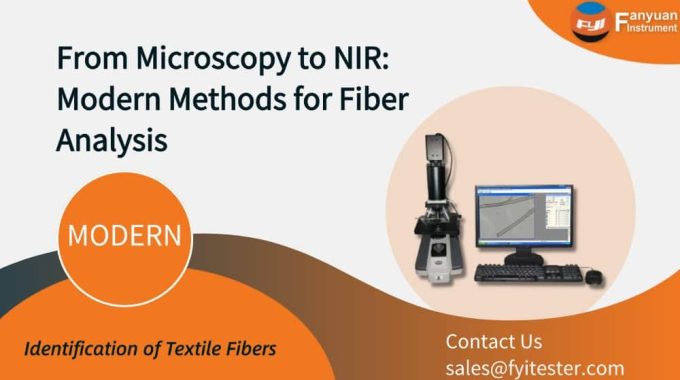
From Microscopy to NIR: Modern Methods for Fiber Analysis
The fiber composition of textiles is directly related to product quality, comfort, and consumer health. Through fiber content testing, we can identify the raw material composition of a product to determine whether it meets expected quality standards. At the same time, it provides consumers with essential information regarding comfort, durability, and potential allergic reactions, helping them make more informed purchasing decisions.
Importance of Fiber Identification
Fiber identification is a fundamental and crucial task in textile testing. As the variety of textile products continues to expand, fiber materials have evolved from natural and chemical fibers to functional composite fibers. The increasing similarity in appearance and texture makes it difficult to determine fiber types accurately through sensory judgment alone. Correct fiber identification not only serves as the basis for quality inspection, labeling, and trade settlement but also plays a vital role in raw material control, process design, product development, and environmental testing within textile enterprises.
The importance of fiber identification can be summarized as follows:
- Protecting Consumer Rights: Accurate fiber labeling prevents false claims and safeguards consumers’ right to know and choose.
- Guiding Production and Processing: Since fibers differ significantly in their physical and chemical properties, identification results help optimize dyeing, blending, and weaving parameters.
- Ensuring Fair Trade: In import and export inspections, precise fiber identification is essential for enforcing trade contracts.
- Supporting Research and Development: Accurate identification assists in evaluating the properties of new fibers and optimizing formulations and processes in material innovation.
Common fiber identification methods include microscopic analysis, chemical solubility testing, and near-infrared spectroscopy (NIR). The first two, based on national and industry standards, are highly accurate and reliable, while NIR, a rapid and non-destructive method, has seen growing use in recent years.
Overview of Relevant Standards
Fiber identification and quantitative analysis in China are mainly governed by two standards:
- FZ/T 01057 — Test Method for Identification of Textile Fibers
This industry standard focuses on qualitative analysis, determining the types of fibers present. It includes methods such as microscopic observation, burning, solubility, and dye reaction. Among these, the microscopic method is the most fundamental and widely applied. FZ/T 01057 emphasizes identifying fibers based on external morphology and cross-sectional characteristics, suitable for both single fibers and blended samples. - GB/T 2910 — Textiles — Quantitative Chemical Analysis of Fiber Mixtures
This national standard focuses on quantitative analysis, determining the percentage composition of fiber mixtures. The principle relies on the different solubility behaviors of various fibers in specific chemical reagents. By dissolving and weighing, the proportion of each fiber type can be calculated. GB/T 2910 includes multiple sub-standards (GB/T 2910.1–2910.24), each designed for different fiber blend systems using appropriate solvent combinations and procedures.
In summary:
FZ/T 01057 focuses on qualitative identification, while GB/T 2910 emphasizes quantitative analysis.
In practice, fiber testing usually begins with FZ/T 01057 to identify fiber types, followed by GB/T 2910 for quantitative determination.
Microscopic Method (Based on FZ/T 01057)
1. Principle

The microscopic method is a qualitative technique used to identify fiber types by observing their longitudinal morphology and cross-sectional characteristics under a microscope.
Fibers from different sources and types display unique surface textures, cross-sectional shapes, luster, and refractive properties. For example:
- Cotton: ribbon-like twists in the longitudinal view, kidney-shaped cross-section.
- Wool: scaly surface structure.
- Polyester: smooth, featureless circular cross-section.
- Nylon: smooth and transparent surface.
- Viscose: irregular cross-section with radial grooves.
By comparing the microscopic characteristics of an unknown sample with those of standard reference fibers, the fiber type can be determined. The following is a detailed article on our website about the microscopic method for identifying fiber components:https://fyitester.com/microscopic-computerized-fiber-analysis/
2. Procedure
- Sampling: Cut an appropriate amount of fiber and remove impurities.
- Slide preparation: Place a drop of glycerin or aqueous solution on a glass slide, disperse the fibers, and cover with a cover slip. For cross-sectional observation, prepare a fiber cross-section slice.
- Microscopic observation: Use a biological or polarizing microscope to observe the longitudinal and cross-sectional morphology and record the features.
- Comparative analysis: Compare the observed features with standard fiber atlases to identify the fiber type.
3. Scope of Application
The microscopic method is suitable for most natural fibers (such as cotton, flax, silk, and wool) and some synthetic fibers, especially for single-component samples. It is most effective for fibers with distinct surface structures but less accurate for synthetic fibers with similar morphologies (e.g., regular and modified polyester).
4. Applicable Instruments

| Model | Observation Type | Main Test Items | Measurement Range | Objectives |
| YG002C | Longitudinal observation | Diameter | 2–200 μm ± 0.5 μm (adjustable) | 4×, 10×, 20× |
| YG002C1 | Longitudinal observation | Diameter, content | 2–200 μm ± 0.5 μm (adjustable) | 4×, 10×, 20× |
| YG002C2 | Longitudinal and cross-sectional observation | Diameter, content, cross-sectional area | 2–200 μm ± 0.5 μm (adjustable) | 4×, 10×, 20× |
5. Advantages and Limitations
- Intuitive and fast: Enables quick differentiation between natural fibers (e.g., cotton, hemp, wool) and certain synthetic fibers through direct observation of surface and cross-sectional features.
- Wide applicability: Suitable for both natural fibers and synthetic fibers with distinct morphological features (e.g., bamboo-like nodes of flax, bark-like striations of ramie).
- Limitations: Difficult to accurately identify smooth, circular synthetic fibers (e.g., polyester, nylon); auxiliary methods such as burning or solubility tests may be required.
- Subjectivity: Results depend on the operator’s experience and equipment precision, which may lead to interpretation bias.
Chemical Dissolution Method (Based on GB/T 2910)
1. Principle
The chemical dissolution method is based on the differences in solubility of various fibers in specific chemical reagents. By stepwise dissolution and weighing of the remaining residue, the proportion of each fiber in a blended fabric can be quantitatively determined.
For example, in a cotton/polyester blend, polyester can be dissolved in formic acid while cotton remains intact. The fiber composition is then calculated by comparing the sample’s mass before and after dissolution.

2. Procedure
- Sample pretreatment: Remove impurities such as oils, sizing agents, and finishing residues.
- Weighing: Accurately weigh a specified mass of the dried sample.
- Dissolution: Select appropriate reagents and conditions (temperature, time) according to the standard to dissolve one type of fiber.
- Filtration and cleaning: Filter out the solution, retain the undissolved fibers, rinse thoroughly, and dry.
- Weighing and calculation: Weigh the remaining fiber and calculate the percentage composition of each component based on mass differences.
3. Characteristics
| Feature Type | Description |
| Analytical nature | A quantitative analysis method that accurately measures the proportion of each component in a blend. |
| High accuracy | Measurement error is typically within ±1%, making it one of the most authoritative quantitative methods. |
| Wide applicability | Suitable for natural fibers, synthetic fibers, and multi-component blends. |
| Good repeatability | Results are stable and reproducible under standard test conditions. |
| Complex operation | Requires multiple steps of dissolution, filtration, and drying; relatively time-consuming. |
| Use of chemical reagents | Requires attention to safety and environmental protection. |
4. Scope of Application
The chemical dissolution method is applicable to quantitative analysis of blends containing two or more fibers.
Due to significant differences in chemical stability among fibers, the GB/T 2910 standard specifies different testing methods and solvent systems for various blend types (e.g., cotton/polyester, wool/acrylic, viscose/polyester, etc.).
Near-Infrared Spectroscopy Method (Based on FZ/T 01144—2018)

1. Principle
The Near-Infrared Spectroscopy (NIR) method is a spectroscopic technique based on the vibrational absorption of molecular bonds such as C–H, O–H, and N–H.
Different fibers have distinct chemical compositions, resulting in unique “fingerprint” absorption spectra in the near-infrared region.
By analyzing these spectral characteristics, NIR enables rapid identification and quantification of fiber types and compositions.
This method is established according to FZ/T 01144—2018 Textiles — Quantitative Analysis of Fibers — Near-Infrared Spectroscopy Method.
2. Characteristics
- Fast and non-destructive: Enables on-site or online detection without the need for solvents or complex sample preparation.
- Multi-component capability: When properly calibrated, NIR can simultaneously analyze multiple fiber types—ideal for large-scale screening and production monitoring.
- Environmentally friendly and safe: Minimizes or eliminates the use of chemical reagents.
- Model-dependent: Requires a high-quality calibration dataset (based on reference chemical methods) and periodic model updates to account for new fiber types, dyes, or finishing processes.
- Sensitive to fabric properties: Fabric structure, color, and surface treatments can affect spectral accuracy; dark or highly absorptive dyes may require correction or sample exclusion.
- Higher technical and cost requirements: Equipment and modeling expertise are crucial, and model transfer between instruments requires standardization or recalibration.
3. Scope of Application
NIR spectroscopy is suitable for rapid analysis of natural fibers, synthetic fibers, and their blends.
It is widely used for on-site screening and laboratory-assisted testing, though it demands careful sample preparation, model development, and calibration to ensure accuracy.
Comparison of Three Fiber Identification Methods
| Method | Principle | Type | Advantages | Disadvantages | Application Scope |
| Microscopic Method | Observation of fiber morphology | Qualitative | Intuitive, simple, low cost | Limited distinction for similar synthetics; operator-dependent | Single or simple blended fibers |
| Chemical Dissolution Method | Differential solubility in reagents | Quantitative | High accuracy, wide applicability | Time-consuming, involves chemicals | Quantitative analysis of blended fibers |
| Near-Infrared Spectroscopy | Spectral absorption feature analysis | Qualitative + Quantitative | Rapid, non-destructive, eco-friendly | High cost, requires model calibration | Rapid testing and auxiliary analysis |
In summary, the microscopic method serves as the most fundamental qualitative approach, the chemical dissolution method remains the most authoritative quantitative technique, while the NIR spectroscopy method represents the future direction of intelligent and efficient fiber identification in modern textile analysis.
Conclusion
Fiber identification plays a vital role in textile quality control. By applying FZ/T 01057 and GB/T 2910, fibers can be analyzed both qualitatively and quantitatively.
The microscopic method helps identify fiber types, the chemical dissolution method provides accurate composition data, and the near-infrared method offers a fast, non-destructive, and eco-friendly alternative.
In practice, combining these methods ensures reliable results, while near-infrared spectroscopy represents the future trend toward efficient and sustainable textile testing.