What’s Best Speed Control System for Jigger Dyeing Performance?
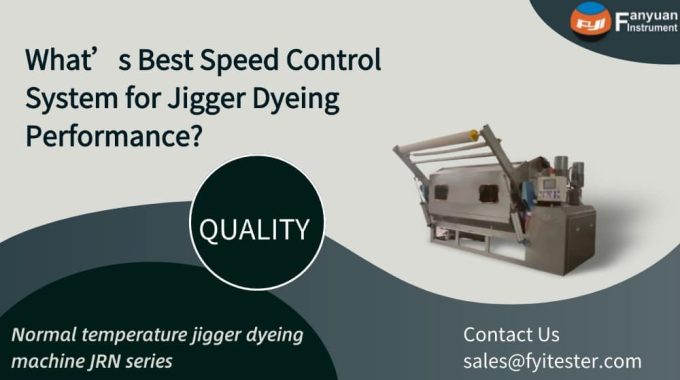
The jigger dyeing machine is suitable for dyeing fabrics in multiple varieties and small batches. Its basic working process involves repeatedly passing a fabric of specific length and width through a dye bath of a certain temperature and concentration. According to the process requirements, a specific number of reciprocating cycles are completed at different temperatures to achieve dye uptake on the fabric surface.
The working principle of the jigger involves two main rollers of identical size. Driven by guide rollers, expander rollers, etc., the fabric is alternately wound and unwound within the dye bath at a controlled speed and tension, following the dyeing process requirements, until the desired result is achieved.
Jigger dyeing machine principle
As dyeing progresses, the diameter of the take-up roller gradually increases, while the diameter of the let-off roller decreases correspondingly. To maintain constant linear speed and constant tension on the fabric, the rotational speed of the take-up roller must gradually decrease, and the speed of the let-off roller must gradually increase. Regardless of the method used for let-off, the let-off tension control must continuously adjust the output torque according to either a constant tension or a tapered tension control curve to achieve the effect of constant tension unwinding.
The control systems for jiggers have evolved through various speed regulation methods: mechanical differentials, hydraulic motor control, DC motor speed control, and single inverter switching between take-up and let-off speeds. Additionally, specialized inverter controllers are used, and imported machines sometimes employ servo controllers. All these control methods essentially aim to regulate output speed and torque. This is because only under suitable temperature, with the fabric passing through the dye bath at a constant speed and constant, required tension, can color differences be avoided and a soft hand feel achieved.

Development and Current Status of Constant Linear Speed Control Systems for Jiggers
Throughout its operating process, a jigger must ensure the fabric spends consistent time in the dye bath – meaning constant linear speed – to meet the dyeing process requirements. Historically, fabric speed control in jiggers has progressed through various methods: purely mechanical differentials, hydraulic motors, wound-rotor motors, DC motors, AC motor speed control, and inverter speed control.
Mechanical Differential Systems:
To achieve constant linear speed control during the dyeing process, mechanical differentials used either bevel gear or spur gear differentials. During operation, the differential gear train drives the cloth take-up roller while the fabric drives the cloth let-off roller. As the number of fabric layers on the take-up roller increases, the linear speed would tend to increase. The differential’s planetary gears counteract this by reducing the take-up roller speed through their rotation.

An automatic reversing device (a counter) stops the motor and reverses its direction once a predetermined number of layers is reached, enabling the reciprocating dyeing action. This method had a complex structure. Fabric linear speed was highest when the rollers were near each other (typically double the speed at reversal), the speed regulation range was poor, speed changes were difficult, and speed fluctuations in the differential mechanism could reach 40%. Achieving full automation was challenging with purely mechanical systems, and components wore out quickly. These drawbacks hindered its further development and adoption.
Wound-Rotor Motor Speed Control
Speed control with wound-rotor motors was achieved by changing the resistance in the rotor circuit. These motors were difficult to manufacture, had complex starting procedures, were hard to interface with computers, and were unsuitable for automatic control.

DC Motor Speed Control:

Compared to AC motors, DC motors offered the main advantages of a wide and smooth speed regulation range and high starting torque. However, DC motors also had significant drawbacks:
- Complex manufacturing process, high consumption of non-ferrous metals, and higher production costs.
- Operation generates sparks between brushes and commutators, restricting the operating environment, leading to lower reliability and difficult maintenance.
- Structural limitations restrict single-motor speed and result in a higher weight-to-power ratio (typically above 5 kg/kW, compared to 1.5-4 kg/kW for squirrel-cage induction motors).
- Armature voltage and current are limited by the commutator, restricting single-motor power output.
- Difficult to interface with computers and implement automatic control.
These reasons limited their further development.
AC Motor Speed Control (with Inverters)
AC motors with inverter drive systems are now widely used in jiggers. Compared to DC motors, they offer inherent advantages:
AC motors are not limited by commutator peripheral speed or armature reactance voltage, allowing higher rotational speeds than DC motors of the same power. This enables higher single-motor power output and a lower weight-to-power ratio.

Simpler structure, resulting in lower manufacturing costs.
Can deliver high power even at high speeds and often operate at constant power up to rated speed. Lacking components like commutators that require frequent maintenance.
Breakthroughs have been made in supporting technologies: power electronic device manufacturing (including semi-controlled and fully-controlled devices), power conversion based on power electronic circuits, vector control technology for AC motors, PWM technology, and fully digital control based on microcomputers and large-scale integrated circuits.
Currently, AC variable frequency speed control drives, using only electronic power converters for AC motor speed regulation, have become the mainstream in electrical drives. Their performance now matches or even surpasses that of DC systems.
Conclusion from Analysis
Early purely mechanical dye jiggers suffered from significant speed fluctuations. Most traditional jiggers used dual DC motors, which could only achieve approximate constant tension control. This approach struggled to adapt to the harsh dyeing environment and thus remained largely unpopular internationally. Some jiggers employed a single frequency converter, with asynchronous motors using DC braking for unwinding and contactors switching between the frequency converter and DC braking modes for rewinding and unwinding. Others employed hydraulic control systems. Later, electronically controlled hydraulic motors with dual DC motors provided adequate control, but required complex hydraulic systems, increasing the machine’s structural complexity, cost, and maintenance burden. Analyzing the principles behind these solutions reveals that they were approximate solutions with significant errors, resulting in unsatisfactory results for low tension and constant line speed control.
DC speed control systems, due to their incompatibility with the high temperature, high humidity, and corrosive atmospheres found in dyeing and finishing plants; hydraulic control systems, typically imported and expensive, required significant maintenance over time; and single frequency converter control systems, which were too crude for tension control, no longer met user requirements. Constant tension and speed are key indicators of dyeing quality in dye jiggers. They ensure uniform color variation between the beginning and end, and between left, center, and right sides of the fabric. As processing requirements continue to increase, so too do the demands for tension and speed. In recent years, with the advancement of high-speed counting, floating-point operations, data processing, and communication capabilities of embedded industrial computers, the communication and recipe functions have become increasingly sophisticated. The performance-price ratio of general-purpose vector inverters has also increased significantly. Improvements in the mechanical properties of AC variable-speed motors have made it possible to implement low-cost, highly reliable electrical control systems for dye jiggers using embedded industrial computers and general-purpose vector inverters.