
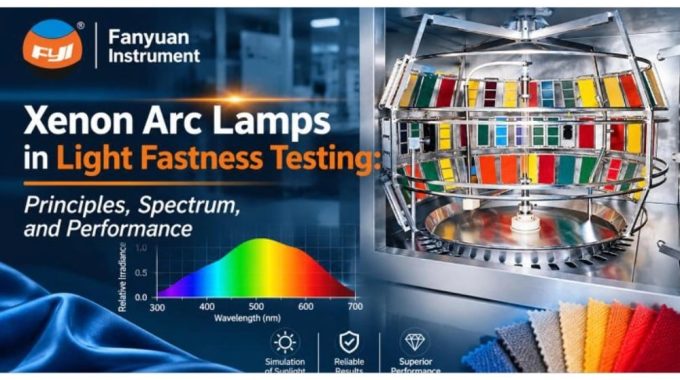
Xenon Arc Lamps in Light Fastness Testing: Principles, Spectrum, and Performance
The reliability of the results of a material’s resistance to fading from sunlight depends on the type of source used to expose the material. The sun outdoors is dependent on the geographical location, season, weather and time of the day, and exposure to the natural sun is difficult to control. Xenon arc lamps overcome this problem by providing a controlled light source with a spectrum similar to natural sun under a controlled set of conditions. Knowing how these lamps work, the effect they have on colour damage, and what factors affect their performance can greatly aid in the interpretation of the light fastness results and in maintaining standard test conditions.
1. Why Are Xenon Arc Lamps Used in Light Fastness Testing?
When evaluating colour stability, it is important to use an exposure source that is able to replicate the photochemical effects of sunlight, but without the uncontrolled outdoor conditions. This is achieved by the use of Xenon arc lamps which have a wide spectrum of light output – UV, visible and IR.
1.1 Broad Spectral Output
The xenon arc lamp is a lamp that produces light by passing an electric current through a tube of ionized xenon gas. It emits several spectral components in both the UV and visible regions and in the infrared. With the correct optical filtering, spectra can be synthesized to match specific parts of the natural spectrum.
This is because the spectrum is important, as the various wavelengths will induce different material degradation effects. Photochemical reactions can be set in motion by UV radiation and sensitive dyes, pigments and polymers by visible light. You can reproduce the relevant spectral regions and check how the colors will fade in the application you are thinking of.
1.2 Controlled and Repeatable Exposure
The outdoor sun exposure is affected by variations in the environment. Radiation reaching your specimens may be affected by cloud cover, atmospheric ozone, solar elevation or temperature.
A xenon arc testing system can control or monitor exposure parameters critical to a specific application such as:
- Irradiance: intensity of radiation at a given wavelength or wavelength band.
- Exposure duration: The period of time that your specimens are exposed to controlled illumination.
- Black panel or black standard temperature: Temperature indicator to be used in characterization of heating under exposure.
- Relative humidity: Conditions of moisture surrounding the specimens when controlled by the tester.
- Incident radiation: Radiation incident on the test materials.
These controls help in setting repeatable exposure conditions and material performance comparisons between test cycles.

1.3 Suitability for Different Materials
Xenon arc exposure can be used to test the color stability of textiles, plastics, coatings, leather, printed materials, and other products which are light-sensitive and prone to degradation.
For instance, a textile dye could be altered at the molecular level by exposure to UV radiation, causing it to fade or change in colour. Light-sensitive pigments may fade or cause discoloration in a polymer, or fading or changes in appearance may occur in a coating.
Degradation mechanisms will vary depending on the material formulation, pigment or dye chemistry, exposure spectrum, and environmental conditions. These can be explored in Xenon arc testing within a specific laboratory environment.
For a broader understanding of exposure methods, you can explore light fastness testing, including how controlled light exposure supports the evaluation of material color stability.
2. How Does a Xenon Arc Lamp Simulate Natural Sunlight?
The xenon arc lamp is designed to produce a wide spectrum of optical output and filter the spectrum to create a sun-like output. The lamp cannot duplicate sunlight in all circumstances. The spectral and environmental requirements must be achieved by setting up the optical system and the exposure parameters.
2.1 Electrical Discharge and Light Generation
A xenon arc lamp is a type of lamp that uses a fluorescent arc discharge through pressurised xenon gas. The discharge excites and ionizes the atoms of xenon, which emit radiation when they are de-excited to lower energy states.
The emission that is created will include a mixture of spectral lines and continuum radiation. The wide wavelength coverage is useful for processes that demand coverage in multiple wavelength regions.
The input spectrum from the lamp, however, is different from the input spectrum in terrestrial sunlight. It emits radiation that does not arrive at the surface of the Earth in the same proportion as the solar radiation. Thus, if a representative sunlight spectrum is required, optical filtering is a must.
2.2 Optical Filters and Spectral Adjustment
| Filter Type | Primary Function | Testing Relevance |
| Daylight filter | Approximates the spectral distribution of sunlight at the Earth’s surface | Outdoor light exposure simulation |
| Window glass filter | Represents sunlight transmitted through window glazing | Indoor exposure and window-related fading |
| UV filter | Limits or modifies ultraviolet transmission | Adjusting UV exposure according to test requirements |
2.3 Irradiance Control and Exposure Stability
Also, irradiance should be controlled for consistent radiation intensity during testing. Irradiance is often denoted in watts per square meter (W/m²), or watts per square meter per wavelength (nm) if measuring radiation within a specific band or spectral irradiance at a specific wavelength.

Irradiance monitoring and feedback control is common in many xenon arc testers to correct for lamp output changes. Depending on the lamp’s age and/or the optical transmission changes, the system may correct operating conditions to maintain the selected irradiance.
If you want to compare the results of the different test runs, you will need to maintain a stable irradiance. But equivalent energy does not always result in equivalent fading, as the fading depends on wavelength, the chemistry of the materials and the exposure conditions.
2.4 Environmental Simulation
Radiation is not the only cause of light-induced fading. The degradation of the dye, polymer oxidation and other changes are affected by temperature and moisture.
A xenon arc chamber can be used for control or monitoring:
- Chamber air temperature
- Black panel or black standard temperature.
- Relative humidity
- Specimen wetting (water spray)
- Irradiance and exposure duration
Parameters should be separated when they are different parameters related to the surroundings of the exposure. Examples include black panel temperature, which provides an indication about the temperature of a dark reference surface irradiated, and chamber air temperature that provides an indication about the temperature of surrounding air.
The combination is a function of the test method you will use and the material you are testing.
3. Xenon Arc Lamp Spectrum and Its Effect on Color Fading
3.1 UV, Visible, and Infrared Radiation
The xenon arc spectrum covers several radiation regions, each contributing differently to material exposure.
| Spectral Region | Approximate Wavelength | Effect on Materials |
| UV-A | 315–400 nm | Promotes photochemical reactions in dyes, pigments, and polymers |
| UV-B | 280–315 nm | Can cause strong photochemical degradation; terrestrial exposure depends on atmospheric filtering |
| Visible light | 400–780 nm | Can fade light-sensitive colorants through absorption and photochemical reactions |
| Infrared | Above 780 nm | Primarily contributes to heating, which can influence degradation indirectly |
These wavelength boundaries are approximate. Different standards may define spectral regions slightly differently.
3.2 How Wavelength Influences Color Fading
These reactions may involve any one or all of the following:
- Photodecomposition – light disrupts the chemical bond structure of a molecule of colorant.
- Photooxidation: Light catalyzes reactions with oxygen, thus changing the structure of the molecular composition of the colourant.
- Chromophore Modification: Affects absorption characteristics that contribute to the original colour.
- Polymer degradation: Changes in color retention and/or colour appearance due to radiation of the surrounding polymer matrix.
3.3 Why Spectral Distribution Matters More Than Total Energy Alone
For reliable evaluation, you should consider:
- Spectral irradiance within relevant wavelength bands
- Irradiance at the specified control wavelength
- Filter transmission characteristics
- Exposure duration and accumulated radiant exposure
- Material-specific sensitivity to radiation
4. Difference Between Xenon Arc Lamps and Other Light Sources
4.1 Xenon Arc vs. Fluorescent UV Lamps
The main wavelength range of radiation produced by fluorescent UV lamps is in a few selected UV bands. There are different types of UVA and UVB lamps, and each varies in both the distribution of their output (wavelengths) and the output type itself (UVA or UVB).
Xenon arc lamps, however, emit a wider spectral distribution in the UV and visible wavelengths and there is a small amount of infrared as well.
4.2 Xenon Arc vs. Mercury Lamps
Radiation from mercury lamps is produced under an electrical discharge of mercury vapor. They produce good spectral lines, the distribution of which varies with the design of the lamp and the operating conditions.
Xenon Arc lamps typically have a wider spectrum of emission, which can be more appropriate for applications that need sunlight-like exposure.
4.3 Xenon Arc vs. LED Light Sources
Radiation is emitted by LED systems within certain range/wavelength. They can be set to emit certain wavelengths (or combinations of spectral bands).
It is, however, not always possible to produce the continuous spectral qualities of sunlight with a multi-wavelength system.
5. Factors Affecting Xenon Lamp Performance and Service Life
5.1 Lamp Aging and Operating Conditions
Xenon arc lamps will reduce output over time due to erosion of the electrodes and deposits on the electrodes while operating. Optical intensity, spectral output and stability of irradiance control may decrease with aging. Check operating times and change the lamp as per the manufacturer’s service life.
5.2 Cooling System Performance
Compared to other lamps, Xenon lamps produce a lot of heat, which requires proper cooling to ensure stable operation and service life. In air-cooled systems inspect fan operation, ventilation openings, ventilation and dust build-up. The lack of airflow will lead to overheating and lead to premature deterioration of parts.

5.3 Optical Filter Condition
Your specimens are exposed to wavelengths that are controlled by optical filters. Their transmission characteristics can be altered by contamination, thermal stress, and/or surface degradation, which can impact the test spectrum. Check filters regularly and replace damaged and/or degraded filters as recommended by the manufacturer.
Conclusion
Xenon arc lamps help you evaluate material color stability under controlled, sunlight-simulated conditions. Proper irradiance control, maintenance, and spectral adjustment improve test consistency and reliability. Explore the Air-Cooled Xenon Arc Tester YG611M to find a testing solution that meets your material evaluation requirements.